
 Download

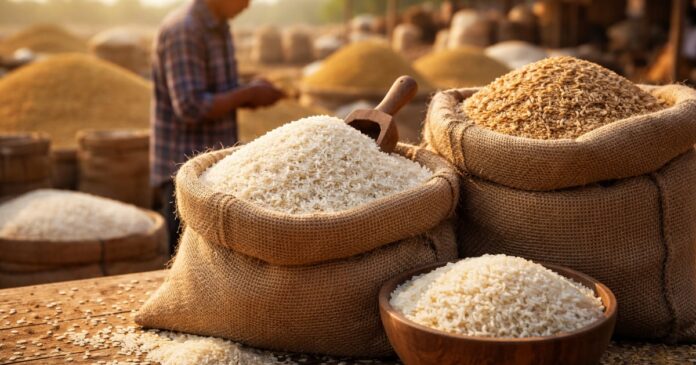

CBoT rough rice eases while Indian and Vietnamese FOB prices stay firm amid El Niño risks and strong Asian import demand. Concise trade-focused outlook.
The rice market is currently balancing weaker paper prices on the Chicago Board of Trade against resilient physical values in Asia. Nearby CBoT November 2026 is drifting lower, but forward structure and Asian export quotations point to an underlyingly tight but not panicked global balance. Strong buying from the Philippines and other Asian importers, coupled with below-normal rainfall in parts of Southeast Asia, is keeping exporters cautious on discounts despite expectations of increased harvest supplies moving into Q4 2026. Short-term, the market looks more like a consolidation phase than a trend reversal.
Prices
CBoT rough rice is softer across the forward curve. The November 2026 contract last traded at 17.07 USD/cwt, down 0.07 USD or 0.38% versus the previous close. January 2027 stands at 17.55 USD/cwt (-0.43%), and March 2027 at 17.96 USD/cwt (-0.14%), indicating a mild pullback rather than a structural sell-off along the curve.
Further out, May 2027 (18.16 USD/cwt), July 2027 (18.23 USD/cwt) and September 2027 (15.92 USD/cwt) are also modestly lower on thin volume, but the curve remains generally elevated versus pre-El Niño levels, reflecting persistent risk premia.
| Contract | Last price (USD/cwt) | Change (USD) | Change (%) |
|---|---|---|---|
| Nov 2026 | 17.07 | -0.07 | -0.38% |
| Jan 2027 | 17.55 | -0.07 | -0.43% |
| Mar 2027 | 17.96 | -0.03 | -0.14% |
| May 2027 | 18.16 | -0.09 | -0.49% |
| Jul 2027 | 18.23 | -0.09 | -0.46% |
| Sep 2027 | 15.92 | -0.09 | -0.53% |
In the physical market, key Indian FOB quotes from New Delhi as of 17 October 2026 are flat versus the previous update, signalling a pause after earlier firming: PR11 all steam at 0.32 EUR/kg FOB, Sharbati steam at 0.45 EUR/kg FOB, and 1121 steam at 0.70 EUR/kg FOB. Golden sella rice holds at 0.81 EUR/kg FOB, while 1121 creamy white sella is stable at 0.60 EUR/kg FOB. Organic basmati stands at 1.57 EUR/kg FOB and organic non-basmati at 1.27 EUR/kg FOB.
Vietnamese FOB indications from Hanoi on 17 October 2026 show a broadly firm to slightly higher tone versus early October: long white 5% at 0.35 EUR/kg FOB, jasmine at 0.37 EUR/kg FOB, Homali at 0.51 EUR/kg FOB, calrose at 0.49 EUR/kg FOB, Japonica at 0.46 EUR/kg FOB and white glutinous at 0.46 EUR/kg FOB. Specialty segments such as black and red rice also edge higher, with black at 0.88 EUR/kg FOB and red at 0.64 EUR/kg FOB.
Supply & Demand
On the demand side, Southeast Asia remains the main engine. The Philippines is on track to import more than 5 million metric tons of rice in 2026 as domestic output is curbed by El Niño-related dryness, keeping steady pressure on suppliers in Vietnam, Thailand and Myanmar. Strong restocking by Asian buyers earlier in the year and continued food security concerns are limiting downside in export prices despite the recent CBoT easing.
Export-side concentration remains high, with India providing over 40% of global rice exports in the first half of 2026 and Vietnam consolidating its role as the key supplier to the Philippines. This concentration magnifies the market impact of any weather or policy shock in one of the main origins, a key reason why futures retain a weather premium even as harvest supplies increase.
CMBROKER · EXCLUSIVE COMMODITIES
Exclusive commodities on CMBroker
Rice
all steam, pr11

Rice
all golden, sella

Rice
al ısteam, sharbati
Weather & Crop Conditions
The ongoing 2026‑2027 El Niño continues to shape the outlook. Below-average rainfall from July to September was recorded across northern Thailand, central and southern Vietnam, parts of Myanmar and Indonesia, as well as sections of the Philippines. Forecasts point to a continued tilt towards below-normal precipitation from October to December 2026 for Vietnam, eastern Cambodia and the Philippines, suggesting yield risks for late-season and irrigated rice.
In the Philippines, the second-crop, rain-fed rice season is particularly vulnerable, and authorities have already flagged production shortfalls tied to persistent dryness. India, by contrast, is currently expected to maintain broadly stable production in marketing year 2026/27 despite El Niño, helped by stocks and irrigation, which provides some cushion to world availability even as policymakers remain ready to use export controls if the monsoon were to disappoint further.
Fundamentals & Market Structure
The current softening in CBoT rough rice futures must be viewed against the backdrop of still-tight but improving fundamentals. Fresh harvest flows in parts of South and Southeast Asia between October and December are expected to modestly ease the tightness that defined the first half of 2026, when importers were aggressively stockpiling ahead of El Niño.
However, with global trade heavily reliant on a few key exporters, the risk of renewed policy interventions – especially from India in the event of further weather stress – remains a central upside factor for prices. Strong Philippine import demand and continued procurement interest from other Asian buyers suggest that any futures-led sell-off will likely meet physical buying interest on dips.
Trading Outlook (Next 2‑3 Weeks)
- Importers / end-users: Use the current CBoT pullback to extend coverage modestly into Q1 2027, particularly for standard long-grain qualities from India and Vietnam, while avoiding over-commitment given harvest-related supply relief.
- Exporters (India, Vietnam): Maintain offer discipline; FOB quotes are well-supported by regional demand and El Niño risk. Consider incremental hedging on futures rallies above the recent range to protect margins.
- Speculative participants: Market structure suggests buy-the-dip strategies may be favoured over aggressive shorts, with weather and policy risk skewing upside if dryness worsens or export controls re-emerge.
3-Day Directional Outlook
- CBoT Rough Rice: Slight downside to sideways as weak momentum and low volumes persist, but with support expected near recent lows in the November 2026 contract.
- Indian FOB (New Delhi): Largely stable over the next three trading days; limited room for downside given steady inquiries and El Niño uncertainty.
- Vietnamese FOB (Hanoi): Sideways to slightly firm, especially for long white 5% and jasmine, as shipment programs to the Philippines and other ASEAN buyers remain active.