
 Download

Hannah Foy, owner and founder of Lau Lau, and her husband and employee Chris Praetzel, left, look at a laptop on the counter at Lau Lau on Friday, Feb. 6, 2026 in Austin.
Aaron E. Martinez/Austin American-StatesmanAs the first new moon of the calendar year rises into the sky, immigrants from East and Southeast Asian countries celebrate the Lunar New Year in the United States, embracing what they left behind. Parents teach their children traditions from their country of origin. They give out red envelopes stuffed with cash and fill the dinner table with traditional offerings.


But when the moon fills out, celebrations cease. They return to “fitting in,” determined not to jeopardize the life they’ve attempted to build in a new country.
Article continues below this ad
For many Asian American young adults, “their parents felt the need to assimilate,” Sarah Lim, owner of OMG Squee, a dessert cafe in Austin, said.
But within the past three years, a network of East and Southeast Asian American business owners has developed in Austin. Although the Lunar New Year is the usual pathway to celebrating their culture, their success showcases a budding community that is about more than just
‘I’ve always been looking for my place.’
Tucked away at the intersection of Guadalupe and 37th Streets sits Lau Lau, an unassuming coffee shop. The warm, red light of paper lanterns greets customers as they enter the cozy, primarily wooden, interior.
Article continues below this ad
In the pastry case are egg tarts (dan taat) and pineapple buns (bolo bao) — staple dim sum dishes. Various wares from local Asian American artists sit on the shelves, ranging from craft soy sauce and chili oil to hand-drawn gift cards.
“I have some fruit for you. I love you,” one reads.
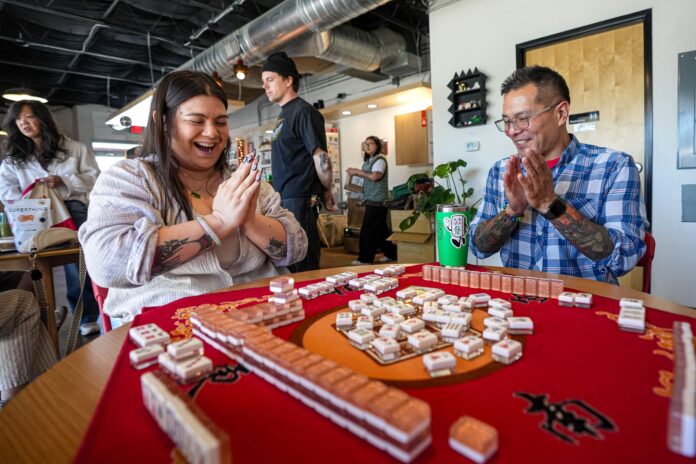
At the back of the store on the first Friday of February sit Lim, Chris Gomez, the owner of Kaiju Cut and Sew, and Hannah Foy, the cafe’s owner. Gomez shuffles Mahjong tiles around on a red mat as he teaches Foy the basics of the game. Foy is of Cantonese-Chinese descent, but no one ever taught her how to play.
Article continues below this ad
It’s a part of her heritage she never connected with. As a fourth-generation immigrant whose father is white, Foy has struggled to find a place where she feels like she truly belongs.
Hannah Foy, owner and founder of Lau Lau, left, celebrates winning a game of Mahjong against Chris Gomez, owner of Kaiju Cut & Sew, right, at Lau Lau on Friday, Feb. 6, 2026 in Austin.
Aaron E. Martinez/Austin American-Statesman“It was very much estranged,” Foy said of her upbringing.
Her parents wanted her “to fit in, and not ‘other’ yourself. But then, over time, obviously, that (tradition) is
Article continues below this ad
Gomez is Taiwanese and Hispanic and was born in Victoria. As a child, he and his mother would often make a two-hour drive to Houston for the nearest Asian grocery store.
OMG Squee owner Lim said her father, a Malaysian immigrant, began to teach her Cantonese. He stopped when her first-grade teacher threatened to put her in an ESL class, calling Lim’s accent incomprehensible.
Split between two cultures, Foy wanted Lau Lau to be a place where those similar to her could feel at ease. It’s why the shop doesn’t represent a specific ethnicity, but rather Asian Americans as a whole.
“I wanted to make sure it was kind of a larger Asian diaspora culture,” Foy said. “Because there are lots of people that are looking for their place, similarly to how I’ve always been looking for my place.”
Article continues below this ad
For Asian immigrants, who left their homes looking for a better life, assimilation was a tool for survival.
“To be successful, you had to adopt white ideals,” Lim said. “At least that’s the old way of thinking about stuff.”
Egg tart pastries are displayed at Lau Lau on Friday, Feb. 6, 2026 in Austin.
Aaron E. Martinez/Austin American-Statesman‘Your influences are kind of everything.’
Asian Americans who are isolated from well-established East and West Coast immigrant communities sometimes lack connection to their individual cultural roots. They form bonds with other Asian ethnic groups. For “No-Coasters” Gomez and Lim, those influences have bled into their current occupations.
Article continues below this ad
Growing up in Victoria, Gomez watched a Houston channel that occasionally aired media from Japan. He remembers seeing an enormous, reptilian figure thundering through cities and shooting atomic breath from its mouth.
Godzilla became the inspiration for the logo behind Kaiju Cut and Sew. Even as Gomez leaned into a niche, working with high-quality Japanese fabrics, his Taiwanese influences peek through in some of his products.
“The very first thing I ever made was the triangle dice bag, and that shape is based on zongzi … a Chinese-Taiwanese rice dish that’s in the shape of a triangle,” Gomez said.
Chris Gomez, owner of Kaiju Cut & Sew, right, shows one of his handmade bags at Lau Lau on Friday, Feb. 6, 2026 in Austin.
Aaron E. Martinez/Austin American-StatesmanLim’s face broke into a wide grin as she reminisced about the shrimp chips and pirouette cookies she’d buy with her father at what was then Richardson’s only Asian grocery store. Food has always been a pillar of their lives.
Article continues below this ad
“It was always at the dinner table. We always celebrated our culture. My dad was like, I have to eat rice at every meal, I have to eat these foods,” Lim said. “But everywhere else? It was ‘No, try to fit in.’”
OMG Squee’s menu is dotted with flavors from all over the world, but Lim’s inspirations can be seen through some of the more unique offerings. A salted egg yolk mochi doughnut wasn’t particularly popular, but it was an homage to Lim’s Malaysian-Chinese heritage. Ube comes from Lim’s fond memories of eating halo-halo with her Filipino childhood best friend.
It’s not about being authentic to their ethnicity. For Lim and Gomez, their art represents the lives they’ve lived.
For Asian Americans in a no-coast region, “your influences are kind of everything,” Lim said.
Article continues below this ad
‘There’s just a longing for personal connections.’
Hannah Foy, owner and founder of Lau Lau, displays family photos at Lau Lau on Friday, Feb. 6, 2026 in Austin.
Aaron E. Martinez/Austin American-StatesmanWhen Lau Lau soft-opened in August, Foy and her husband, Chris Praetzel,
“I told her, you kind of caught lightning in a bottle,” Gomez said. “There are a lot of companies that don’t have this. They try to have a space like this that encourages community, and they still haven’t gotten it right.”
Article continues below this ad
There’s just a longing for personal connections with people.”
Lau Lau has quickly become a hub for Asian American artists. Gomez calls it their “headquarters.” But the secret behind their success is a genuine desire to support their neighbors. In a capitalist society where individual success is prioritized, the concept of community can sometimes be mistaken for a give-and-take.
When the winter ice storm hit Austin hard in 2021, Lim said she aided Gomez and others by providing water, internet and shelter, as OMG Squee was one of the few properties in the area that still had electricity. During the COVID-19 pandemic, Gomez made face masks and donated the proceeds to displaced artists who were struggling after the cancellation of the South by Southwest Conference and Festival.
Foy lived in Minneapolis before moving to Austin in 2020 and is fiercely pro-immigrant. In the aftermath of Renee Good and Alex Pretti’s deaths, Lau Lau remained open on Jan. 30 when many businesses closed in protest but operated on a “pay what you can” formula. It also donated $484 of its Jan. 31 sales to the Austin Mutual Aid Immigrant Fund.
Article continues below this ad
“I definitely think that reciprocity is huge,” Foy said. “But not because you expect that you’re getting something. It’s just the right thing to do.”
Gomez and Lim collaborated for their first Lunar New Year party in 2022, when the COVID-19 outbreak was coming under control, and it was safe to gather. The celebrations have grown since then, and each of the three businesses is hosting its own gathering this year.
There will be a festival with local Asian vendors at OMG Squee on Feb. 28. Gomez plans to host a get-together Feb. 21 at Austin Beer Works, where he’ll release a Lunar New Year brew. And Lau Lau is holding a Lunar Market on Sunday from 12:30 to 4:30 p.m. in collaboration with the Lucky Market Festival.
Sharing their culture has allowed these artists to develop a deeper understanding of themselves. Foy said she understands that being American isn’t a catch-all definition.
Article continues below this ad
René Foy, mother of Lau Lau owner Hannah Foy, serves water to visiting family members at Lau Lau on Friday, Feb. 6, 2026 in Austin.
Aaron E. Martinez/Austin American-Statesman“The United States is unique in that so many different people live here. It’s not a homogeneous culture at all,” Foy said.
That sense of broad acceptance has a ripple effect on people around them. Foy’s mom, René Foy, endured struggles similar to Gomez and Lim. Although she grew up in California, where she said Asian immigrants had large communities, she was never as connected to her roots as her parents.
When René Foy
Article continues below this ad
“I’ve never been able to have these conversations with anybody,” she said. “I really understand Hannah seeking her own community … because now she’s offered that to me.”
It’s not just her mother. Hannah Foy said customers she’s never met before shared similar experiences. Gomez, Foy and Lim don’t represent their cultures in the traditional sense. But that’s what makes them American.
Sharing his own experiences, Gomez found a community of people he can lean on.
Article continues below this ad
“Accepting who you are is a big thing,” Gomez said. “It’s not that I never accepted who I was. I just never felt comfortable in my own skin.”