
 Download


DEFENSIVE LINE:
Prevailing winds in the investment markets are blowing toward safer, less risky propositions amid AI disruption, tech selloffs and global unrest
Asian shares retreated from record highs on Friday as worries about shrinking margins in the tech sector hit the likes of Apple, driving investors into safe-haven bonds ahead of key US inflation data.
On Wall Street, the technology-heavy NASDAQ Composite tumbled 2 percent after Cisco Systems posted quarterly adjusted gross margin below estimates as costs of memory chips surged. That drove its shares down 12 percent and wiped out about US$40 billion of its market cap.
The selloff spilled over into tech giants such as Apple , which tumbled 5 percent in the biggest daily drop since April last year when US President Donald Trump’s sweeping “Liberation Day” tariffs spooked markets. Transportation companies got caught up in worries about AI disruption.
Photo: AP
“The prevailing tone in markets is a rotation toward more defensive areas of the equity market and companies with steady, less cyclical and more predictable earnings,” said Chris Weston, head of research at Pepperstone. “It is clear that investors are viewing developments in [artificial intelligence] AI and [artificial general intelligence] AGI through a new lens, attempting to price a future that feels more uncertain and structurally disruptive than before.”
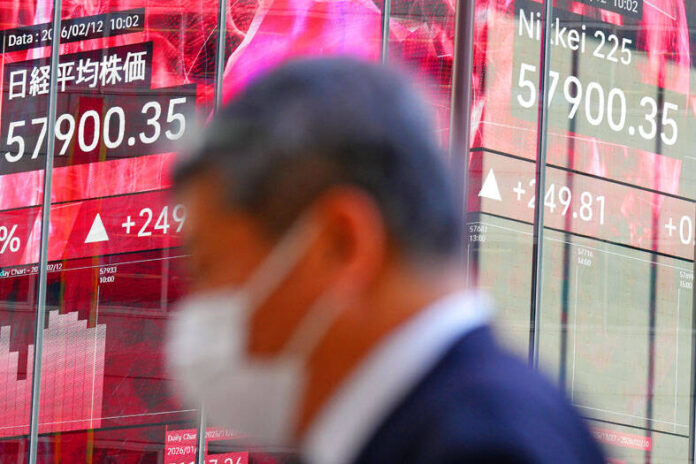
On Friday, MSCI Inc’s broadest index of Asia-Pacific shares outside Japan fell 1.1 percent, trimming this week’s gain to 3.7 percent. Japan’s Nikkei skidded 1.3 percent, but was still up almost 5 percent for the week.
Chinese blue chips dropped 0.9 percent while Hong Kong’s Hang Seng index slid 2.1 percent.
NASDAQ futures and S&P 500 eased 0.2 percent, while Euro STOXX 50 futures edged up 0.1 percent.
The Financial Times reported on Friday that Trump is planning to scale back some tariffs on steel and aluminium goods, citing sources familiar with the matter.
The broad selloff in stocks pushed buyers toward US treasuries, with the yield on the benchmark 10-year note tumbling 7 basis points overnight, its biggest drop since Oct. 10 last year. It was steady in early Friday trade at 4.1134 percent.
A very strong auction of the 30-year bonds helped drive longer-term yields lower. Thirty-year yields slumped 8.5 basis points overnight to 4.728 percent, its lowest since Dec. 3 last year.
Fed funds futures rallied to reverse most of the losses after the payrolls data that led markets to pare back the chance of a rate cut in June. A move in June is back in play, with the chance priced at 70 percent and a total easing of 60 basis points is expected this year.
Much attention would be on US inflation. Forecasts are centered on a monthly rise of 0.3 percent in the core measure, which would be enough to see the annual rate slow to 2.5 percent from 2.7 percent.
“Even an in-line result would reflect a meaningful deceleration from December and that could bolster animal spirits and spark energy back into the cyclical trade,” said Jose Torres, a senior economist at Interactive Brokers.
In currency markets, the risk-sensitive Australian and New Zealand dollars took a step back. The Australian dollar slipped 0.2 percent to US$0.7071, having lost 0.5 percent overnight, while the New Zealand dollar eased 0.1 percent at US$0.6029, after slipping 0.3 percent overnight.
Precious metals attempted to recover from heavy losses. Gold rose 1.3 percent to US$4,984 an ounce, after losing over 3 percent on Thursday, while silver climbed 2.5 percent to US$77.0 an ounce, having plunged 10 percent overnight.
Oil prices extended declines after a sharp 3 percent slide overnight. The Associated Press reported that a US aircraft carrier is being sent from the Caribbean to the Middle East as tensions with Iran escalate.
US West Texas Intermediate crude slipped 0.3 percent to US$62.66 per barrel, while Brent crude futures fell 0.2 percent to US$67.37.