
 Download

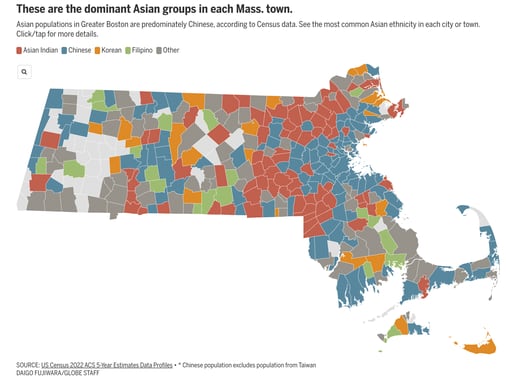

The rapidly growing Asian community in Massachusetts is reshaping suburbs and driving economic growth, experts say, but it’s not just one ethnic group that’s singlehandedly driving the growth.
Although people of Chinese ancestry still make up the biggest share of Asians in Massachusetts, with nearly 164,000 people as of 2022 data, there are now seven other Asian ethnic groups with more than 10,000 people. Some of them have grown rapidly between 2012 and 2022, according to the Globe’s analysis of American Community Survey data.
During that time, the Malaysian, Burmese, Taiwanese, Indonesian, Sri Lankan, Hmong, and Pakistani communities more than doubled their size. Malaysians saw the fastest growth, with an increase of 184 percent. However, the population size was relatively small in 2012 compared to most other AAPI groups in the state and remained fairly small in 2022 — increasing from 282 to 802 people, data show.
Collectively, those of Asian ancestry represent nearly 500,000 people — 7 percent of the total population — in Massachusetts, according to Census Bureau data. It’s among the fastest-growing racial groups in the state and Greater Boston, fueled by an influx of new immigrants who are helping to offset the exodus of people leaving the state for elsewhere in the country.
The makeup of the AAPI community in Massachusetts has changed dramatically since the 1960s, when it was largely defined by the Chinese population, said Paul Watanabe, director of the Institute for Asian American Studies at the University of Massachusetts Boston. There is now “tremendous diversity” within the community, with more than a dozen ethnic groups represented.
Beginning in the 1970s, the influx of Southeast Asian refugee populations — from Vietnam and Cambodia — significantly transformed the character and demographics of the community, Watanabe explained. Those changes have been further amplified by the growth in South Asian populations, such as Indian Americans, the second largest Asian ethnic group in the state with more than 127,000 people.
“This continues right up to the current period of time where you see populations of immigrants from Burma, for example, and other places coming to Massachusetts,” he said of the increasing diversity within the AAPI community. The Burmese population in the state went from 800 in 2012 to more than 1,900 in 2022, data show.
Over the past quarter-century, the residency patterns of the Asian American community in Massachusetts also have changed dramatically, Watanabe said. While the Asian population is principally concentrated in Boston, suburbs such as Quincy and Malden have been established enclaves for years now.
More recently, there has been a sharp uptick in middle- and upper-class Asian Americans moving to affluent communities such as Lexington and Acton, Watanabe said, calling the transformation a “phenomenon.”
The allure of wealthier suburbs involves the typical draws, such as job opportunities and schools. But the move of Asian communities also reflects other cultural changes that have taken place.
For instance, Chinatown was once one of the only places to get Asian food, but there is now an abundance of ethnic supermarkets outside the city, he said. There is also a growing movement to add Asian American studies to school curriculums.
While the rising Asian immigrant population is boosting economic growth in the region, there are substantial disparities among the many AAPI groups, said Kelly Harrington, senior research manager at Boston Indicators, the research arm of the Boston Foundation.
For example, the median income for Nepali residents in Greater Boston was about $59,000 in 2018, compared with nearly $129,000 for Indian residents, according to a report published in February that Harrington coauthored. The median income for Asians, in general, was about $103,000.
“AAPI” encompasses an increasingly wide range of ethnicities that cannot be defined by any one shared data point or fact alone, experts said, pointing to cultural, historical, and socioeconomic distinctions between groups.
“It’s been a longstanding desire — agenda item, actually — for Asian Americans … to be able to get data that is not simply a one-time average representation,” which masks the diversity of the community, Watanabe said.
Shannon Larson can be reached at shannon.larson@globe.com. Follow her @shannonlarson98. Daigo Fujiwara can be reached at daigo.fujiwara@globe.com. Follow him @DaigoFuji.