
 Download

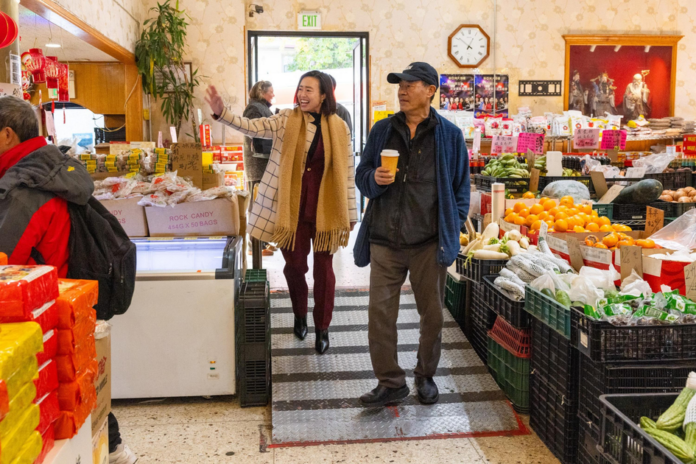

On a cold December morning, Supervisor Connie Chan walked through Chinatown, stopping to greet shop owners and residents. In Cantonese, she told them she is “ging syoon gwok wui” — running for Congress.
The response was immediate, and mostly warm.
After Chan visited New Asia Supermarket, she stopped outside to film a social media video (opens in new tab), highlighting the plan to increase housing development in the neighborhood. The grocer’s owner, Hon So, appeared excited about her candidacy.
“We’ll definitely support her,” he told The Standard in Cantonese. “We’re not just looking forward to it — we’re hoping for it.”
Chan, a Chinese immigrant who moved to San Francisco as a teenager, is running in a competitive race to replace Rep. Nancy Pelosi, whose retirement after four decades in Congress has opened a once-in-a-generation opportunity. The leading candidates — Chan, state Sen. Scott Wiener, and tech founder and former congressional staffer Saikat Chakrabarti — are scrambling to build coalitions that can lift them into the top two spots in June’s primary, letting them advance to the general election.
But Chan has a built-in advantage among some Chinese American voters, for whom identity politics and representation are paramount (opens in new tab). To win a tough race, she has been pressing this advantage as hard as possible.
Her launch video prominently featured Chinatown (opens in new tab), where she spent her teenage years, and she spoke in Chinese (opens in new tab) in another campaign video. She has made frequent appearances in Chinese-language media over the years, including an eight-episode “Tea Time” video series (opens in new tab) with Sing Tao Daily. She has been a regular presence (opens in new tab) at Asian community events while actively networking with Asian American political activists (opens in new tab) across the ideological spectrum. Her campaign website includes a dedicated Chinese-language section (opens in new tab), while other candidates’ sites are in English only.
It’s not surprising that Chan is making moves to court Chinese voters. Asians make up 37% (opens in new tab) of San Francisco’s population, with Chinese residents accounting for 22%, the largest share among major U.S. cities. Pelosi’s 11th congressional district excludes parts of the city’s south side, reducing the share of Asian voters to roughly 31% (opens in new tab). The demographic makeup of registered voters is unclear, as voter registration does not track race or ethnicity.
Chinese Americans have broken nearly every political glass ceiling in San Francisco — from the Board of Supervisors to mayor to state legislator. Congress remains the last frontier. The prospect of sending the city’s first Chinese representative to Washington has generated excitement in the community (opens in new tab), according to David Ho, a political consultant and Chinatown activist. He pointed to examples of elected officials, including former mayors Ed Lee and Art Agnos, winning office by building coalitions with strong Chinese support and noted that the Chinese electorate has continued to grow.
“When Ed Lee ran for mayor, he unified progressive, moderate, and conservative Chinese voters,” Ho said. “Let’s see if Connie can replicate that.”
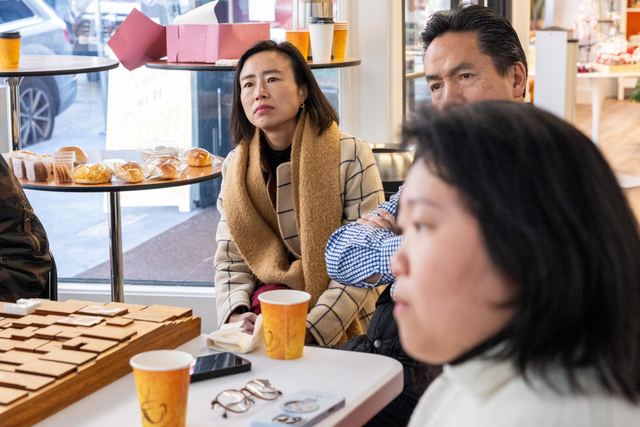
Even before she entered the race, Chinese people were stopping her on the street to tell her she could make history, Chan said.
“I am excited, too,” she added. “But I’m also thinking, OK, we have to run the campaign. We have to win.”
Still, the excitement is more a matter of vibe than verifiable data. Chan is confident she can earn strong support from Chinese voters but emphasized that the community is not a monolith and that she takes nobody for granted.
She rattled off the neighborhoods packed with Chinese restaurants and the highest concentrations of Chinese voters: “I know where I’m gonna find my Chinese food, but also our community,” she said with a laugh. “There’s Ocean Avenue, Portola, Irving, and Taraval, and much more. It’s those relationships and roots that bring me the confidence that, as I continue to do that work, I will earn their vote.”
Joyce Lam, director of the Chinese Progressive Association Fund, a political action group long allied with Chan, said many in the community appear energized by her candidacy.
“Having someone our community has worked with and experienced as a champion for workers and everyday people is very exciting,” Lam said.
She said Chinese Americans have grown more accustomed to exercising their political power, but Chan’s victory “would be historic.”
Chinese voters on the other side
Of course, Chan will not win every Chinese vote. She may not even win a majority.
Nancy Tung, the moderate chair of the San Francisco Democratic Party, said she is not persuaded by identity politics and is supporting Wiener, citing his experience at multiple levels of government.
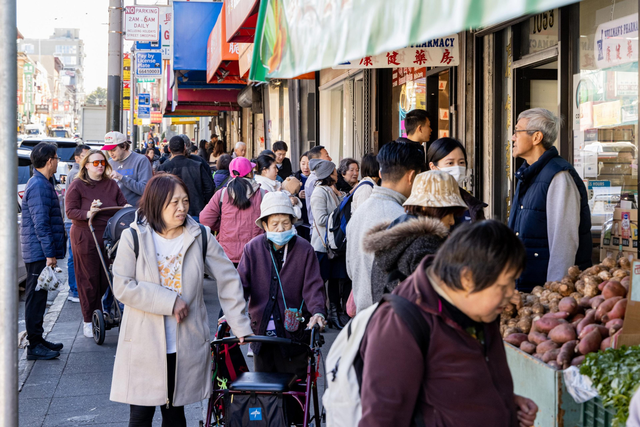
“Congress is a very crowded place,” Tung said. “It’s very different from being one of 11 members on the Board of Supervisors.”
However, she added, racial preferences are a reality for voters, particularly among new immigrants who are less politically involved.
Wiener, who began his career in San Francisco nearly two decades ago, could benefit from citywide name recognition, including a well-known Chinese name, 威善高 (Wei Shan Gao, which translates to “authority, kindness, tall”).
Chakrabarti, a newcomer to local politics, is also running a strong campaign. The centimillionaire former aide to Rep. Alexandria Ocasio-Cortez has changed his Chinese name twice in an effort to establish a Chinese identity on San Francisco ballots, which are printed in both English and Chinese.
Chakrabarti said he recognizes the importance of the culture in San Francisco, noting that his daughter attends a Chinese bilingual school. His campaign has prioritized outreach to Chinese-speaking communities and is actively hiring (opens in new tab) bilingual canvassers, offering higher pay.
“If you know folks, send them our way,” he said.
Some moderate Chinese political groups remain firmly opposed to Chan. The Association for the Advancement of Asians rated Chan an “F” (opens in new tab) on public safety and education-related issues during her 2024 supervisorial run.
The Great Highway impact
On the west side — which is heavily Asian American and traditionally moderate — Chan could be aided by the fight over the Great Highway, which has reshaped political alliances and shifted some moderate Asian voters toward Chan.
Chan was a staunch opponent of Proposition K, the 2024 ballot measure that closed the Great Highway to cars. The measure passed citywide but faced strong opposition on the west side, particularly among Asian American residents (opens in new tab). Wiener, while not the author of the measure, endorsed it and has been vocal in support of urbanist transportation policies.
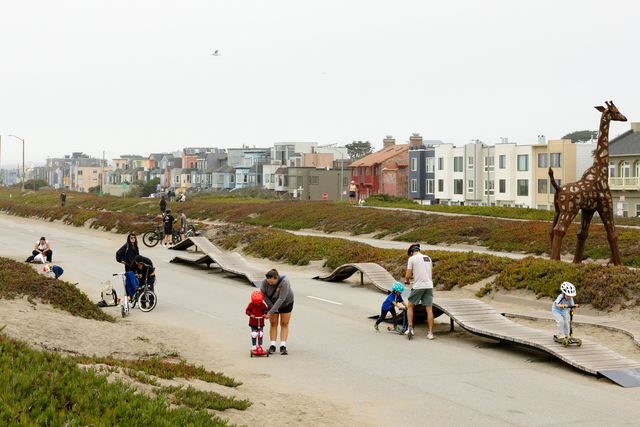
Dennis Wu, a longtime moderate voter, said Chan’s advocacy on the Great Highway changed his view of her, and now he’s supporting her congressional run.
Wu did not support Chan’s reelection to the Board of Supervisors in 2024. At the time, public safety dominated the political debate, and Chan was attacked by moderates as being weak on crime.
“But the Great Highway changed everything,” Wu said. “With Prop. K, the issue for the west side was no longer public safety. It became people’s daily lives.”
Tung agreed that the highway debate could benefit Chan politically but questioned its relevance in a congressional race.
“These are purely local issues,” she said. “What touches Congress is federal funding — for transit, for example. [Wiener] is extremely strong on transit and bringing home federal dollars for Muni and BART. And the next few years are going to be about fighting against Trump.”
Wiener’s campaign cited a September poll (opens in new tab) showing that he is more popular than Chan among Asian voters citywide. According to EMC, Wiener leads with 58% of Asian voters, followed by Chan, with 16%; Christine Pelosi, who has opted not to run for her mother’s seat, with 10%; and Chakrabarti, 6%. Chan’s campaign dismissed the poll as premature, saying it was conducted in the fall before Chan announced her candidacy. The campaign also criticized Wiener over what it called his “very public and very political reversal on Gaza.”
Jason Galisatus, a political consultant of Chinese descent, supported Wiener, saying Chan has often been out of step with Chinese voters, pointing to the 2022 school board and district attorney recalls.
“It bears repeating that Connie barely won reelection in 2024, when Prop. K was also on the ballot,” Galisatus said. “It’s wishful thinking that this race will be decided on this narrow issue — and wishful thinking doesn’t win elections.”
More likely than the Great Highway fight, housing and family zoning issues could draw west-side support for Chan, who’s uniting lefties and NIMBY-aligned conservatives.
But for Wu, those political labels matter less, and he wanted to place more value on highlighting the successes of Chinese Americans, not only in tech, AI, and business but in politics.
“Our people are used to being quiet, brought up to stay out of politics,” Wu said. “You have to stand back and admire what [Chan] had to confront herself with.”