
 Download

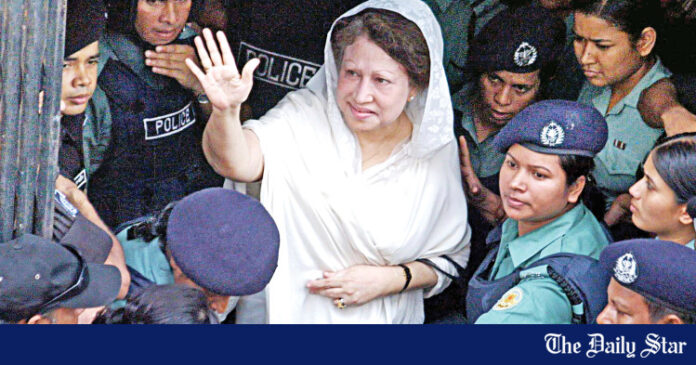

The passing of former prime minister and BNP chairperson Khaleda Zia has drawn extensive global media coverage, with major international news agencies describing her death not merely as the loss of a Bangladeshi political leader, but as the end of a defining era in South Asian politics.
Reuters and the Associated Press (AP) were among the first to break the news globally, describing her as a “towering figure” whose decades-long rivalry with Sheikh Hasina defined the nation’s political landscape.
AP wrote that the former prime minister’s “archrivalry with another former premier defined the country’s politics for a generation”. Similarly, Reuters noted that Khaleda, who became Bangladesh’s first female prime minister in 1991, went on to develop a rivalry with Hasina as they “spent decades trading power”.
British media focused heavily on her historic achievements. The BBC and The Guardian highlighted her distinction as the first woman to lead the country, documenting her transition from a homemaker to a fierce campaigner for democracy.
The BBC published a report headlined “Khaleda Zia: Slain leader’s widow who became Bangladesh’s first PM”, noting that she became head of government in 1991 after leading her party to victory in the country’s first democratic election in 20 years. The Guardian, in its online edition, reported: “Khaleda Zia, first female Bangladesh prime minister, dies aged 80”.
The Independent (UK) wrote that Khaleda had faced corruption cases she maintained were politically motivated. German broadcaster Deutsche Welle wrote that during her terms from 1991-1996 and 2001-2006, Khaleda was “the first female prime minister of Bangladesh and the second female prime minister in the Muslim world”.
In the United States, The New York Times wrote that Khaleda Zia’s rivalry with “another woman at the helm of a duelling political dynasty shaped the fate of the young South Asian nation”. The Washington Post headlined its obituary: “Khaleda Zia, former Bangladeshi prime minister and archrival of a previous premier, dies at 80”.
CNN reported that Khaleda was the first woman elected prime minister of Bangladesh, noting that her death was announced by the BNP in a statement yesterday. Bloomberg wrote that Khaleda “helped usher in democracy after a tumultuous period of military rule and dominated the country’s politics for decades”.
In the Middle East, Al Jazeera highlighted wrote on her role in the 1990 anti-autocracy movement. It ran stories titled “Bangladesh mourns former leader Khaleda Zia” and “Khaleda Zia, Bangladesh’s first woman PM: A life of power and resistance”, alongside obituaries recounting her years of legal and health struggles.
The Times of India published multiple reports, observing that her death comes at a sensitive moment as Bangladesh heads towards a crucial election, and just “days after her son Tarique Rahman ended years of exile by returning home”. One of its headlines read, “From First Woman PM To Fierce Rivalry: Khaleda Zia’s Three Terms That Redefined Bangladesh Politics”.
The Hindu published live updates and stories with headlines such as “Khaleda Zia: Return of the Begum” and “Between the Begums, and their parties, a bitter rivalry and vengeful past”.
Indian news agency Press Trust of India (PTI) described her as a formidable figure who dominated Bangladesh politics for decades.
NDTV’s coverage, titled “Khaleda Zia, Bangladesh’s First Woman Prime Minister, Who Had An India Connection”, wrote that she left behind a strong political legacy. The report mentioned that she had renewed her fight for democracy after 2009 and was honoured as a “Fighter for Democracy” by New Jersey’s State Senate in 2011.
Meanwhile, Pakistan’s leading newspaper Dawn reported that despite years of ill health and imprisonment, Khaleda had vowed in November to campaign for the February 2026 election — the first vote since a mass uprising toppled her arch-rival Hasina last year.
Dawn wrote that the BNP is widely seen as a frontrunner, and reported that she was rushed to hospital in late November, where her condition declined due to a raft of health issues despite the best efforts of medics.
Other international outlets, including Nikkei Asia and Arab News, also covered the passing of the veteran leader, marking the end of a chapter that shaped modern Bangladesh.