
 Download

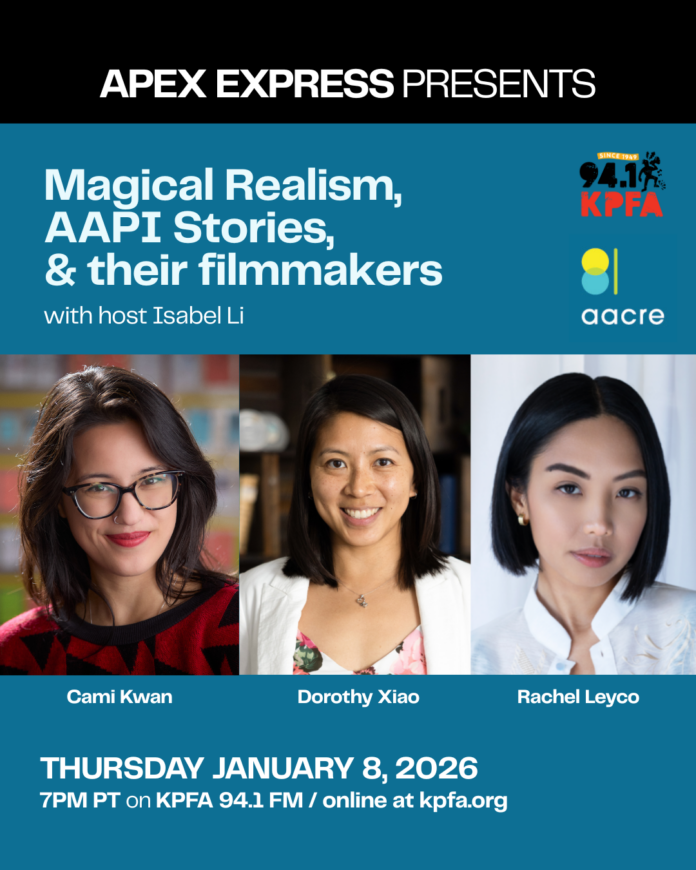

Think about the histories of your family or memories from your past. What if you recounted them with a dash of magic? What happens when we infuse our stories on film with some magical realism? Tonight’s edition of APEX Express features three filmmakers who created magical realism short films centering AAPI women. Listen to directors Cami Kwan, Dorothy Xiao, and Rachel Leyco discuss their films and experiences behind the scenes with host Isabel Li.
Cami Kwan: Website | Instagram | Seed & Spark
Dorothy Xiao: Website | Instagram
Rachel Leyco: Website | Instagram
Transcript
00:01 [INTRO]
Isabel: You’re tuned into Apex Express on KPFA. Tonight’s edition is all about stories. Think about the histories of your family or memories from your past. Now, what if you recounted them with a dash of magic? What happens when we infuse our stories on film with some magical realism? I’m your host, Isabel Li, and today we have three very special guests, Cami Kwan, Dorothy Chow, and Rachel Leyco.
All of them are AAPI filmmakers who received the Julia S. Gouw Short Film Challenge grant from the Coalition of Asian Pacifics and Entertainment and have created short films featuring AAPI stories with magical realism. My first guest of the night is Cami Kwan, a Chinese-American director specializing in stop-motion animation who directed the short film Paper Daughter.
Hi Cami, welcome to APEX Express!
Cami: Hello, thank you so much for having me.
Isabel: How do you identify and what communities do you consider yourself a part of?
Cami: So I identify as a queer Asian American woman um and I am a descendant of immigrants, of Chinese immigrants. um Then the communities that I am part of, part of the queer community, part of the Los Angeles community, part of the Chinese American and Asian American community, part of the mixed race community and part of the stop-motion animation and independent artist community.
Isabel: I’m so excited to talk to you about your upcoming short film, Paper Daughter, a gothic stop-motion animated Chinese-American fairy tale about a young woman grappling with the guilt of using the identity of a deceased girl to immigrate to the US via Angel Island in 1926, which is such a fascinating concept. Can you tell our listeners a little bit about how you came up with this story and the historical specificity behind it?
Cami: Absolutely, yeah. So like I mentioned, I’m the child of immigrants, descendants of immigrants rather. So my great grandparents immigrated to the US from China. My great grandfather came over in 1916 and my great grandma came over in 1926. And so I’ve always grown up knowing the story of Angel Island and knowing the story about the paper sons and paper daughters who had to find any way into the United States that they could. And so they were forced to, you know, take on the identities of other people. And those stories have always stuck with me, you know, like it’s very personal. Angel Island means a lot to me and my family. And just the extreme measures that people have always had to take just for the chance at a better life have always been really meaningful to learn about. just the like, I’ll use romances in like the art movement, like romantic. It’s very romantic and kind of fairy tale-ish, the idea of having to take on a new identity and pretend to be somebody that you’re not. And often those identities would be people who had passed away, and then those families had then sold those identities or given those identities to new people. And so it’s so interesting the idea of being like the last person to know somebody so deeply, but you’ll never get to meet them and you’ll never be able to thank them or repay what they sacrificed for your future. And that’s kind of how I feel as a descendant of immigrants. The sacrifice that my family made for me was made so long ago that there’s no way for me to ever pay it back. And I didn’t really get a say in whether I received that sacrifice or not. And I think a lot of descendants of immigrants kind of have to struggle with this. What does it mean for us to be given this new chance at the cost of somebody who came before us? And so that’s all of that kind of rolled up into this 14-minute film.
Isabel: You describe your film as being in a gothic style? Can you describe what this looks like and why gothic?
Cami: The subject matter is just so naturally gothic. It’s dealing a lot with death and a lot with guilt and those big capital R romantic subjects and stuff. My day job, my day-to-day job is working in stop-motion animation directing mostly like children’s series and mostly toy related stuff. And so I spent so much of my time in the happy brighter like birthday party storyline kind of like space. But what really made me want to be a filmmaker in the first place were all these like heavier themes, these bigger themes, films by Guillermo del Toro and like Tim Burton and Henry Selig and Hayao Miyazaki and all of those kind of have this like gothic edge to them. And so that’s like a story that I’ve been a type of story I’ve been wanting to tell for about a decade now.
Isabel: Stylistically, how does this show up in your film? So I imagine darker colors or do you have a visual like preview for us?
Cami: it is a little bit in the darker color space, but it’s still very colorful despite all that. It’s moody more so than dark, I would say. um We have a lot of like light and dark themes, a lot of like shadow. stuff and um a lot of magical realism, which is where that fairy tale aspect kind of comes in, because you’re dealing with things that are so abstract, like guilt and sacrifice and wearing the identity of somebody else, that there’s no literal way to convey that. Well, there are literal ways to convey that, but none of those literal ways I feel fully convey the emotional weight of everything. And so we’ve gone in this very magical realism space where people are tearing information out of these booklets that contain information about the person they’re supposed to be and creating these paper masks out of them. And so yeah, there’s this whole like magical aspect that tends to be kind of darker. There’s imagery of just like being consumed by the identity that you’re just supposed to temporarily wear. And there’s a lot of like, yeah, there’s a lot of darkness in those themes, I think.
Isabel: Wow, that’s so interesting. I’d love to learn more about stop motion. What does stop motion make possible that isn’t as easily accomplished through other forms of filmmaking?
Cami: Yeah, I think the reason why I’m drawn to stop motion, what I stop motion makes possible is like a universality of just like a human experience because with other kinds of animation and other kinds of filmmaking, like there is kind of like an opacity to like how it’s made. There’s this this veneer, this magic to it, and there’s that magic to stop motion too. But the difference between all of those and stop motion is made out of like everyday materials. It’s made out of fabric. using paper. We’re using clay. We’re using materials that people have encountered in their day-to-day lives. And like, that’s the one thing that we are all guaranteed to have in common is that we live in a material world and we encounter these textures and materials around us. so by like taking such a specific story and trying to convey such universal themes, it really like behooves us to be using like um a medium that is as universal as stop motion is. So I think that’s like the big thing that stop motion unlocks for us. Plus also story-wise, like it’s very paper centered, paper daughter, they’re tearing paper strips, they’re making paper masks. So like physically using these paper textures adds a lot to our world. um And I think working in stop motion gives you a degree of control that live action doesn’t give you because we’re creating. all of our characters, all of our sets by hand, which gives us so much of a say over what they look like and what they convey based on how they’re constructed and stuff. And that’s just a degree of communication that nothing else brings.
Isabel: I love that this is a magical realism film and you mentioned Guillermo del Toro. I know that in your campaign trailer, you featured Pan’s Labyrinth, which is my all-time favorite movie.
Cami: Me too!
Isabel: Yeah! How exactly did you come up with this specific blend of history and fantasy for your film?
Cami: I think that it’s almost a natural human instinct to kind of have history and fantasy. Like, that’s all that histories are, just stories told to us. And it’s just being less literal about it and really leaning into the metaphors that we might use to convey the emotional realities of those histories, right? And so I feel like Del Toro does that a lot with his work. And Miyazaki as well does a lot of that with his work. So much of it deals with unpacking like World War II and things like that. And that’s something that I’ve always just personally been drawn to. Even as a kid, my dream jobs were archaeologist or animator. And so here I kind of get to like do a little bit of both of those, know, like using the magic of animation to make history feel a lot more present and tangible and like emotionally relevant, which is It’s really quite poetic to be able to be telling this story right now because it’s going to mark the 100 year anniversary of my great grandmother’s immigration to the US. I think we are due for an examination of immigration in our country. And I’m very interested to see how people respond to the questions that this raises of how different is the immigrant experience 100 years later. Have we gotten better? Have we gotten worse? Like I would posit it’s perhaps worse now than it was then, but I’m really hoping to like, yeah, bring that reality into a more approachable space. And I feel like having that blend of magic and history just makes it a little bit more approachable than telling it in a literal way, you know?
Isabel: Those are some great questions to ask. And on that same note, I’m interested in the specificity of Angel Island as well. What types of research did you do to produce your film?
Cami: Oh, gosh, I read every book I could find about it. have… How many books were those? Oh, my gosh, I want to say, like, not as many as I want there to be, you know? Like, Angel Island is not as well covered in history as places like Ellis Island, and there’s a lot. to unpack as to why that may be, especially like the racial aspect of it. But I probably read about a dozen different books to prepare for this film. One of the most concrete and useful books that I read is a book called Island, and it’s a collection of the poems that are carved into the walls of the men’s barracks that remain on Angel Island. And those poems are a huge part, perhaps, the reason why Angel Island has even been preserved as a historical landmark. And so um the three authors went to great pains to replicate these poems, translate them into English, and provide a lot of historical context for the different topics of the poems. And there’s a lot of like first-hand testimony from people who immigrated through Angel Island that they interviewed and included in this book. And so I do think that that book, Island, is like the primary source of most of my research for it. Everything else is more like quantitative history and quantitative data. Oh, also The Chinese in America by, I believe it’s Iris Chang, that it’s not just about Angel Island, but I read that and that gave me a much better understanding about like the place that Chinese immigrants have in American history. Because when I was a kid, like I really only ever learned about great grandma came over through Angel Island and now we’re American and we live in America. But our history, as far as I was ever taught, begins and ends with us entering the United States. And so reading um the Chinese in America gave me a much broader understanding about, like, why did we leave China in the first place? And like, what has it meant for us to be in America as Chinese people since then? Yeah, all that came out of like in 2020 and 2021 when the rise of anti-Asian hate crimes were kind of coming about. I personally had to have a huge reckoning with like my racial identity and like how that has impacted like my experience growing up as a mixed-race person who’s pretty perceivably Asian and all that stuff. So it was a really whole circle broad situation. Oh, I want to do a quick shout out to the Angel Island Immigration Station Foundation. They were very generous with their time and they answered a lot of my questions and sent me a lot of archival images from Angel Island. So I want to thank them so much for their help in the research process of this.
Isabel: Oh, wow. How fascinating. Did you have any expectations on how the production process was going to go? And now that you’re on the other side of it, what are your reflections?
Cami: I had no expectations as to whether we were going to get outside funding or not. Like I, I’m not an experienced or adept grant applicant. Like, it was really just because this was the right kind of project to fit with those kinds of grants. So I had no expectations there. So I am beyond thrilled to have received the support from Cape and Janet Yang and Julia S. Gouw and Shorescripts that we’ve received, like beyond thrilled for that. So that exceeded all of my expectations. um But as far as how the actual production has gone, the fabrication and the animation and the post-production, that’s all stuff that I’m extremely familiar with. Again, that is my day-to-day life, that is my job, that is like what I have done for the last eight years at my studio, Apartment D.
So that all went pretty much as I hoped and expected that it would, but here on the other side, the one thing that has surprised me about it was how much love all of the artists put in this project because like we’ve said so much in this conversation, there’s so much specificity to this. This is about my great grandma. This is about my family and my feelings about being a descendant of immigrants. It’s so specific that I wasn’t sure how emotionally it would resonate with anybody else that wasn’t me or wasn’t part of the AAPI community, you know?
But every single person — doesn’t really even matter if they were Asian, doesn’t really even matter if they have a specific connection to immigration — every artist that I asked to join me on this project, I immediately understood what it meant and understood what we were trying to say. And they put so much love into it. And like, we all put a lot of love into everything we do. It’s stop motion. It’s like, you don’t do this unless you love it, you know, because you certainly are not doing it for the money or anything. um everyone was just so…I’m gonna say careful, but I don’t mean careful like cautious. I mean careful like full of care. And I did not expect that and I am so grateful for it. Yeah, looking back, it’s just so precious and so tender and like I’m so fortunate to have had the crew with me that I had to make this film.
Isabel: That’s so lovely. What are you most excited about upon completing your film?
Cami: I’m just excited to share it with the world. I’m so proud of it. It is truly, and I’m not just saying this because it’s my baby, but it is very beautiful and it is very special. For a lot of us, one of the first times that we’ve been able to be in charge of our own departments or to make the decisions that we wanna make and tell things, do things, show things the way that we think they should be done. And so it’s kind of significant for many of us to have this film come out and to be received.
What I want people to take away from it is an appreciation and a gratitude for everything that has had to happen for us to be where we are now. And I also really want people to take away the unconditional love that has occurred for us to be in the country that we have and to be the people that we are. Every single person is where they are. doesn’t matter if you’re in America or anywhere else, like we are all here because of the sacrifices that were made by the people who came before us. And those were all made out of unconditional love. And that’s like, I want people to come away from this film remembering that our country is built on the unconditional love and sacrifice from people who came before us. And then wanting to give that unconditional love and sacrifice to everybody who’s gonna come after us.
Isabel: Such an amazing message. And I know that there’s still lots to do and you still have a lot to celebrate with your upcoming film and with the festival circuit with Paper Daughter. But looking ahead, do you have any plans of what you want to do after the short film?
Cami: Yeah, I would love to bring it into a feature. There was so much that we had to cut out to make this film. On one hand, I’m glad that we cut out what we did because I think the film as it is, is like so tight and so like airtight and good and perfect and sparse in a really nice way, but we don’t even get to delve into life before Angel Island. It begins and ends on the island, and I would love to explore the stories that brought this all about and the stories that come after. So bringing this up into a feature version and getting that in front of people would be amazing. And I have a couple other short film and feature film and script ideas that I would like to start working on as well. I’ve kind of really, I’m really grooving on the like Asian early Chinese American history. um So most of them are going to be set in California and focus on like Chinese immigrants and their role in the founding of America. um I’m really excited for the like, after all the film festivals, I really want this film to end up in classrooms. And I even just the other day like I have a friend who’s a third and fourth grade teacher and she showed it to her class and then the students asked me questions about Angel Island and about animation. if this can play any part in helping to spread the story of Angel Island and the people that immigrated through there, like that’s all that I could ever want from this. So I’m really excited for that.
Isabel: That’s wonderful. I’ll put your website, social media and seed and spark page for Paper Daughter up on kpfa.org so our listeners can learn more about this stop motion film and get updates for how they can watch it. I can’t wait to see it when it comes out. And Cami, thank you so much for joining me on Apex Express today.
Cami: Of course, thank you so much for having me. It was a great, great time talking with you.
Isabel: You just heard Cami Kwan talk about her film Paper Daughter. On Apex Express tonight, we have two more special guests who made magical realism short films. Next up is Dorothy Xiao, who made the film Only in This World. She’s a Los Angeles-based award-winning filmmaker who likes to create grounded family dramas with a hint of fantasy.
Hi, Dorothy. Welcome to APEX Express.
Dorothy: Hi. Thanks for having me!
Isabel: Of course! Thank you for coming here. My first question for you is actually quite broad. How do you identify and what communities are you a part of?
Dorothy: Oh, that is a good question. I think in a broader sense. I would say, obviously, I identify as an Asian American. um But I think, like, for me, because I grew up in the 626 or the San Gabriel Valley, I grew up with a lot of people who looked like me. So I think I didn’t truly identify as being Asian or had awareness of my identity until later on when I went to college. And then I took Asian American Studies classes and I was like, oh, wow, I’m Asian. Or like, what does it mean to be Asian? You know, like, I think I, at that time, prior to recognizing and understanding what it meant, and also even to be a minority, because at that, like I said, growing up in 626, even going to UCLA, where I’m surrounded by a lot of Asians, I never really felt like a minority. But I think it was really after graduating where I, depending on the spaces that I would enter into, especially in the film industry, I was learning like, oh, yeah, I am a minority and this is what it feels like. And prior to that, I think I just identified as being a daughter of immigrants. And that still is very strongly the case just because I grew up listening to so many stories that my parents would tell me, like coming from China, growing up like they grew up in China during a completely different time. I can’t even imagine what it would be like living in the way that they did, you know, during the Cultural Revolution, under communism, in an intense way where they were starving, all this political stuff. But yeah, a second gen or for a lot of people, first generation, daughter of immigrants, of parents who decided that they wanted to make a better life for their kids out here in the States. I think that I want to stand by me saying that I don’t feel like I am, I don’t really want to identify as only just single categories all the time, just because within each community, could be, you could have nuances, right? Because I am a woman, but I’m also like a woman who doesn’t want children, you know, and there was just so many different things of how I identify. So hard for me to categorize myself like that. But they are, there are tidbits of different communities. Like I still identify, identify as Asian American. I identify as a daughter of immigrants. I identify as a female filmmaker and yeah. And a business owner, I guess. Yeah.
Isabel: Right. Yes. Thank you for that nuanced answer. You know, it’s so fascinating because I was reading about your work and you have worked in animal research administration and an afterschool program and even web development for nonprofits. How did you get into writing and directing?
Dorothy: Yeah. So after graduating college, I was definitely in a place where many, I’m sure, fresh grads understand what we call the quarter life crisis, where we don’t know what we wanna do with our lives. And I was working at UCLA because that was the only job that I could get out of college for an animal research administration office. And really, I worked for them as a student. So I was like, well, it makes sense to have that be my full-time job, because you’re in a place where you don’t have skills. So how do you get a job if you don’t have skills? That weird silly catch-22 situation. So I studied psychology in undergrad because my goal was to become a therapist. I wanted to work with Asian and Asian immigrant communities to help them with mental health because there’s such a stigma attached to it. And being somebody who found mental health really important and also found that it was a really great way to understand myself. I wanted to work with, I guess, the people of my community. But at that time, I realized that there’s still a stigma attached to mental health and it’s really hard to get people to even go to therapy. Like living with my parents, it’s really difficult. I cannot ever convince them to go. um And so I had pivoted into, or at least I discovered this filmmaking competition and ended up just like making a film for fun with a couple of friends, random people that um were not in film at all. And I had a lot of fun and I realized that we could actually create stories talking about things that are very similar to mental health or could provide that catharsis and validation that you could probably get in a session, in a therapy session. And it’s not clinical at all. It’s not as clinical. So, you know, on all those different jobs that you mentioned, they’re all day jobs, know, animal research administration and then working for an after school program. That was me still trying to figure out how to be a filmmaker on my weekends. I still needed a day job. I didn’t have the luxury of going to film school. So I would work at different places that gave me the flexibility of having a day job. But then also I had free time during the weekend to just make films with my friends, make friends films with people like my mom, who was one of my first actors earlier on. Love my mom. She did not do the greatest in my film, but I love her for being there for me. But yeah, like the different organizations or just jobs that I worked for were all really good in terms of providing me management skills and also communication skills because I worked in different industries, you know, and so at the end of the day, it all culminated in me at my current place. Like I am a freelance filmmaker and I also run my own video production company. So um becoming a writer, I mean, being a writer director is my main identity as a filmmaker. However, I don’t think you could be a good writer-director if you don’t have life experience. And having all those different jobs that I’ve had provided me with a lot of varied life experience and I interacted with a lot of different people, many different personalities.
Isabel: Yeah, no, I love that. So you grew up in Alhambra, which I’m familiar with because I too grew up in the San Gabriel Valley. How would you say that growing up in Alhambra has shaped you as an artist?
Dorothy: Alhambra is really special, I feel like, because in the San Gabriel Valley, there are many cities like this. You have Chinese people who can actually get by without ever having to learn English. And the same goes for Latin communities as well. And, you know, I have aunts and uncles who lived in Alhambra for years and never learned how to speak English. So I think it’s like, what’s so special about it, it feels like a safe space for a lot of immigrant communities. And then my parents being immigrants from China. living in Alhambra was a place where they could feel safe and feel connected to the people that they left behind in another country. And so being a child of immigrants, a daughter of like an Asian American, like a Chinese American growing up in Alhambra, I definitely felt like I grew up with a lot of people who were similar to me. know, we were like a lot of times the first American born children of our families even, and it was, we had to essentially understand what it meant to be Asian versus American and all of that.
But I think like being in Alhambra, I never felt like I wasn’t seen, or at least I never felt like I was a minority. I think I mentioned this earlier, in that growing up in Alhambra, you do see a lot of people who look like you. And I have a lot of friends in the film industry who have moved out to California because they grew up in towns where they were like one, the only person, the only Asian person in their school or whatever. And I didn’t have that experience. So for me, it was really special just being able to have a whole group of friends where there’s a bunch of Asians. And we all spoke different languages. Like I had a lot of friends who were Cantonese speakers, but I’m a Mandarin speaker, but it was just really cool. It was like going to your friends’ places and then you have aunties. So it’s almost like having more family. You could feel like you have more aunts and uncles that will feed you all the time because that is the way they show love, right?
Isabel: Oh, certainly. I think there’s so many stories in multicultural places like Alhambra. And speaking of which, you did in your film Only in This World. It’s about an empty nester who has to face her ex-husband’s mistress in order to summon her daughter back from the afterlife, which is featured in the 2025 Silicon Valley Asian Pacific Film Festival in Sunnyvale. Congratulations on such a beautiful film. I will say that I am a huge fan of magical realism, and Only in This World has some magical elements to it. So I’d love to get to know, how did you come up with this specific plot and characters that make up this film?
Dorothy: Yeah, and thank you for wanting to talk about this one. It’s a special story to me just because it is, I think it’s the first film that I’ve made where I just decided to incorporate elements of where I grew up. And so Only in This World is inspired by my mom and her Tai Chi group at our local park, so Alhambra Park. My mom would go to do Tai Chi every morning for years. And in Alhambra, actually, as I mentioned, because there are so many immigrant communities, many of the immigrant communities tend to stay together with the people who speak their language. So Chinese people usually stick together with the Chinese speakers, Spanish speakers stick together with the Spanish speakers. You don’t see a lot of mingling or intersectionality. But one of the special things that I saw with my mom’s Tai Chi group was that they were not just Chinese people or Asian people, but there were Latino people in their group as well. And so even though they couldn’t speak the same language, they would show up and still do Tai Chi every morning because it was a matter of doing something together. And so I love that a lot. And I wanted to tell a story about just older women who are finding friendship because I think that’s really important in older age and in these groups because you see that a lot of the people in these Tai Chi groups are even the ones, not just Tai Chi groups, but there are dancers in the park, you know, like you’ll see them in the mornings, not just in Alhambra, but in Monterey Park, all the different parks, open spaces, they’ll have little dance groups.
A lot of the people who are part of those groups happen to be seniors, and I think it’s just because they don’t have work, they don’t have children, they’re lonely. And so…I think it’s really important to be aware that where friendship or loneliness is actually an epidemic in the senior community. And it’s really important to providing good quality of life is to just have them have that connection with other people. And seeing that in my mom, because my mom is getting older, having her be part of that community was what kept her happier. And so, yeah, and also my mother-in-law is Colombian. And she’s done Tai Chi before as well with her group in Rosemead. And so I just was like, well, I’m part of a multicultural family. I want to tell a multicultural family story. Yeah, in terms of the magical realism element, I thought a lot about just how my family, if our house has ever burned down, the things that they would take out are our photos, the print four by six, like, you know, just the print photos because they’re just so precious to them. There’s something about hard copy pictures that is so special that digital photos just can’t take over. Like there is an actual energy to how a photo is made or even like back then when we used to use film, there’s energy that’s required to actually create photos. And so, you know, I wanted that to be the power that powers this magical scanner where energy is taken from the picture and then you have the ability to bring someone you love back from the afterlife. And I really love grounded magical realism because I think it just makes difficult things a lot easier to understand when you add a little bit of magic to it, a little bit of fantasy.
Isabel: Yeah, magical realism is such a special genre. What part of the production process that you find the most profound?
Dorothy: I think it was just really my gratitude in how much my family came together for me and also just like the people of this team, know, like there were, I think one major situation that I can think of that I always think is really funny was, um so we filmed at my mother-in-law’s house and my husband, Diego, was also working on set with me. He is not in the film industry. He’s a software engineer manager. He’s like in tech, but he is one of my biggest supporters. And so…when we were like, yeah, can we film at your mom’s house? He was like, okay. But he had to end up being the, quote unquote, location manager, right? Because the house was his responsibility. And then, and he was also my PA and he was also DIT. Like he would be the one dumping footage. He did everything. He was amazing. And then ah one day we found out that his neighbor was actually doing construction and they were hammering. It was like drilling stuff and making new windows. They were doing new windows. And we were just like, oh, like, how do we get them to, like, not make noise? And so, and they don’t speak English. And so we were like, oh crap, you know. So like, unfortunately, my producers and I don’t speak Spanish, like we’re all just English speaking. And then I did have Latinos working on my set, but they, you know, they had other jobs. I wasn’t going to make them translate and do all that other stuff. So then Diego so kindly went over and talked to them and was like, essentially we set up. They were totally cool about it. They were like, yeah, okay, you’re making a film. then whenever you’re rolling sound, we’ll just like prevent, like not hammer. And then so Diego is sitting outside with a walkie and talking to the first AD and other people inside the house, because we’re all filming inside. don’t know what’s going outside. And then so like, we would be rolling, rolling. And then um the workers, I think his name was Armando, are like…whenever we cut, Diego would hear it through the walkie and he’d be like, Armando, okay, you’re good to go. You can drill. Armando would drill. And then when we’re going, and we’d be like, I’m going for another take. And then Diego would be like, Armando, please stop. So it was so nice of them to be willing to accommodate to us. Because you hear a lot of horror stories of LA productions where neighbors see you’re filming something and they’ll purposely turn on the radio to make it really loud and you have to pay them off and whatever. And in this case, it wasn’t it was more like, hey, like, you know, we’re making a movie and they were so supportive and they’re like, yeah, totally. This is so cool. We will definitely pause our work, our actual work and let you roll down during the brief period. So we’re really grateful. We definitely brought them donuts the next day to thank them. But that was just something that I was like, oh yeah, like I don’t think I could have pulled that off if I didn’t have Diego or if the fact, if it wasn’t for the fact that these were the neighbors, know, that we were filming at someone’s house and the neighbors already had a relationship with the people who lived here.
Isabel: Wow, that’s really adaptable. And I’m so glad that went well for you. Dorothy, you’ve directed 13 films by now. Have you ever seen one of your films resonate with an audience member that you’ve interacted with in the past?
Dorothy: So there was this one short I had done a couple years ago called Tarot and it came at a time when I was struggling with the idea of whether or not I wanted to have kids and many of my friends are off having their first or second kids, you know, and so I never really wanted to be a mom, but then I have a partner who I can see being a great father, so I’m more open to the idea of being a mother, but it was still something I was conflicted about. And so I put this all into a short film, just my feelings of how my identity would change if I were to become a mom, because I’ve read so much about that. I found a Reddit thread one day where people were just talking about how being a mother is hard. And they openly stated how much they hated it. And it’s okay to feel that way. And I wanted to put those feelings into this film to just put it out there like, hey, like if you don’t like being a mom, even though you love your kid, you could still hate having that identity and be lost about, and it’s okay to be lost or not sure about who you are. And so it was a really short film and it ended kind of open ended. It was like five minute film, so it didn’t have like a full ending, but it was an open ended ending. And then afterwards I had a bunch of people come up. I had people who were parents, not just mothers, like even, or like fathers who had just had their first kid who were coming up and telling me like, oh, I totally identify. I understand that struggle of learning about who your new identity is after you’ve had a kid. And then I had people who were child free who were coming to me and saying like, yeah, this is a similar feeling that I’ve had about whether or not I should have any kids. Because, you know, as women, we have a biological clock that ticks. And that’s something I feel frustrated about sometimes where it’s really because of my body that I feel pressured to have a kid versus wanting to have one because I want one. And so that was a story I wanted to, or just something I wanted to put into a film. Yeah, and I also had another person come up and tell me that they were like, this was something I felt, but I never really openly talked about. And so I resonated a lot with this and it just helped basically articulate or helped me identify like, oh, I totally feel this way. And so that was really validating to me as a filmmaker because my goal is to reach others who don’t feel comfortable talking about certain things that they tend to hide because I have a lot of those types of thoughts that I might feel ashamed or embarrassed to share. But then I put it into a story and then it makes it more digestible and it’s like, or it’s more, it’s entertaining. But then like the core message is still there. And so people watch it and if they feel that they can connect to it, then I’ve done my job because I have resonated with somebody and I’ve made them feel seen. And that’s ultimately what I wanted to do when I wanted to be a therapist was I just wanted to make people feel seen. I wanted to make them feel connected to other people and less lonely because that’s something that I also have struggled with. Yeah, so filmmaking is my way of putting something small out there that I feel and then finding other people who feel the same way as me. And then we can feel validated together.
Isabel: Ah yes, that is the power of film, and Dorothy’s work can be viewed on her website, which I’ll be linking on kpfa.org, as well as her social media, so you can get new updates on what she is working on. Dorothy, thank you so much for joining me on APEX Express today!
Dorothy: Thank you! Thank you for having me, it was so great to meet you!
Isabel: That was Dorothy Xiao, our second guest for tonight’s edition of Apex Express, featuring magical realism AAPI filmmakers. Now time for our final guest of the night, Rachel Leyco, who is a queer, award-winning Filipina-American filmmaker, writer, actress, and activist. We’ll be talking about her upcoming short film, Milk & Honey.
Hi Rachel, it’s such an honor to have you here on APEX Express.
Rachel: Hi, thank you so much for having me.
Isabel: How do you identify and what communities do you consider yourself a part of?
Rachel: Yeah, I identify as a queer Filipina-American.
Isabel: So we’re here to talk about your short film, Milk & Honey, which is about an ambitious Filipina nurse who leaves her family behind in the Philippines to chase the American dream in the 1990s and facing conflicts and hardships along the way. How did you come up with this specific 90s immigration story?
Rachel: Yeah. So Milk and Honey is inspired by my mom’s immigrant story. you know, that’s really her true story of coming to America in the early 1990s as a very young Filipina nurse while, and also a young mother and leaving behind her daughter, which was me at the time. um you know, following her journey in the film though fictionalized, a lot of the moments are true and there’s a lot of exploration of assimilation, cultural barriers, loneliness and the emotional cost of pursuing the American dream.
Isabel: Yeah, when I read that synopsis, I immediately thought of this short film could totally be something that’s feature length. How did you sort of this story to something that is like under 15 minutes long?
Rachel: Yeah, so I wrote the short film script first. And actually, you know, this is a proof of concept short film for the feature film. I actually wrote the feature film script after I wrote the short because there was just so much more I wanted to explore with the characters and the story. It definitely couldn’t fit into a short film, though I have that short film version. But there was just so much richness to my mom’s story that I wanted to explore, so I expanded into a feature. So I do have that feature film version, which I hope to make one day.
Isabel: And you mentioned that this film is inspired by your mom’s story. Is there any other sort of research that you did into this story that really helped you write?
Rachel: Yeah, one of the main reasons I wanted to write the story, I mean, there’s many reasons, but one is because there, if you ask the average American or the general public, they won’t really know why there are so many Filipino nurses in the healthcare system. Because if you walk into any hospital, you’ll see a Filipino nurse, more than one for sure. ah so I was really curious about the history. ah Having my mom as a nurse, my sister’s also a nurse, I have a lot of healthcare workers around me. I grew up with that. I, you know, growing up, I also didn’t really know or learn Filipino American history because it’s not taught in schools. And I, you know, I took AP US history and didn’t learn anything about, you know, my culture and our history. It’s, not in the books at all.
And it wasn’t until like my early twenties that I was really curious about my roots and my upbringing and what it means to be Filipino-American specifically. And so um I really went into like a deep dive of just researching Filipino-American history. And specifically last year, I had been wanting to tell a story about a Filipino nurse because of my proximity to it with my mother. And you know, myself being an artist, being a filmmaker in the industry, there’s so many medical shows out there, like, know, Grey’s Anatomy, that’s been long running, but very, very few, and rarely do we see Filipino nurses at the forefront and at the center of those stories. um You know, rarely are they series regulars. You know, sometimes they’ll feature a Filipino nurse for like one episode or two and, you know, a recurring or a side character, but Filipino nurses are never the main character, never the series regular. And so that was another big driving force for why I wanted to make this story. And, you know, really making my mom’s character the center of it. And so as far as like research, too, I definitely interviewed my mom and I asked her to just tell me her her entire story and specifically why she even wanted to move to the United States because she could have stayed in the Philippines or she could have moved somewhere else. um she saw a newspaper or her friend actually at the time when she was in a nursing school, a friend of hers saw an ad in the newspaper that America was sponsoring nurses. And so she had it in her mind already like, oh, yeah, I’ve heard of America. I’ve heard of the United States that it’s, you know, there’s better opportunities for me there. And at the time she had just had me. And so she had, you she’s a young mother. She’s trying to take care of her baby, her newborn. And so, you know, she had her eyes set on moving to the United States and that’s kind of how her journey happened. And on top of that, I also did my own research on you know, our history, I watched this really amazing documentary um by Vox. It’s on YouTube. It’s all about why there are so many Filipino nurses in America. And it really just ties back to U.S. colonization. And after World War II, was so many, there was big nursing shortage in the United States. you know, white Americans did not want to, you know, fill that role. So they turn to Filipino women to fill the gap.
Isabel: Yeah, was there something special about the production process that looking back, you would want to replicate in the future or that really speaks to you?
Rachel: Absolutely. um Yeah, mean, definitely this experience and a lot of the people that I brought on to this project, I want to continue to make films with them and continue to make art with them because um I’m just so proud of the team that we put together. Everyone was so passionate and they knew how important the story was. They also had their own special connection to the material that they brought so much heart and passion into the film. that really comes through in the project. so like a lot of the people I brought onto this film, I want to continue to make art with them forever. That’s one thing that I’m really, really grateful for, because I got to work with some really awesome people that I had never worked before or I had been wanting to work with. And so it was such a great opportunity that was given to me to be able to connect with such amazing and talented AAPI creatives in my circle.
Isabel: Yeah, I saw on your Instagram page for the film that you shot this film in both Los Angeles and Austin, Texas. Have you ever done a production where you had to sort juggle two different sets in two very different locations? And how was that entire process?
Rachel: Yeah, that was really, it was really fun. It was my first time being able to film in two different cities, let alone like two different states, really. A lot of my past projects have just been, you know, shooting it with the resources that I had that were available to me. You know, usually like my past short film, Thank You for Breaking My Heart, that I did last year, we shot all of it in one location, which was of course like, know, that is something that’s really impressive in and of itself, of course. But, you know, because of the bigger budget that we had for Milk and Honey, I really wanted to challenge myself with this. And I really advocated for filming a part of the film in Texas because it is set in Texas. I was raised there. That’s where my mom was placed when she, because how the process goes is, you know, she applied for the nursing sponsorship and then they placed them in certain areas. And so she was placed in El Paso, Texas at the time. And so that’s where I also grew up. So I set the film there and I really advocated for filming in Texas because I wanted the film to have that feeling of the environment and atmosphere of Texas. um And so we shot some exteriors there for like this really fun Texas montage where you can really like feel that the character is there in, you know, in that heat, the Texas heat. So that was really, that was really fun. And I, you know, we shot, we shot two days in LA and we shot half a day in Austin, Texas. And we hired a second unit in Texas, because, you know, again, like, even though we had a really good budget, was still, you know, it was still pretty small. So I wasn’t able to, you know, fly my LA crew over there. um So what we did was we just hired a second unit crew in Austin, Texas, and they were amazing. And most of them were queer, non-binary filmmakers. And it was just such a fun, intimate crew that you know, we just breezed by and had such a great time shooting that.
Isabel: That’s wonderful. As a director, what inspires you and what are some of your filmmaking influences?
Rachel: Yeah, I mean, I’m constantly inspired by, you know, new films, filmmakers that I’ve seen, em particularly for Milk and Honey. I um so the film is, you know, this grounded drama, but there are a lot of moments of magical realism that I mix into it. love magical realism. love one of my favorite movies is Eternal Sunshine of the Spotless Mind. It’s such a beautiful film, also very grounded, but it’s filled with all of this, you know, magical realism, surrealism. And so I infused that into, you know, Milk and Honey, which was really fun and a challenge to execute. But yeah, and some other filmmakers and creatives that I’m inspired by are Ava Duvernay. think her work is just incredible and also just an incredible artist overall. I love the kind of work that she does because it comes from such a deep place. And I love that she can combine art with politics and social justice as well.
Isabel: I also love that you said in your one of your project funding descriptions that you use your art as your act of revolution, which is so relevant given that, you know, in our current state of, you know, our administration is silencing and suppressing voices of our immigrant communities. And how do we as filmmakers, as artists, what does that revolution and representation mean to you as a filmmaker and artist?
Rachel: I truly believe that that art is our act of revolution and just merely creating the art is that act in and of itself. We don’t have to do more than that as from, in my opinion, as an artist, because the mere fact of us existing as artists, existing, myself existing and creating the work and having the work exists out there and putting it out. The most powerful thing that an artist can do is to make their art and share it with the world. And after that, just let it go, you know, forget about how it’s going to be received. Forget about like, you know, the critics and, and, and the, you know, self doubt you may have and all of those things, because yeah, it’s going to come. I think especially in the landscape of, like you said, of where we’re at right now with our current administration and you know, just who knows what’s going to happen in the next few years, but also in the face of like AI and technology and all of that, I think all we can really do as artists is to, in order for us to change the system is we have to be the change, right? And in order for us to be that change is just to continue to tell our stories and stay authentic to ourselves. Because I think that’s also what a lot of people out there are really craving right now. People are craving authentic, real stories by people that we really don’t get to see or hear their stories very often. And so um that for me is something that fuels me and my artistry every day.
Isabel: Very well said and a great reminder to all of us artists out there to keep making our art. What do you hope for audiences to take away when they watch your film?
Rachel: What I hope for audiences to get out of watching the film, well, one, at the core of it is a mother-daughter story. And I also did it to honor my mother and her sacrifices and her story. So I hope that, one, audiences will, you know, maybe reflect on their relationship with their mother and… um think of ways to honor their mother and their family and their ancestry as well. And another thing is to really think about what the American dream means to you, because that was another driving force for me with the film is it’s called Milk & Honey because a lot of immigrants coined Milk & Honey as America’s milk and honey as this like land of abundance, land of opportunity and you know, this is a, this is a place for creating a better life for ourselves. But I, for me, as I’ve grown up and as an adult now, really looking at like, well, what does the American dream mean to me? Is that still true to me? Do I still think the U S is a place where I can, where I can build a better life? Is it a place of abundance and something in the film, a big theme in the film is where Cherry’s character scrutinizes that dream and thinks for herself, like, is the American dream worth it? And what does the American dream actually mean to me? What is the definition of that? So I think that’s a big thing I would love audiences to also take away from it, you know, asking themselves that question.
Isabel: That’s a great thought to end on. I’ll be including Rachel’s social media and website on kpfa.org as usual so you can see if Milk and Honey will be screening in a film festival near your city during its festival run. Well, Rachel, thank you so much for joining me on APEX Express today. Thanks so much for having me. I really enjoyed it. Please check our website kpfa.org to find out more about magical realism in AAPI stories and the guests we spoke to.
We thank all of you listeners out there. Keep resisting. Keep organizing. Keep creating and sharing your visions with the world. Your voices are important.
APEX Express is produced by Miko Lee, Jalena Keane-Lee, Preeti Mangala Shekar, Anuj Vaidya, Swati Rayasam, Cheryl Truong, and Isabel Li. Tonight’s show was produced by me, Isabel Li. Thanks to the team at KPFA for their support. Have a great night.