
 Download

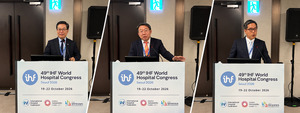

Asian hospital leaders called for a shift away from hospital-centered care as rapid population aging, workforce shortages and rising costs put growing pressure on healthcare systems.
Hospitals should become links between communities and homes, not just places where patients seek treatment, they said. Artificial intelligence should help support that transition.
However, adopting AI alone does not make a hospital more competitive. Leaders must choose technologies that solve practical problems, integrate them into existing care systems, and prepare staff and patients to use them through organization-wide changes.
Hospital executives from Korea, Taiwan and Hong Kong shared their challenges and strategies at the Asian Hospital Federation (AHF) special session of the 49th IHF World Hospital Congress at the COEX Magok Convention Center on Wednesday.
The session was co-chaired by IHF President-designate Lee Wang-jun, chairman of Myongji Medical Foundation, and Eugene Fidelis Soh, deputy group CEO for population health at Singapore’s NHG Health.
Speakers included Kenneth Tsang, CEO of IHH Healthcare North Asia; Wui-Chiang Lee, vice superintendent and chief information officer (CIO) at Taipei Veterans General Hospital; and Koo Ja-seong, chairman of Eunsung Medical Foundation.
Beyond hospital walls: From treatment providers to health partners
CEO Tsang, the first speaker, said hospitals must expand their role from treating illness to managing community health. As populations age, chronic diseases and workforce shortages are becoming global challenges, and the traditional approach of managing all patients within hospitals is increasingly inadequate.
“We need to consider how to transform hospitals from places that simply provide treatment into organizations that coordinate and connect healthcare services,” he said.
Hospitals should remain central to coordinating patient-centered care, he added, while moving beyond a model that requires patients to visit them.
IHH Healthcare is pursuing that approach by expanding services beyond hospital walls. It operates about 190 facilities worldwide, including hospitals, outpatient centers, and clinics, and is building an integrated network that connects hospitals with community providers.
Examples include its outpatient centers in Singapore, Hong Kong and Shanghai. In Shanghai, it operates an outpatient center of about 8,000 square meters that occupies an entire third floor of a shopping center. Consultation rooms, treatment rooms, operating rooms and recovery beds are located on the same floor, with services linked to local clinics.
Tsang cautioned, however, that owning multiple facilities is different from connecting them into a single healthcare system.
Existing electronic medical records (EMRs) have limitations because clinical information becomes available for use only after patients visit a healthcare facility, he said. Providers need to manage patients’ health before they arrive at a hospital.
IHH is, therefore, working to build an AI-powered health management platform. As patients use mobile phones and computers at home to review health information and manage their lifestyles, providers should also use AI to offer more proactive support, he said.
Tsang also warned of the risks of wider AI use. For an organization operating across multiple countries, he said, individual hospitals should not be left to adopt AI independently, emphasizing centralized governance and data sovereignty.
“However important AI may be, it can pose risks without appropriate controls,” he said. “Policies, procedures and monitoring systems must be established alongside efforts to strengthen the capabilities of clinicians and other staff.”
Tsang added, “Hospitals will not disappear because not every disease can be treated in an outpatient setting or at home. But their role will gradually change. They must become health partners that go beyond simply providing treatment.”

Taiwan hospital develops over 80 AI tools, with integration the priority
CIO Lee of Taipei Veterans General Hospital said the key measure of progress is how effectively hospitals use AI in clinical practice, not how many tools they have developed.
“Many hospitals are developing various AI programs, but AI programs alone do not make a hospital intelligent,” he said. “Trustworthy AI must be integrated into clinical workflows and operated under appropriate governance.”
Taipei Veterans General Hospital has more than 3,000 beds at its main campus and over 6,000 across its affiliated hospitals. It handles about 10,000 outpatient visits a day but faces twin pressures: an aging population and staff shortages.
The hospital is using AI to reduce administrative work and support clinical decisions.
In nursing, generative AI supports tasks ranging from voice input to preparing handover records. The system can consolidate about 60 hours’ worth of recorded data in three seconds, Lee said, potentially saving more than 155 nursing shifts a day.
The hospital also operates clinical decision support systems to improve patient safety. One checks patients’ hepatitis B status during cancer treatment and helps ensure that those who need antiviral treatment receive it, reducing the risk of hepatitis B reactivation.
In intensive care units, predictive systems help identify risks including sepsis, acute respiratory distress syndrome (ARDS) and hemodynamic instability.
The hospital has developed more than 80 AI programs, at least 40 of which are in active use. With applications spanning imaging, pathology and genomic analysis, it is working to integrate separately developed tools into its next-generation EMR system.
The aim is to make relevant AI functions available within routine clinical workflows, without requiring clinicians to launch multiple programs separately.
Staff trust is another important factor. More than 80 percent of the hospital’s nurses use AI, and physicians use it at a similar rate, Lee said. Involving hospital staff directly in development helped improve acceptance.
“AI is only an assistive tool for healthcare professionals. It cannot replace them or make decisions on their behalf,” he said. “When AI makes a recommendation, a person must approve and implement it, and its performance must be continuously monitored.”
CIO Lee also said the return on AI investment cannot be judged solely by financial results.
“From a physician’s perspective, AI’s ability to improve the quality, safety and efficiency of care matters more than financial returns,” he said.
Korea’s AI strengths face practical barriers in hospitals
Chairman Koo of Eunsung Medical Foundation said Korea has favorable conditions for developing medical AI but faces multiple obstacles to putting it into practice.
He pointed to the structural difficulty of improving healthcare quality, access and cost at the same time, arguing that AI, robotics and other technologies need fundamental changes to support them.
He said Korea’s strengths include widespread EMR adoption, medical information accumulated through the National Health Insurance system, and the technological capabilities of medical AI companies. Government support for smart hospital pilot models could also provide a foundation for digital transformation.
However, those advantages do not automatically translate into successful AI adoption. Koo identified data quality, staff workload, system integration, patient experience and organizational change management as key barriers.
He said large volumes of digital data do not necessarily mean a hospital has enough high-quality data for AI. Clinicians often record diagnoses using abbreviations or free text, and departments may describe the same concept differently. Cleaning such data requires substantial time and money.
AI can also increase clinicians’ workload. When programs are not integrated with existing systems, staff may have to enter the same information repeatedly or open several applications separately.
“At our hospitals, we use five different AI tools to support the diagnosis of cerebrovascular conditions, including stroke and cerebral hemorrhage,” Koo said. “What matters is whether clinicians can make better clinical decisions while reducing unnecessary work.”
Exchanging medical information between hospitals remains another challenge. Although EMR adoption is high in Korea, differences in systems and data structures make smooth information sharing difficult.
He said addressing that problem requires common standards, clear agreements on information access and responsibility, and public support to encourage hospital investment.
Patient experience is also easily overlooked. A system designed to simplify registration and payment may create difficulties for patients unfamiliar with digital devices.
“We need to think about patients hesitating in front of a kiosk because they do not know which button to press,” Koo said. “The technology may work properly, but the service itself may not suit the patient.”
“There is a saying that AI adoption is 10 percent technology and 90 percent change management,” he added. “Staff training, organizational leadership and time to adapt to new ways of working are essential.”
A shared challenge: Moving elderly care into communities
The question-and-answer session focused on how healthcare delivery must change to accommodate aging populations.
Koo said Korea’s care for older people has traditionally centered on hospitals, while the government is now seeking to shift services toward communities and homes.
“Korea has a distinctive healthcare system in which older people are cared for in hospitals, and this is driving rapid growth in medical spending,” he said.
“The government is shifting from hospital-centered care toward community care, and that could create financial difficulties for some long-term care hospitals,” Koo added. “But I believe the direction is right. Older people should receive care in their communities and homes.”
Taiwan faces similar challenges. CIO Lee said Taiwan, like Korea and Singapore, is experiencing population aging and is considering ways to shorten hospital stays and allow stable patients to receive treatment at home.
He acknowledged that staff shortages make that transition difficult, but AI and telemedicine could help expand home-based treatment, starting with selected patients.
CEO Tsang said Hong Kong’s government is encouraging screening to detect conditions such as diabetes and hypertension early. Private providers should align their prevention and screening services with that policy direction and consider patients’ entire health journey, rather than focusing solely on hospital treatment, he said.
The speakers agreed that AI and digital technologies could play an important role in reshaping Asian healthcare. They emphasized, however, that the priority should be building systems that connect hospitals and communities around clinical needs and patient experience.