
 Download

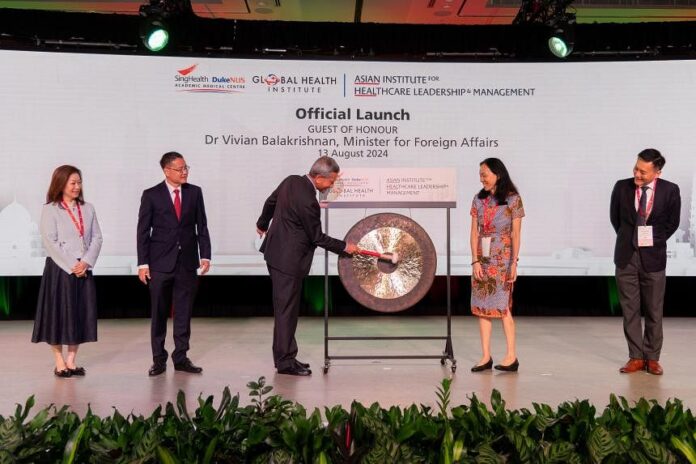

SINGAPORE – The challenges of managing healthcare operations in Asia are the focus of a new institute launched in the Republic on Aug 13.
The Asian Institute for Healthcare Leadership and Management (Asian HEAL) will adopt a “for Asia, by Asia” approach to raise the standard of healthcare management in this part of the world and pave the way for future leaders in the industry around Asia.
It provides a platform for healthcare professionals in Asian countries to share their experiences and learn from one another.
For example, developed countries such as Singapore can study developing countries where limited resources led the healthcare professionals there to think out of the box for alternative solutions to challenges.
The institute will also be launching a master’s programme that focuses on both experience-based and practice-based learning.
The part-time programme will cover critical areas such as risk management and disease preparedness, and health informatics and digital transformation.
Running between 15 and 18 months, it allows for regional site visits to hospitals, giving learners real-life examples of models of care and health systems in Asia.
Asian HEAL will also offer customised programmes for organisations to address specific health system management issues. It will engage the organisations to understand their needs and design a relevant syllabus for them.
The customised programmes already have participants from many countries in Asia, the institute said.
Asian HEAL, established under the SingHealth Duke-NUS Global Health Institute (SDGHI), was launched by Foreign Minister Vivian Balakhrishnan at the Singapore Healthcare Management Conference 2024.
In his speech, Dr Balakrishnan, an ophthalmologist by training and a former chief executive of the Singapore General Hospital, said there are three fundamental challenges confronting healthcare management: management during a crisis, such as the Covid-19 pandemic; the challenge relating to cost effectiveness, safety, reliability, and resilience; and the impact of developments in other fields on healthcare.
“Healthcare doesn’t exist in isolation… Fundamental advances in genomics, the potential for editing, the prospects for individualised, tailor-made, customised medicine, will transform the way we deliver health. All of these things, if not properly managed, come with an enormous price tag,” he said.
To address these challenges requires “management, assembling pieces together, assembling the team, organising the incentives and disincentives, and making sure outcomes are obvious and people are accountable”.
When this is done, he added, “the (advances) in information science and in engineering will percolate into healthcare”, he said.