
 Download


RAFU STAFF REPORT
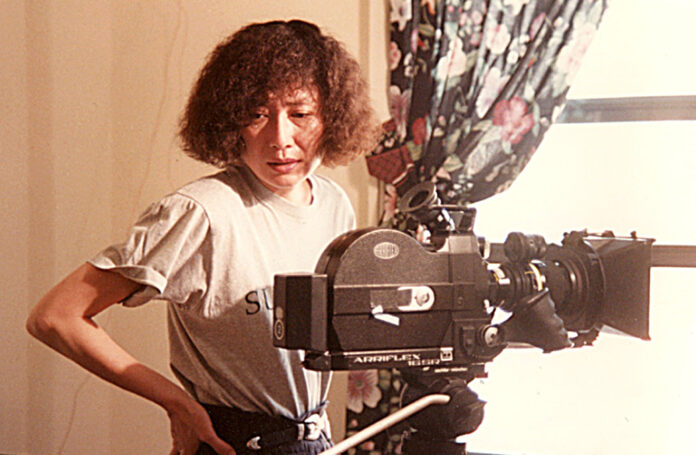
NEW YORK — Acclaimed documentary filmmaker Christine Choy, an Academy Award nominee for “Who Killed Vincent Chin?,” died on Dec. 7 at the age of 73.
Starting in the 1970s, Choy produced and directed about 70 works in various forms, receiving over 60 international awards.
Born in Shanghai as Chai Ming Huei to a Korean father and a Chinese mother, she left China, moved to South Korea, and at age 14 moved to New York City, where she got involved with the local chapter of the Black Panther Party. She studied architecture at Manhattanville College of the Sacred Heart, worked as an editor and animation director at Newsreel, and earned a directing certificate at the American Film Institute.
In 1972, she co-founded Third World Newsreel with filmmaker Susan Robeson. Choy directed documentaries on the 1971 Attica prison uprising, the life of women in U.S. prisons, and Namibia’s struggle for independence from South Africa. “From Spikes to Spindles” (1976) focused on Chinese migration and Chinese Americans’ struggle for equal treatment.
In 1975, Choy co-founded Asian Cine Vision with Peter Chow, Danny Yung and Thomas Tam. Initially focusing on Chinatown, the organization launched the Asian American International Film Festival in 1978.
Her other documentaries include “Bittersweet Survival: Southeast Asian Refugees America” (1982); “Mississippi Triangle” (1984), a look at Chinese American, African American and white communities in the Mississippi Delta; “Homes Apart: Korea” (1991), co-directed by J.T. Takagi, an examination of the devastating human cost of the Korean War, which suddenly and forcibly divided the nation in two in 1953; and “Sa-I-Gu” (1993), which shows the impact of the 1992 L.A. riots on the Korean American community. Choy revisited the latter topic with “Rodney King: Koreatown Reacts” (2016).
Choy and Spiro Lampros co-directed “The Shot Heard ’Round the World” (1997), a documentary about the 1992 death of Japanese exchange student Yoshihiro Hattori. The 16-year-old was on his way to a Halloween party but mistakenly went to the wrong house and was shot by the homeowner. The case made headlines in Japan and prompted an apology from President Bill Clinton and a campaign for stronger gun-control laws. The film won the Jury Award at the Bangkok Film Festival.
“In the Name of the Emperor” (1998), co-directed by Choy and Nancy Tong, was a documentary about the 1937 Rape of Nanjing, in which over 300,000 Chinese civilians were massacred by the Japanese military.
In “Electric Shadows” (1998), Choy draws fascinating insights from Asian directors making films in the ’90s, including Wong Kar-Wai, Ang Lee, Zhang Yimou, Tony Chan, Wayne Wang and John Woo.
Choy directed “Long Story Short” (2008), the story of Larry and Trudie Kimiye Long, a popular Asian American nightclub act of the ’40s and ’50s, told through the eyes of their daughter, actress Jodi Long. The film won the Audience Award and Honorable Mention for Documentary Feature at the Los Angeles Asian Pacific Film Festival.
Choy was a full-time professor at New York University’s Tisch School of the Arts, where mentored young auteurs and students at NYU and Third World Newsreel.
Dean Rubén Polendo called her “a triumphant force in documentary filmmaking whose works penetrated America’s social conscience.”
Vincent Chin’s Story
Choy and Renee Tajima-Peña co-directed “Who Killed Vincent Chin?” (1987), which focused on the murder of a 27-year-old Chinese American in the Detroit area in 1982, when Japanese imports were being blamed for the decline of the U.S. auto industry. The assailants, Chrysler plant supervisor Ronald Ebens and his stepson, laid-off auto worker Michael Nitz, were sentenced to probation and a fine.
The light sentence sparked outrage in Asian American communities across the country and led to a “Justice for Vincent Chin” movement, which resulted in federal civil rights charges. Nitz was acquitted but Ebens was convicted on one count. However, the conviction was overturned on appeal.
Choy and Tajima-Peña worked on the film for four years, interviewing almost everyone involved in the case, including Chin’s mother Lily and Ebens. While interviewing the killer was not easy, the filmmakers did not want a lopsided account. “Journalistically, we stand behind the film 100 percent,” Tajima-Peña said at the time. Nitz declined to be interviewed, as did Chin’s fiancee and two of the three friends who were with him that fateful night.
In addition to the Oscar nomination, “Who Killed Vincent Chin?” won Best Documentary at the Hawaii International Film Festival, the IDA Award from the International Documentary Association, and the Peabody Award; was named to the National Film Registry by the National Film Preservation Board; and was nominated for the Grand Jury Prize at the Sundance Film Festival.
Choy wrote and Tajima-Peña directed “Permanent Wave” (1986), a dramatic short about sexual harassment in the workplace.
Choy, Tajima-Peña and Jeff Bartz co-directed “The Best Hotel on Skid Row” (1990), which focused on some of the desperate people living at the Madison Hotel in L.A.’s Skid Row. The documentary received the Un Certain Regard Award at the Cannes Film Festival and was nominated for a Cable ACE Award.
Choy was one of the cinematographers for Tajima-Peña’s documentary “My America … or Honk If You Love Buddha” (1997). Interviewees included activists Yuri and Bill Kochiyama and actor Victor Wong. The film won the Cinematography Award at the Sundance Film Festival.
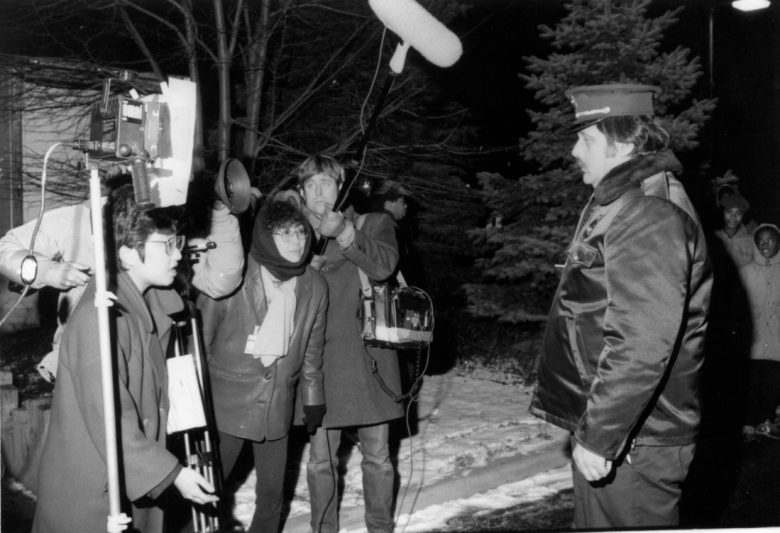
Renee Tajima-Peña, Christine Choy and their crew during an interview with a police officer who witnessed the fatal attack on Vincent Chin.
Filmmaker’s Memories
Tajima-Peña recalled, “I first met Chris after graduating from college, when I got involved in the emerging Asian American independent filmmaking scene in New York. I worked with her at the Third World Newsreel film collective — Chris was one of the OGs there that also included her husband at the time, Allan Siegel, the filmmakers/film activists Pearl Bowser, J.T. Takagi, Ada Griffin, Nancy Tong and others.
“One day in 1983 I got a mailing from the historian Jack Tchen (who was a co-founder of what is now the Museum of Chinese Americans-NY). Inside there was a mimeograph of a newspaper clipping about a murder in Detroit. It was the Vincent Chin story, and local Asian Americans there who were outraged at Ron Ebens and Mike Nitz’s light penalties were mounting a national Justice for Vincent Chin campaign. Chris and I decided to make a film about the case.
“‘Who Killed Vincent Chin?’ was rooted in that ethos of collaboration of independent filmmaking collectives like TWN. WTVS-Detroit Public Television’s Juanita Anderson was our executive producer, me and Chris produced and directed, Nancy Tong conducted all the Chinese-language interviews with Vincent’s mother Lily Chin and the Chinatown community. JT was our sound recordist. We were like a filmmaking ecosystem.
“We were in constant motion during the production with Chris always the picture of cool — sunglasses, cigarette in hand. She was brash and outspoken — her cigarettes may have had filters but her language didn’t. But her audaciousness was all a part of the package. We’d all bond over freezing winter nights waiting in rental cars for witnesses to come out to talk to us and warm evenings over Lily Chin’s home-cooked Toison dinners.
“This was long before the streamer era and documentary filmmakers with Hollywood agents. We were idealistic — making ‘Who Killed Vincent Chin?’ was a search for truth and justice. JT is still at TWN as executive director and eventually we all went our own way, but I’ll always remember Chris from those days.”
Praise from Media Groups
Detroit PBS: “Her artistry and craft undergird ‘Who Killed Vincent Chin?,’ the Detroit PBS co-produced documentary that chronicled how Asian American communities became galvanized in the aftermath of Vincent Chin’s death.
“In 1988, ‘Who Killed Vincent Chin?’ was nominated for an Academy Award. In 2021, the film was inducted into the Library of Congress National Film Registry, and the following year, the 40th anniversary of Chin’s death, POV rebroadcast the documentary.
“To mark the occasion, Detroit PBS produced its own look back at this key moment in Asian American history. In the video, filmmakers Choy and Renee Tajima-Peña, along with the film’s executive producer, Juanita Anderson of Detroit PBS, told the story of making the documentary.
“To interview Choy, One Detroit Senior Producer Bill Kubota and Detroit-area filmmaker Chien-An Yuan visited her in New York, where she recounted her experience making the film and its place in American history.”
During that interview, Choy reflected on the impact of the film decades later and her role in bringing it to life: “It became part of the syllabus for a lot of Asian American studies from high school all the way to college. I’m very glad … to contribute to the history of America.”
P.O.V.: “A fearless storyteller and pioneering voice in Asian American cinema, Christine dedicated her life to illuminating injustice, uplifting unheard communities, and pushing the boundaries of nonfiction filmmaking. Her work continues to inspire generations of filmmakers, activists, and viewers.
“We extend our heartfelt condolences to her family, friends, students, and the many artists whose lives she shaped. Thank you, Christine, for your vision, courage, and uncompromising truth.”
Jeff Yang, Wall Street Journal columnist, author of “The Golden Screen: The Movies That Made Asian America”: “Every time I saw Christine Choy, she yelled at me — shouting praise, criticism, advice, advocacy; abjuring, exhorting, complaining, exulting. She always lived life with the dial turned to 11. It was bracing and intimidating to face her, but in the times I had the chance to do so — while working at Asian CineVision, writing at the Village Voice, and running A. magazine — I learned a helluva lot.
“Rest in passion, Christine Choy. You will not be soon forgotten and your voice will continue to carry.”
Center for Asian American Media: “A founding mother of Asian American cinema, Christine was one of the filmmakers at the 1980 National Conference of Asian Pacific Producers in Public Broadcasting, which spurred the creation of the organization that became CAAM.”
Asian Americans Advancing Justice: “We are saddened to hear of the passing of the prolific and deeply influential documentary filmmaker Christine Choy on Dec. 7. The award-winning film “Who Killed Vincent Chin?,” which she co-directed with Renée Tajima-Peña, reshaped the national conversation on anti-Asian hate and civil rights and highlighted the strength and resilience of the Asian American community that rose up in the wake of Vincent Chin’s killing.”
Third World Newsreel: “As one of our founders and a member of the Newsreel collective, she was a prolific filmmaker who made significant films that helped form our Asian American and American film history.
“Her films include ‘From Spikes to Spindles’ about NYC Chinatown and Chinese immigration history; ‘Teach Our Children’ about the Attica Rebellion; ‘Mississippi Triangle’ about Black, Chinese and white relations in the Delta; and later, the seminal ‘Who Killed Vincent Chin?,’ among many others.
“Highly creative, outspoken, and controversial, she mentored many filmmakers as a film professor and helped to build Third World Newsreel into a center for social justice media.”