
 Download

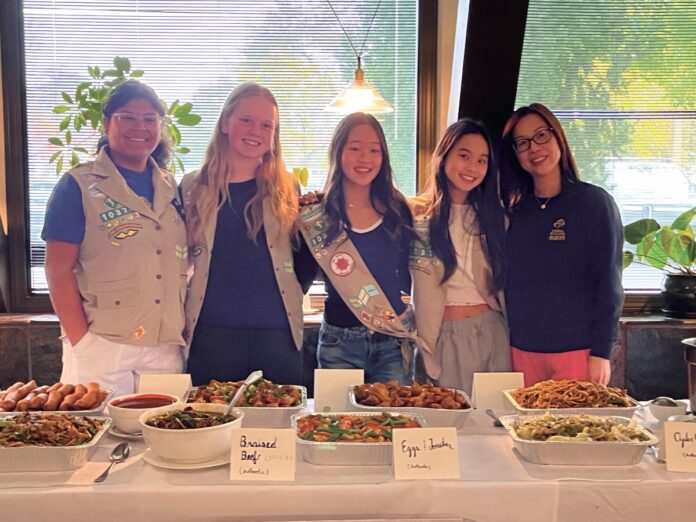

Many popular dishes found at Chinese restaurants in the Western world aren’t authentic Chinese cuisine at all. Egg rolls, orange chicken, fortune cookies and more actually originated in America.
Of the “inauthentic” foods, fortune cookies have the most storied history. A Japanese immigrant in San Francisco and a Chinese immigrant in Los Angeles both laid claim to inventing the treat in California in the early 1900s.
While that dispute was never officially resolved, it is known that through the decades innovative Chinese American chefs developed recipes for sweet and fried foods, such as orange chicken and egg rolls, to appeal to American palates. Ditto for General Tso’s chicken and crab Rangoon, rich fried wontons filled with crab and cream cheese.
Authentic Chinese food typically has stronger, spicier flavors, according to 12-year-old Yilin Cai, one of four local Girl Scouts who delved tastebuds first into the authentic versus inauthentic Chinese cuisine topic. Yilin’s sister, Molin Cai, 14, says examples of authentic dishes include dim sum from the Guangdong region; hong shao rou, a pork belly dish from the Hunan province; and braised beef from the province of Sichuan.
The sisters teamed up with two other Girl Scout Cadettes from Troop 10374, Riley Bakken, 13, and Karen Gonzalez, 13, to turn Chinese food into a project for their Girl Scout Silver Award, the top honor for their age group. After brainstorming about project parameters, they gained the support of their troop leader, Janine Coleman. Then they made a formal in-person presentation to the Girl Scout Council.
Not surprisingly, the council gave a nod to the group, allowing them to move forward with the project. Each of the girls—middle schoolers at Novato Charter School—has now spent the requisite 50 hours learning about Chinese cuisine and culture and implementing a plan to make an impact in their community with the information.
What made them want to spend dozens of hours evaluating the authenticity of Chinese food? It all boiled down to sharing awareness about Chinese cuisine specifically and culture in general, while dispelling some common misconceptions.
“I thought it was a very important project because during school, I asked people what their favorite Chinese food was and they were like, ‘I love orange chicken,’” Yilin said. “It isn’t even an actual authentic Chinese food, and I would like to bring this awareness to our community.”
Through their research, the girls discovered that Chinese American restaurateurs, seeking to make their businesses more successful in the United States, needed new recipes. Americans weren’t used to the strong and unique traditional Chinese flavors.
Novato’s China Palace Restaurant, which provided support as a community partner for the girls’ project, serves both authentic and inauthentic Chinese dishes. Wen Mo and her family have owned the restaurant since 2003, and she played a substantial role in helping the Girl Scouts understand the significance of menu items.
“What we noticed in working with a Chinese restaurant for this project has been really helpful,” Molin said. “This aspect, where they’ve just had to change the flavors and adapt the dishes to something that fits more to the American taste, is cultural information.”
After Molin, Yilin, Riley and Karen learned about why and how Chinese American cuisine evolved, they entered the next phase of their project, which centered on educating the community about it. Again, Mo and China Palace were key to the process.
First, Karen printed and posted flyers in Novato, inviting the community to a luncheon at China Palace. Last month, the girls hosted 30 community members for a buffet of five authentic and five inauthentic dishes prepared by Mo and her staff. The authentic cuisine included beef chow fun, chicken egg corn soup, eggs and tomatoes, braised beef and oyster oil lettuce. On the inauthentic side of the table, diners found sour spicy soup, chow mein, orange chicken, braised tofu with vegetables and egg rolls.

Before the food was brought out, the Girl Scouts explained their project’s importance to the guests. Authentic cuisine has a cultural connection, reflecting history, traditions and lifestyle. The dishes provide a balance of flavors, along with distinctive tastes. Recipes are passed down through generations.
Americanized Chinese food has been adapted to regional tastes, with the dishes often designed for easier preparation and commercialized mass production. Inauthentic dishes can weaken cultural roots by breaking the connection of traditional ingredients and flavors. The evolving recipes may also fail to accurately represent the culture.
They encouraged the diners to sample the 10 dishes, take note of the different flavors and participate in a survey after the meal. The crowd took heed, devouring the lunch and a special serving of homemade pot stickers, another traditional food. China Palace’s Mo and the Girl Scouts received continual praise for the delicious food and insightful information.
With everyone’s appetites sated, the girls handed out the experience questionnaire. Participants were asked whether the project helped them learn more about authentic food and cultural awareness. All responded “yes.” And everyone agreed that they would like to attend a similar event in the future.
The survey also asked diners which dish they enjoyed the most and which authentic dish was their favorite. Drum roll, please. Braised beef and oyster oil lettuce were crowd favorites, both dishes from the authentic category. Oyster oil lettuce was such a hit that China Palace will soon add it to their regular menu.
Indeed, the Girl Scouts achieved their project goal of helping people recognize and appreciate authentic Chinese food and culture. Bravo.
“It feels good to educate people on what food is authentic,” scout Riley said.
The Silver Award decision is pending. But with the girls’ enthusiasm, subject expertise and professionalism, they’re well on their way to attaining the highest honor for Girl Scout Cadettes.