
 Download


Hello, welcome to Politics Insider. Let’s look at what happened today.
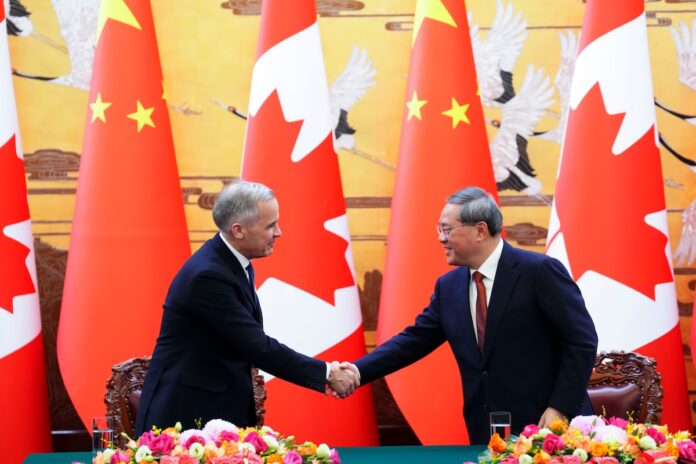
Prime Minister Mark Carney’s government said today it would welcome more Chinese investment in Canadian energy, including the oil sands, during a visit to Beijing that the Asian giant’s Premier called a “new starting point” for bilateral relations.
Carney is on his first trip to China as Prime Minister. Steven Chase reports that Carney, in search of more investment and markets for Canada to offset damage done by U.S. protectionist tariffs, released a blueprint for warmer and closer relations with Beijing.
In a joint announcement with the Chinese government, Canada said it will welcome Chinese investments in Canada in areas including energy, agriculture and consumer products as part of a joint “economic and trade co-operation road map.”
Ottawa and Beijing also signed a memorandum of understanding on “strengthening energy co-operation,” a deal that follows rising petroleum exports to China from Canada. China’s PetroChina received delivery of liquefied natural gas from Canada’s first LNG export facility in 2025 and Chinese buyers have ramped up purchases of Canadian oil over the past year.
In other news, Foreign Affairs Minister Anita Anand has confirmed today that a Canadian has died at the hands of the authorities in Iran.
Marie Woolf reports that as public protests against the theocratic regime continued, Anand, who is in China, said on X that she had just learned about the death.
Global Affairs declined to give further details about the circumstances of the Canadian’s death, citing privacy reasons.
But in a post, Anand said, “I have just learned that a Canadian citizen has died in Iran at the hands of the Iranian authorities. Our consular officials are in contact with the victim’s family in Canada and my deepest condolences are with them at this time.”
Thousands of Iranians have taken to the streets and have faced a violent crackdown in response, with at least 2,500 protesters killed, according to U.S.-based Human Rights Activists News Agency.
Prime Minister Mark Carney and Premier of China Li Qiang shake hands following a signing ceremony at the Great Hall of the People in Beijing, China, on Thursday.Sean Kilpatrick/The Canadian Press
What else is going on
Canada’s privacy watchdog expands probe into X over Grok’s sexualized deepfakes: The investigation by the Privacy Commissioner will include an examination of whether X’s parent company, X Corp, is meeting its obligations under Canada’s federal privacy laws.
Ottawa investing up to US$65-million in B.C.-based company’s critical-minerals push: The support is going to lithium processing company Mangrove Water Technologies Ltd. as part of federal efforts to bolster Canada’s critical-minerals capabilities as it fights back against China’s dominance.
B.C. ending drug decriminalization pilot program: Health Minister Josie Osborne says the province will not be applying to Health Canada to extend its exemption from the federal Controlled Drugs and Substances Act, which expires Jan. 31.
Home sales fell in December: Canada’s residential real estate sales dropped sharply in December, ending a tepid year for the housing market when many buyers stayed on the sidelines.
On our radar
Prime Minister’s Day: In Beijing, Mark Carney met with Zhao Leji, chairman of the standing committee of the National People’s Congress of China, then attended an official welcoming ceremony at the Great Hall of the People. Carney then met with China’s Premier, Li Qiang, and witnessed a signing ceremony. In the evening, Carney attended an official dinner held by Premier Li Qiang.
Party Leaders: In British Columbia, Green Party Leader Elizabeth May spoke to the Mayne Island Assisted Living Society and, in the evening, held a community meeting on Mayne Island. No schedules released for other party leaders.
Ministers on the Road: In St. John’s, Environment Minister Julie Dabrusin made an announcement on strengthening climate resilience. Veterans Affairs Minister Jill McKnight, on behalf of Finance Minister François-Philippe Champagne, announced support for a clean economy in the British Columbia city of Delta.
New chief of staff for Eby: Cheryl Oates, who was a chief communications director for former Alberta premier Rachel Notley, is to serve as acting chief of staff for B.C. Premier David Eby, according to a statement from the B.C. government. Oates, a provincial campaign director for the NDP in the 2024 Saskatchewan provincial election, is replacing Jim Rutkowski, Eby’s chief of staff since 2024, who is taking a leave for medical treatment after a recent cancer diagnosis. Rutkowski was previously Notley’s principal secretary.
Black in BC Conservative leadership race: Former B.C labour minister Iain Black has today entered the race to lead the provincial Conservatives. Black, who also served as the president and CEO of the Greater Vancouver Board of Trade, joins a field that includes political commentator Caroline Elliott, businessman Yuri Fulmer and BC Conservative MLA Sheldon Clare.
Quotes of the Day
“Standing on a new starting point, China is ready to work with Canada to increase dialogue and communication, enhance political mutual trust, expand practical co-operation, work for more new outcomes so as to add more vigor for the growth of our two countries.” – Li Qiang, the Premier of China, speaks to Prime Minister Mark Carney, as the pair begin talks during a working session in Beijing today.
“We’ve been clear eyed. We’re eyes wide open. We know this. But there has been investments by Canadian companies for years here.” – Industry Minister Mélanie Joly, in Beijing today, responds to a question from a Canadian reporter about concerns, in Canada, on whether China is the right kind of partner for Canadian industry. The questioner noted that Canadian journalists in China are using burner phones because China spies on journalists and businessmen.
Question period
“I have often regretted, Mr. Speaker, and never more than on the present occasion, that we are living beside a great neighbour who, I believe I can say without being deemed unfriendly to them, are very grasping in their national acts and who are determined upon every occasion to get the best in any agreement which they make.” Who, referring to Canada’s relationship with the United States, made this comment?
Scroll to the bottom of this newsletter for the answer.
Perspectives
How Canada can use China to deliver a counterpunch to Trump
Canada needs a trade deal with the U.S. that we can live with, letting us refocus on the even harder tasks of building the domestic economy and expanding trade globally. Mr. Trump refuses to accept that Canada has anything to offer. An EV deal with China can only work on its own terms. But it might also make Mr. Trump pay more attention to the world as it is.
— Drew Fagan is a professor at the University of Toronto and a visiting professor at Yale University.
François Legault set out to bridge Quebec’s divides. He ended up widening them
While almost all popular premiers eventually become unpopular as the wear and tear of power takes its toll, Mr. Legault’s downfall remains one of the most spectacular such slides in recent Canadian political history, surpassing even Justin Trudeau’s fall from grace. Mr. Trudeau’s popularity never rose to the heights that Mr. Legault’s once did, when his folksy style captured the hearts of Quebeckers.
— Konrad Yakabuski, Columnist
What cost-of-living crisis? The data tell a different story
So the cost-of-living crisis may just be a perception crisis, fuelled by a global slowdown in standard-of-living growth and the worldwide increase in time spent on social media. Governments can help with the former by trying to boost productivity and workers’ bargaining power, but there will be a very long lag and there’s no guarantee they know what to do.
— Claude Lavoie is a contributing columnist for The Globe and Mail. He was director-general of economic studies and policy analysis at the Department of Finance from 2008 to 2023.
Go deeper
Got a news tip that you’d like us to look into? E-mail us at tips@globeandmail.com. Need to share documents securely? Reach out via SecureDrop.
The answer to today’s question: Sir Wilfrid Laurier, prime minister of Canada between 1896 and 1911, speaking in October, 1903 after arbitration to resolve a border dispute went in favour of the United States.