
 Download

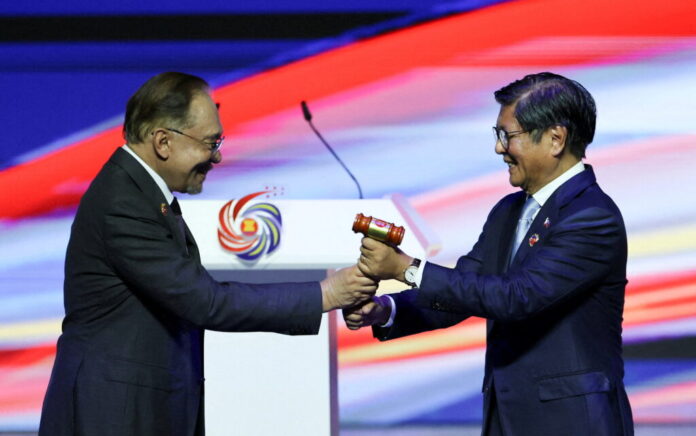

A cliche of Southeast Asia’s political landscape is that it is defined by diversity. As 2026 gets under way, domestic political trends in major states seem bound to complicate efforts to institutionalise regional commitments to cooperate in grappling with the huge, shared challenges that their eleven-member Association of Southeast Asian Nations, ASEAN, now confronts globally.
In the first of our two lead articles this week — that continues our series of looking back at the events of 2025 and the outlook for 2026 — James Chin surveys the state of Malaysian politics as parties position for an election tipped for late 2026 or early 2027.
Prime Minister Anwar Ibrahim has defied the predictions of his political precarity made after he assembled a thin majority following the November 2022 elections. His troubles are now less to do with coalition maintenance and more to do with keeping the Malaysian public happy at a time of governance and economic problems.
‘Corruption scandals remain the most corrosive trend, eroding public trust and straining the unity government’s cohesion’, as Anwar is accused by critics of using anti-corruption prosecutions as a tool to discipline his own coalition and harass members of the opposition. Malaysia’s relationship with China is being increasingly politicised as a surge of Chinese investment is painted by Anwar’s Islamic and Malay chauvinist opposition as signifying the prime minister’s alignment with ethnic Chinese interests.
‘Most of the unemployed are Malay youth, an important segment of the voting polity. If growth falters amid global risks like US tariffs or commodity volatility, public discontent could surge, pressuring Anwar to call the election early,’ says Chin.
The upshot is that Anwar’s tendency to view foreign policy with an eye firmly on domestic politics will only intensify, constraining his room for manoeuvre on issues that touch on economic and political ties with China and the United States alike.
The uncertain outlook for Anwar’s Pakatan Harapan coalition in the upcoming polls raises the question of how Malaysia’s regional role might evolve under a federal government led by or including the biggest opposition party, the Islamist PAS.
Meanwhile, as the Philippines takes over as ASEAN chair from Malaysia, President Ferdinand ‘Bongbong’ Marcos faces a potential descent into lame-duck status due to the growing threat of a Duterte restoration — a prospect that has frozen major policy initiatives and created new uncertainty about the country’s democratic trajectory.
While Marcos has proven a more benign custodian of the Philippines’ democratic system than his liberal critics feared ahead of the election in 2022, his efforts to sideline the Dutertes seem to have totally backfired. After their electoral alliance for the 2022 polls collapsed during his first few years in office, Marcos moved against the Dutertes, most notably by allowing the former president Rodrigo Duterte to be arrested by the International Criminal Court. Instead of weakening the Dutertes, this generated a wave of public sympathy for them. Meanwhile, major corruption scandals continue to tarnish the Marcos government’s popularity.
As Marcos’ estranged vice president Sara Duterte positions herself as a frontrunner in the 2028 presidential election race, ‘it is the Marcos clan, rather than the Duterte dynasty, that stands accused in the court of public opinion’, writes Mark Thompson in the second of this week’s lead articles.
‘Marcos’ promises to uphold civil liberties and improve government accountability appear to hold limited discursive power against resurgent illiberal populism, fuelled by grievance and the allure of punitive leadership,’ writes Thompson.
There are cautious hopes that the Philippines will use its year as ASEAN chair to mobilise regional cooperation as a hedge against the increasingly doubtful value of its traditional alliance relationship with the United States and its periodically strained relationships with China. But any efforts by the Marcos government to institutionalise a deeper Philippine engagement with ASEAN-centred processes are likely to be hostage to a Duterte restoration in 2028, and with it the return to the madcap bilateralism that marked Rodrigo Duterte’s presidency.
Thailand’s election, meanwhile, looks set to sustain rather than resolve the profound schism in that country’s polity. The conservative establishment remains determined to deny the progressive Move Forward Party a chance at forming a government despite a strong showing in the elections on 8 February 2026. By the next time Thailand chairs ASEAN, there is a non-trivial chance that the country will be either wracked again by popular unrest, or under the rule of a junta, or both.
The uncertain political outlook across the region only underlines the importance of Indonesia supplying the steady leadership that emerges from an institutionalised commitment in Jakarta to regional cooperation through ASEAN.
Like everything else in Indonesia these days, the foreign policy agenda is being steered by the personal passions and whims of its president Prabowo Subianto. Prabowo’s own preference for bilateralism has overwhelmed the local foreign policy establishment’s longstanding championing of ASEAN and commitment to multilateralism.
Prabowo’s ability to shift the foreign policy consensus toward his own personal priorities is a double-edged sword. It has resulted in needless and damaging engagement with Donald Trump’s profoundly problematic Board of Peace, sparking a backlash from the public and foreign policy experts.
But for Indonesia’s partners, the tractability of the Indonesian system when you get the president on side may pay dividends. This week saw the signing in Jakarta of a landmark new defence treaty between Indonesia and Australia that owes much to the investment of Australian diplomatic capital in the personal relationship with Prabowo. The deal is not universally greeted with enthusiasm within the Indonesian policy elite, but Prabowo’s dominance has made it a reality. For Australia now, the task is to work across its range of partnerships to institutionalise a deeper security relationship with Indonesia in a way that will see it outlast the personal goodwill towards Canberra that exists for the moment in the presidential palace.
Domestic political turmoil across Southeast Asia’s major states makes even more urgent efforts to institutionalise commitments to cooperate on the economic and security challenges that now confront the region.
The EAF Editorial Board is located in the Crawford School of Public Policy, College of Law, Policy and Governance, The Australian National University.