
 Download

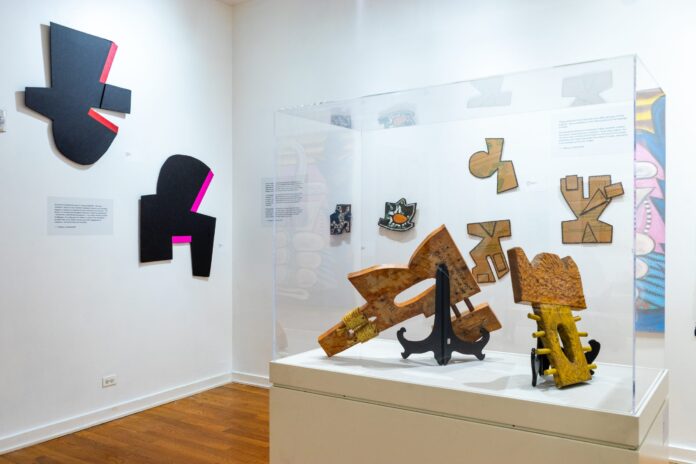

Other than their backgrounds and their eventual emigration to Chicago, artists Ruyell Ho and Li Lin Lee may seem to have little in common. Over a career spanning more than 60 years, the China-born Ho has worked across photography, painting, and sculpture, among other mediums. He works primarily in biomorphic abstraction, abstracted compositions that resemble living forms; his lines and shapes are bold and buoyant. Lee, born in Indonesia to Chinese parents, has worked in painting, printmaking, and collage over the past 40-plus years. His pictographic, dreamlike forms emerge intuitively, often in muted palettes. But in “Language of Abstraction,” on view at the Chinese American Museum of Chicago (CAMOC), curator Larry Lee makes the case for putting the artists’ work in conversation.
“Language of Abstraction”
Through 4/26/26: Wed and Fri 9:30 AM–5 PM, Sat–Sun 10 AM–5 PM, Chinese American Museum of Chicago, 238 W. 23rd St., camochicago.org/exhibition-archive/language-of-abstraction
“[I] just wanted to reintroduce both these artists who have been working without fail,” Lee said. The more he thought about their work, the more he realized that their shared background in language and “the tradition of the calligraphic” had a strong resonance. “For them, that probably stemmed from the fact that they were trained using a brush as not only a writing but painting tool,” he said.
Lee grew up near CAMOC’s current location and has a near-encyclopedic recall of Asian American artists and movements, particularly those with ties to Chicago. “We actually call Larry the cultural memory,” Caroline Ng, CAMOC’s executive director, told me.
Lee has long been inspired by both Ho and Lee’s work. “[I] was a little bit sad that people maybe didn’t have as much knowledge about their work, who they are, the contributions that both artists have made, and the influence and vice versa of their work on Chicago,” he said. “Language of Abstraction” sets out to change that.
The exhibition, installed on the museum’s first-floor gallery, is expansive but tight, offering important examples of both artists’ work alongside sketches, journals, videos, and timelines of their lives and careers.
Credit: Chinese American Museum of Chicago
Li Lin Lee was born in 1955. He moved to the U.S. in 1962, studying biochemistry at the University of Pittsburgh before eventually switching to art and settling in Chicago. Lee works in layers, adding and subtracting to his paintings, collaging materials together in his monoprints. He likes to work on a relatively small scale, so that the viewer can take in the whole composition at once.
A series of oil and mixed-media paintings on burlap, from the past six years, features geometric shapes on textured vertical rectangles executed in rich brown, deep purple, pale yellow, and muted greige. The Astronomy Lesson (undated) is in tune with Surrealism while feeling undoubtedly contemporary; in the left section of the painting, a blue orb hovers below a coral-like motif on a yellow background, while the right is cast in black, with striped UFO-like shapes partly in view.
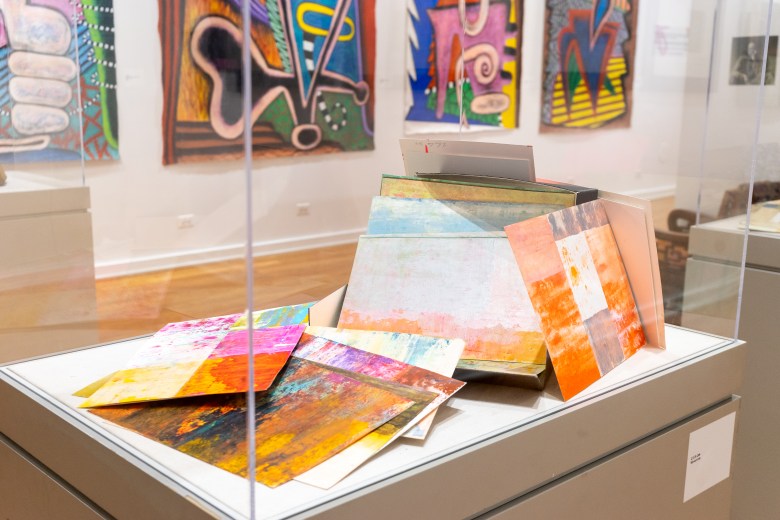
Samples of paintings, displayed in glass vitrines, that show Lee working in brighter shades—hot pink, aquamarine—could be studies for a 2025 series of monoprints, larger-scale works made by cutting out and stenciling over many sheets of Thai mulberry paper.
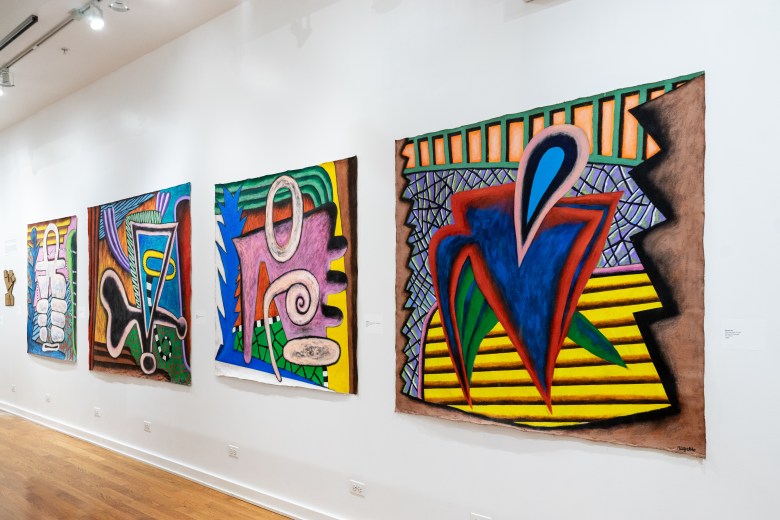
Across the gallery, Ruyell Ho’s well-defined nonrepresentational shapes appear to be in midmotion. A suite of four large-scale acrylic paintings, from the late 80s and early 90s, seems equally inspired by the Imagists and graffiti. In bright primary and secondary colors, Ho anthropomorphizes shapes into expressive, busy designs, like Memphis Milano furniture rendered flat.
I was particularly drawn to two wall-mounted acrylic on foamcore pieces from 2015, both large black shapes with red or pink accents. They are glyph-like but mysterious, as if playfully trying to communicate.
Credit: Chinese American Museum of Chicago
Ho was born in Shanghai in 1936. He moved to Chicago in 1960, taking art classes at the School of the Art Institute with Ray Yoshida, mentor to the students who would become the Chicago Imagists. In the mid-70s, Ho helped cofound Chicago Artists Coalition and in 2003 cofounded the long-running Artist Breakfast Group. His daughter, Amanda Ross-Ho, who is also an artist, is the archivist of her father’s work; her own work often draws from his life.
“Language of Abstraction” excels at establishing Ho and Lee’s importance in the Chicago art world. “We hope [this exhibition] will transform how the public sees the museum, from this sort of neighborhood, community-based legacy project . . . to something that looks forward,” Lee said.
He proposed the show to Ng shortly after she stepped into her role, almost two years ago. She quickly put the wheels in motion; everything came together in around six months, a very condensed time frame for such an extensive exhibition.
“This was something we really wanted to do because I think when people think contemporary art, they don’t think of Chinese people, and then when they see our gallery upstairs, they think, ‘Oh, it’s all new. It’s all young people.’ But it’s not new. Ruyell’s turning 90,” Ng said. “So for me, it’s exciting that we get to insert this into the Chinese American story and also the Chicago art lexicon.”
A small gallery on the museum’s fourth floor hosts the ongoing Spotlight Series, also curated by Lee, that features work by local emerging and mid-career artists of Chinese descent. Since its launch in 2022, the series has garnered critical praise, exhibiting notable artists such as Adrian Wong, Guanyu Xu, and Cathy Hsiao.
Credit: Chinese American Museum of Chicago
It can be a challenge to make the case for the inclusion of contemporary art in CAMOC’s schedule, Ng explained. Part of her job is to make their programming accessible to the local community and its ever-changing demographics. “[There is] this whole chance to expand the historical record in a layered way, to tell more stories,” she said. And while their new programming, like their Pride Month series, may not be for everyone, Ng is heartened by the response overall.
“I do think there’s a lot of opportunity, a lot of gaps to fill,” she said. “We still can contribute to the conversation from a particular point of view and open it up for more than what is expected. . . . People are looking for more, so how to make the space relevant? How to make these historical things matter?” After all, as Ng put it, “History is still happening.”
As a show by local, living artists who helped create Chicago’s cultural scene as we know it today, “Language of Abstraction” deftly presents stories that are both current and historically important. It also helps illustrate the museum’s mission to foster intergenerational dialogue on the Chinese American experience. While Ho and Lee have both spoken about their hesitation for their work to be labeled according to their ethnicity, their experiences nonetheless resonate across generations.
This reporting was supported by the Andy Warhol Foundation Arts Writers Grant.
Reader Recommends: ARTS & CULTURE
What’s now and what’s next in visual arts, architecture, literature, and more.
The artist, curator, and connector wants to build a more sustainable art ecosystem in Chicago.
Celebrating a decade of Western Pole at Patient Info
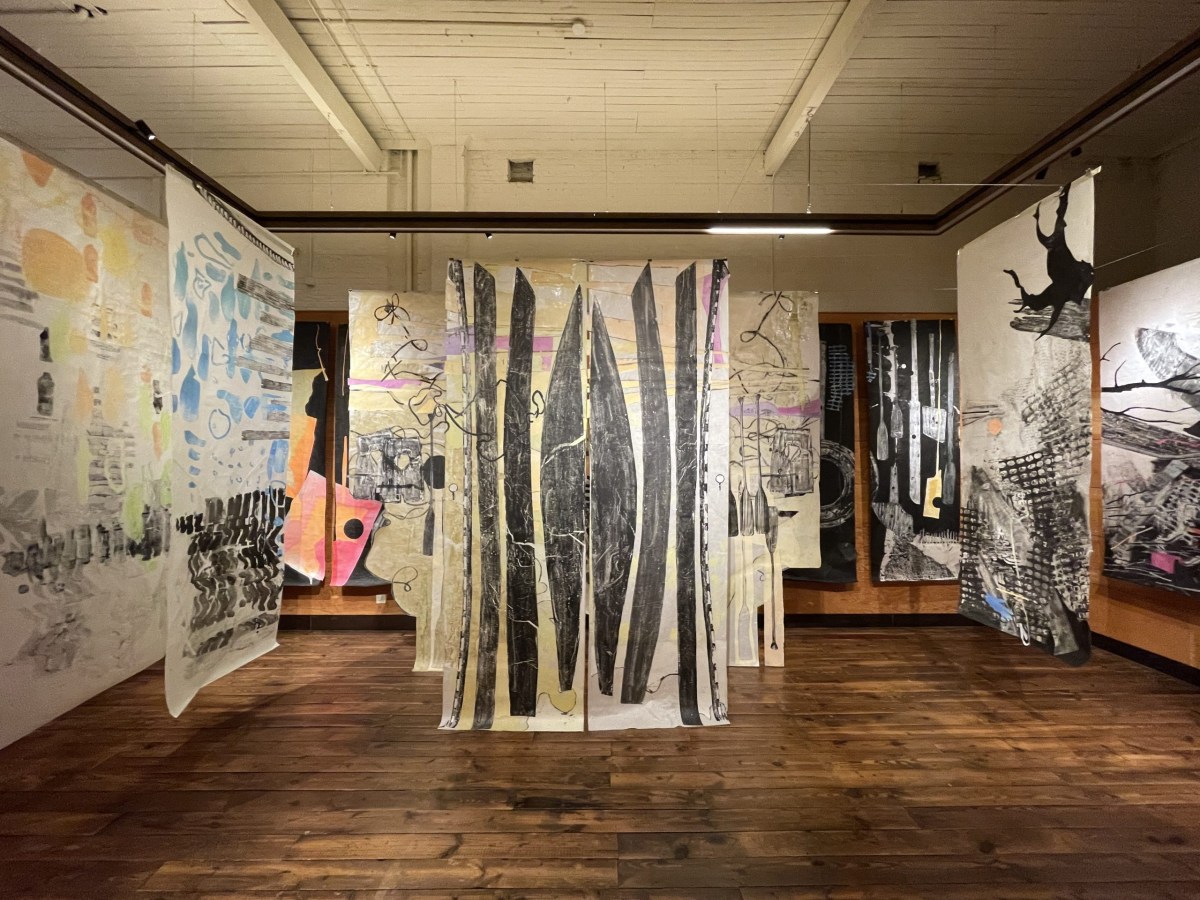
Marie Lorenz has spent 20 years removing debris from New York City’s waterways.
Historian Michael Rossi’s latest book draws eerie parallels with today’s social and political discourse.
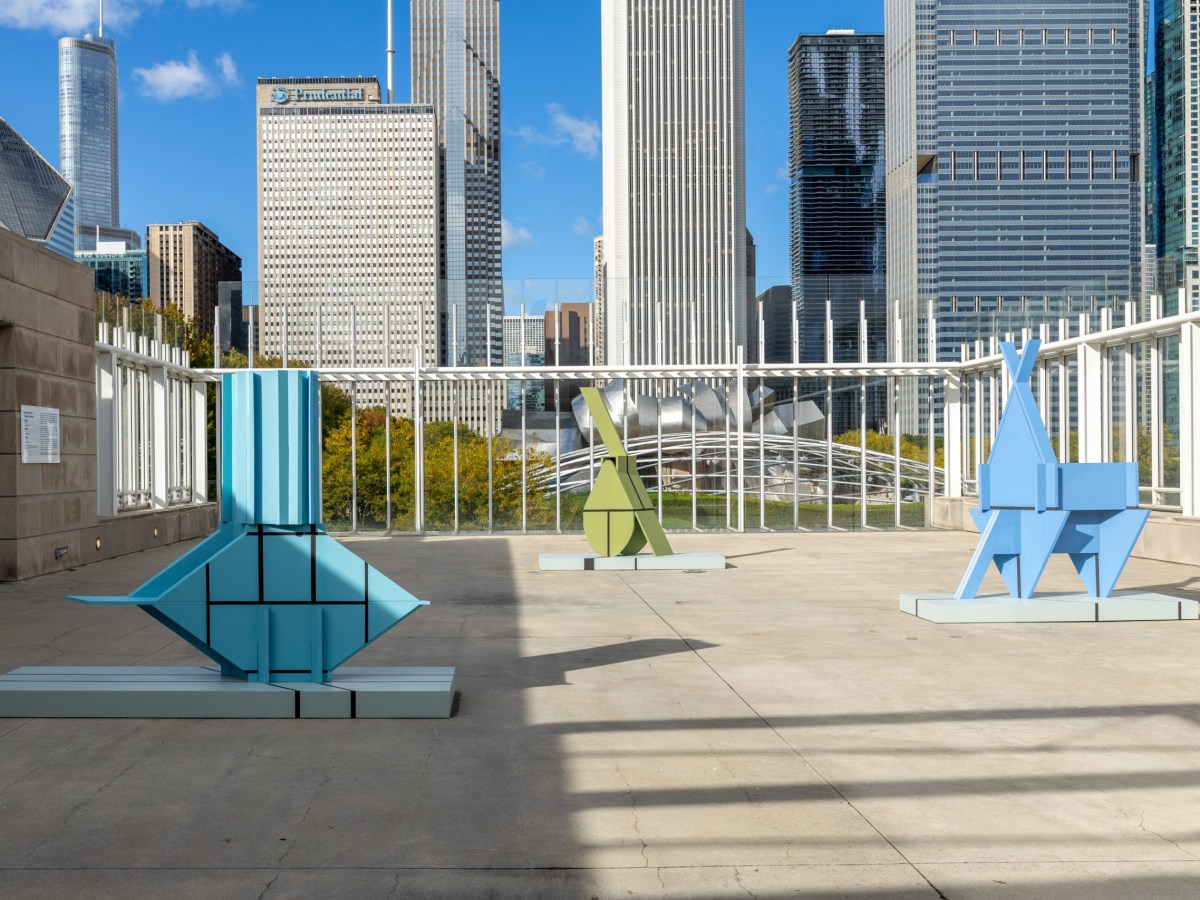
At the Art Institute of Chicago, Diane Simpson has built herself into the heart of the city.
For Yoko Ono, ideas visualized in our minds are the most important of all.