
 Download


When Juleigh Chin was on the campaign trail asking voters to elect her to the Nassau County Legislature, there had never been anyone on the chamber’s dais in Mineola who resembled her.
She ran in a newly drawn northwest district with the county’s largest Asian American population in her first bid for political office. She knew it would be a challenge to knock off the Republican incumbent. Although she did not win, she learned about the electorate there.
“Asians don’t necessarily fall along party lines. They might be registered as either a Democrat or a Republican or even a blank, but that doesn’t necessarily dictate the way that they will vote. They really do want to be inspired by a candidate,” said Chin, a first-generation American born to Korean immigrant parents. “They know what the cost of living is and they want to know they are getting the value for what they are paying.”
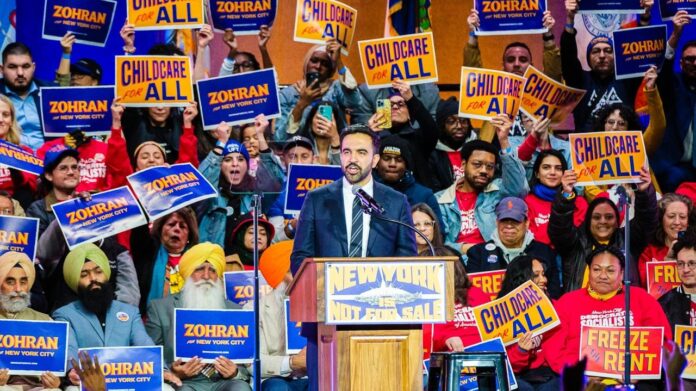
Meanwhile, New York City Mayor-elect Zohran Mamdani, an assemblyman and democratic socialist whose parents are Indian immigrants, tapped a well of Asian American — particularly South Asian — voters with a message of affordability. In many of the immigrant neighborhoods of Brooklyn and Queens, Mamdani won over voters who just a year earlier cast ballots for President Donald Trump and don’t regularly turn out in elections.
With Asian Americans among the fastest-growing group of newly enrolled voters, they are becoming a rising political force, election research and exit polling suggest. In contrast to the “party faithful” who turn out for most election cycles, Asian Americans often have been described as “low propensity.” These voters are eligible to cast ballots but might miss a primary, local election or even skip a national general election or two. Campaigns, however, are increasingly engaging them — similar to reaching out to nonaffiliated voters — because they can be crucial in closely contested races.
Coming off Mamdani’s win, and heading into the 2026 congressional and state elections, these voters and donors could become more important, experts say.
“It’s only more recently that some campaigns are finally wising up and saying, ‘Hey, we can actually win if we bring in and also engage voters who have typically not been reached out to,’ ” said Christine Chen, co-founder and executive director of Asian Pacific Islander American Vote, APIA Vote, a nonpartisan organization based in Washington, D.C., aims to educate and empower the Asian American electorate by working with various community groups nationally.
In a nonpartisan, multilingual exit poll of this year’s New York City election, nearly half of Asian American voters said they voted for Mamdani. The economy was the top issue influencing them in this year’s election. Those who were South Asian overwhelmingly supported Mamdani at 87.2%, according to the poll released in November by the Asian American Legal Defense and Education Fund and the Asian American Federation.
One in 5 Asian American voters who cast ballots for Trump in 2024 voted for Mamdani this year, according to the same poll.
‘Toughest time’
Chen, who has been working in this field for more than 30 years, said Asian Americans always have had “the toughest time winning elections” and attracting candidates regardless of ethnicity, whether they were Chinese, Korean or Indian; to consider running was even tougher.
She said among the more pivotal moments for Asian American politics in New York was the 2012 election of Rep. Grace Meng, who represents central and eastern Queens. Meng, in her seventh term, is the first and only Asian American U.S. House member from New York and her district neighbors that of Rep. Tom Suozzi (D-Glen Cove).
“Folks are inspired because now they know they can actually win,” Chen said.
The growth over the last two decades in population and voter registration will soon make it tough for both major political parties to ignore the demographic, she said, whether that means choosing candidates of Asian heritage or not. Non-Asian candidates benefit from being more proactive in outreach and sustained involvement in Asian American communities, including those with low English-language proficiency, Chen said.
Lots of eligible voters
In addition to voter registration efforts by nonprofits and advocacy groups, some of the gains can be attributed to the natural course of an immigration wave: those emigrating from Asia becoming U.S. citizens and the American-born children coming of age, experts say.
In January 2024, a Pew Research Center study projected 15 million Asian Americans would be eligible to vote. For two decades , this population was the fastest-growing segment of eligible voters out of the major racial and ethnic groups in the United States, researchers found.
From 2020 to 2024, the number of eligible voters grew by 15%, or about 2 million, faster than the 3% growth rate for all eligible voters during that span and the 12% for Hispanic eligible voters, who can be of any race. More Asian American voters are naturalized citizens and are more likely to hold a bachelor’s degree than the overall voting population, according to the report.
On Long Island, Suozzi’s 3rd Congressional District has the highest Asian population by far when compared with the Island’s other three congressional districts. Of the 775,000 residents counted in the U.S. Census 2024 American Community Survey, nearly 200,000 identified as Asian and/or Pacific Islander — more than 25%. That district stretches from Whitestone, Queens, across northern and central Nassau County and eastward to include Huntington, in Suffolk County. In comparison, the 1st Congressional District, held by Rep. Andrew Garbarino (R-Bayport), has the lowest number of residents identifying as Asian, fewer than 30,000.
Nassau and Suffolk rank fourth and fifth behind Queens, Brooklyn and Manhattan for counties in New York with the highest percentage of Asian American Pacific Islanders, according to APIA Vote. And the difference was marginal with AAPIs comprising 12% of the total Manhattan population and 11% of the Nassau population.
South Asians see the most success
There are some signs that Asian American candidates are making headway on Long Island, with South Asians seeing the most success.
In 2018, Kevin Thomas, an attorney from Levittown, became the first Indian American elected to the New York State Senate. Thomas flipped a longtime Republican seat and after serving six years, was redistricted out. He then attempted to run for Congress in the 4th District, but after a few months, he was persuaded to leave a Democratic primary race to make way for Rep. Laura Gillen (D-Rockville Centre) in 2024.
In the Town of North Hempstead, the clerk’s race featured two Asian American candidates. Republican incumbent Ragini Srivastava, an Indian American from Manhasset Hills, defeated challenger Democrat Jason Lew, a business owner from East Hills and president of a Chinese American nonprofit called Greater Roslyn Association for Chinese Enrichment.
While not a monolith, South Asian voters are generally concerned about the economy and immigration policy, advocates say. Issues such as the Trump administration’s limits on H-1B visas for foreign workers drive South Asians to vote Democratic, they say. But the Hindu nationalist movement in the United States, which includes priorities like conservative values and pro-business economic policies, might push some South Asian voters toward the Republican Party, experts say.
“For a long time, we’ve seen our community overlooked so in the last couple of election cycles, it’s been great to see candidates really engaging in our community as well, and there’s certainly more opportunity for increased engagement,” said Kiran Gill, executive director of the Sikh American Legal Defense and Education Fund, which has worked on voter engagement of Sikh Americans but also broader efforts to reach Indian and other South Asian groups. “Our community right now is very motivated to participate and center politics, so I think both sides should be courting the community.”
Jaslin Kaur, senior manager of community outreach and civic engagement for SALDEF, who has spent a lot of time in the temples and other houses of worship registering voters in New York City, said Mamdani went into “pockets of the city that were largely ignored.”
“For him to ask voters directly, ‘’Why did you vote for Trump and if you didn’t, why didn’t you vote at all? Why did you make that choice?’ — I think really spoke to voters who did not really feel seen by any other candidate,” Kaur said.
In Nassau, where Republican County Executive Bruce Blakeman recently won reelection with an anti-Mamdani platform, a pro-business and pro-law enforcement stance has worked.
Among Blakeman’s biggest donors is Harry Singh, the Old Westbury billionaire founder and chief executive of Bolla Market. Singh, who became a U.S. citizen three years after emigrating from India in 1983, has contributed hundreds of thousands of dollars to both Democrats and Republicans over two decades.
Most recently, Singh has signaled support for Blakeman, who is mulling a run for governor, but he also will meet with Mamdani in the near future. Singh said he wants “better government” and considers his political contributions among the essential “civic duties that should be part of your life.”
“I pick the candidate more than I pick the party,” said Singh, who owns dozens of Bolla gas stations on Long Island and in New York City. “I don’t stand for either red or blue. I stand for red, white and blue. We should be talking about all of us as Americans.”
WHAT NEWSDAY FOUND
Asian Americans are emerging as a notable political force, with increasing voter registration and engagement, particularly in closely contested races, as campaigns recognize their potential impact, experts say.
Asian American voters, often described as “low propensity,” are becoming more engaged, with candidates like Zohran Mamdani successfully appealing to them by addressing key issues such as affordability and the economy.
Voter concerns among South Asians include the economy and immigration policy, influencing their political affiliations and engagement.