
 Download


Welcome back to Asia Tech Review, your curated digest to keep up to date with tech news across Asia.
Firstly, apologies to our subscribers. The last week in Singapore was intense and we missed two issues of ATR. But we’re back with major news for DeepSeek, Manus, Moonshot AI, Revolut and more. I’ll recap the Token2049 event later this week when there’s a chance. Thanks for your patience, time and generosity sharing our work with your friends.
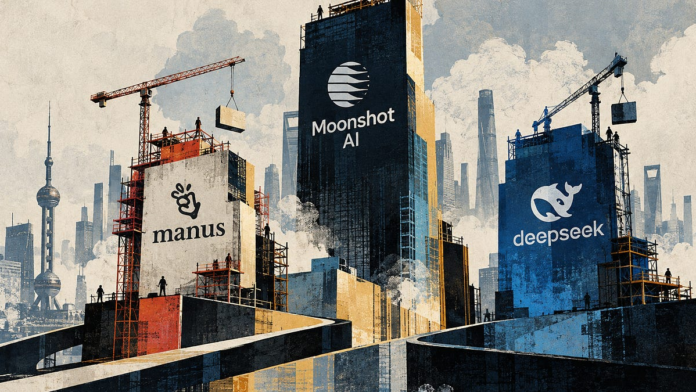
It’s been quite a week for China’s private AI companies after Manus, Moonshot AI and DeepSeek all made progress on major, strategic funding rounds that will have a big say on their futures.
Manus, well its parent company Butterfly Effect, raised more than $500 million to cement its journey as an independent business less than a year after it was acquired by Meta for over $2 billion. The deal was led by Boyu Capital, the fund co-founded by a grandson of former Chinese premier Joang Zemin, and IDG Capital with existing investors Tencent, HSG and ZhenFund taking part.
There’s no word on valuation. Butterfly Effect has been linked with an IPO, with the idea being investors could back a sure thing for a public listing at a late stage. There’s no word on that, either, but Reuters said the company “won’t begin the process for a Hong Kong initial public offering until at least 2027.”
A listing is coming sooner for Moonshot AI, which Bloomberg reports closed a final private company funding round that values the business at $50 billion. Unlike Manus, we know the valuation for this deal but we don’t know exactly how much Moonshot raised.
It is, however, in the market for a $5 billion fundraise from its Hong Kong IPO, Bloomberg says, which could come in the first quarter of next year with impressive financial headwinds.
Moonshot’s annual recurring revenue, a gauge of future sales, is expected to rise to $2 billion by December from the current $1 billion, people familiar with the matter have said. The company achieved $300 million of ARR in June, Bloomberg News reported earlier.
Finally, because news comes in threes, DeepSeek is said to be close to raising ‘at least’ $12 billion in a new round that could reach $15 billion, according to another Bloomberg report. The deal is said to be led by Tencent and battery firm CATL and it would value DeepSeek at $75 billion, the report added.
Interestingly, the deal would give Liang Wenfeng, DeepSeek’s founder, a net worth of $36 billion, more than Anthropic CEO Dario Amodei and other US AI executives. That’s all paper money until an exit, of course, but it does show the buzz behind DeepSeek, how the firm has managed investors and the fact that Liang has also invested his own capital, too. Definitely not an ordinary company or regular investment deal.
Without wishing to repeat myself, these deals feel incredibly risky without existing public companies to model valuations on. Yes, we have results from Z.ai and MiniMax in Hong Kong but OpenAI and Anthropic’s listing will be illustrative in knowing exactly how the markets will value DeepSeek, Moonshot and others.
We’ve written about DayOne and its billions of dollars in funding, and now the growing data centre operator has filed for a US IPO.
DayOne, the international business of China’s GDS, has raised nearly $6.5 billion. We don’t officially know how much the company plans to raise nor at what valuation, but WSJ reports it could target a $5 billion float at a potential $20 billion valuation. Just before that happens, though, it is closing a $500 million bond raise.
The company is focused on Southeast Asia, Japan and Korea and it saw revenue grow 3X to reach $512 million in the first half of this year with a net loss of $81.9 million, which jumped significantly from $13.5 million.
This is a huge listing that, like these AI IPOs, could help define revenue-valuation comparatives for a host of future listings, market sentiment and more.
Qualcomm agreed to license patents underpinning Huawei’s novel LogicFolding chipmaking technique [Yahoo Finance]
Granite Asia and Google’s AI Futures Fund will co-invest up to $2 million in selected Asian AI startups [Granite Asia]
Prosus is in talks to invest in Indian fintech startups Kiwi and Oolka as it increases its bets on the country’s financial services sector [Economic Times]
Garuda Aerospace raised about $10 million in a pre-IPO round that valued the Indian drone maker at $320 million [Economic Times]
Indian fintech Navi is in talks to raise about $40 million from Elevation at a valuation of $1.4 billion to $1.5 billion [Moneycontrol]
Former ByteDance intern and current PhD student Tian Keyu is said to have raised nearly $30 million for a stealth startup developing AI world models [Bloomberg]
StarHub will acquire MyRepublic’s mobile business to expand its multi-brand mobile strategy [The Straits Times]
Universal Quantum raised $100 million to expand research hubs in Germany and Singapore [WSJ]
SoftBank founder Masayoshi Son is seeking up to $100 billion from Gulf investors to finance his expanding AI investments [FT]
Indian edtech startup byteXL raised $9 million to expand its engineering-college network and AI learning tools [Entrackr]
Singapore-based AI company OneByZero has raised $20 million in Series A funding led by Jungle Ventures, its first external funding round. The company, which deploys AI across financial services, telecommunications and retail, has more than doubled its revenue annually over the past three years [OneByZero]
Transsion, now Africa’s dominant smartphone maker, is reportedly seeking to raise up to HK$3.36 billion ($428 million) through a Hong Kong share sale [Bloomberg]
Malaysian chipmaker SQ Advanced Interconnect is said to be considering a first-quarter 2027 IPO that could raise about 300 million ringgit ($73 million) [Bloomberg]
Tencent is reportedly considering an offshore bond sale of up to $5 billion as tech companies raise debt to fund AI investment [Bloomberg]
Dramatic: Firmus Technologies scrapped its planned $44 billion Australian IPO and will seek funding from Nvidia and existing investors instead [AFR]
Uzbek fintech Uzum is considering its first eurobond sale as early as the end of 2026 [Bloomberg]
Shanghai Biren Technology shares fell more than 12% in Hong Kong after the AI chipmaker announced plans to raise HK$4 billion ($510 million) through a share placement [SCMP]
Samsung Electronics reported record third-quarter operating profit as demand for AI memory surged [Bloomberg]
AirTrunk plans to invest up to $30 billion in Japan over five years and more than double its committed capacity to over 1GW [Nikkei Asia]
Reflection AI launched Beam, an open-weight model it says matches leading Chinese models on reasoning benchmarks at a lower cost [Reflection AI]
South Korea will launch a state-backed frontier AI project next year, backed by 4.7 trillion won ($3.48 billion) in equity investment [The Korea Times]
Anthropic began processing Claude requests locally in India through AWS Bedrock, giving Indian organisations local inference and compliance controls [Economic Times]
ElevenLabs plans to support all 22 officially recognised Indian languages, up from 14 on its latest text-to-speech model [Economic Times]
Samsung Electro-Mechanics will invest $5.07 billion in Vietnam and South Korea through 2028 to expand chip-substrate production [Nikkei Asia]
Zero Gravity will invest S$20 million ($15.6 million) in Singapore over five years and establish its global headquarters there [CNA]
Huawei is using homegrown chips to rebuild overseas smartphone sales and plans to expand HarmonyOS abroad within one to three years [CNBC]
Line Thailand plans to add more AI features as it tries to become an everyday AI platform for its 56 million local users [Nikkei Asia]
Japanese contract chipmaker Rapidus will partner with 17 semiconductor design companies, including the Toshiba group, to help clients develop their own branded advanced chips. Rapidus expects the partnerships to generate more orders as it expands its role across the semiconductor supply chain, from chip design through production [Nikkei Asia]
Malaysian chip designer SkyeChip is targeting Japanese companies developing custom AI processors as Tokyo seeks to strengthen its semiconductor industry. The company, which joined Rapidus’ Collaborative Open Rapid Ecosystem as one of 17 inaugural design solution associates, expects Japan’s push to mass-produce 2-nanometer chips from 2027 to create opportunities for smaller chip designers [Nikkei Asia]
Chinese chipmakers have accumulated an estimated 343 immersion DUV lithography tools since 2012, many capable of supporting 7nm-class chip production, . The equipment could give Chinese fabs significant capacity to produce advanced processors despite restrictions on access to ASML’s more advanced EUV systems [Tom’s Hardware]
AM Intelligence has placed binding orders for about 20,000 Nvidia Vera Rubin GPUs, taking its total committed capacity to 29,000 GPUs and nearly 100 MW across India and Malaysia. The additional 70 MW is due to be deployed from the second quarter of 2027, following AMI’s initial 9,000-GPU commitment for an AI factory in Hyderabad [Moneycontrol]
US data centre operators continue to rely on Chinese suppliers for batteries, cooling systems and optical equipment despite national security concerns. Chinese manufacturers offer shorter lead times than US rivals, leaving companies such as Amazon, Google, Microsoft and Oracle dependent on them [The Information]
Taiwanese semiconductor and electronics companies are accelerating overseas investment to expand supply chains for surging AI infrastructure demand, with major commitments in the US and Southeast Asia. TSMC has announced $265 billion in US investments, while companies including Quanta, Wistron, Inventec, Asia Vital Components and Taiwan Union Technology are expanding server, circuit board and cooling component production across the two regions [Nikkei Asia]
Elon Musk said his companies will build and operate the Texas-based Terafab chipmaking project independently, ruling out a role for TSMC in running the facility. TSMC may only lease part of the planned site, Musk said, as Terafab targets chip production for Tesla and SpaceX [Bloomberg]
A union representing Micron Technology workers in Taiwan has authorised a strike after 1,994 members, or 99% of those who voted, backed industrial action over the company’s bonus scheme. The timing remains undecided, but a strike could disrupt Micron’s Taiwan operations, a key production hub for DRAM and high-bandwidth memory chips used in AI servers [Reuters]
Canon plans to bring its semiconductor technology and service centres to India after discussions with companies involved in the country’s chip manufacturing projects. The Japanese imaging and optical major aims to support India’s efforts to build domestic semiconductor fabrication capabilities with its lithography systems [BusinessLine]
Japanese publishers are questioning Anthropic’s bulk purchases of books after Nippan Group Holdings sold large quantities of titles from publishers in the Japan Book Publishers Association to the AI company between December 2024 and December 2025. Nippan said it was unaware the books would be used to train AI models, reigniting concerns over authors’ rights [Nikkei Asia]
Alibaba chairman Joe Tsai said Europe should use open-source AI and build its own computing infrastructure to reduce reliance on US and Chinese technology. He urged European countries to develop local capacity to train and run AI models, including inference [Bloomberg]
SoftBank Group, Grab and Malaysian energy group Petros will explore developing an AI and digital infrastructure platform in Sarawak, Malaysia’s largest state. The partnership will cover AI computing and services, advanced technologies, robotics and workforce development [Nikkei Asia]
Hyperliquid is drawing scrutiny in Singapore over its leveraged perpetual futures contracts ahead of founder Jeff Yan’s Token2049 appearance [FT]
Singapore-based Nium is partnering with RedotPay to expand fiat off-ramp access for the stablecoin platform’s more than 9 million users. RedotPay will connect to Nium’s cross-border payments network to support digital asset-to-fiat conversions across more markets [PRNewswire]
Hong Kong’s de facto central bank questioned HSBC over choosing Singapore, rather than Hong Kong, for its global AI centre of excellence [FT]
Four US states sued TP-Link, alleging the networking company misled consumers about router security and its China ties [Tom’s Hardware]
The US Treasury fined Plug and Play parent Amidi $200,000 for failing to report an investment in a Chinese robotics AI startup [SCMP]
The US is offering a $10 million reward for information on Zhang Yu, a Chinese national accused of helping lead the Hafnium hacking campaign [The Record]
India rejected Elon Musk’s claim that Starlink is being unfairly blocked as SpaceX seeks commercial approval after years of regulatory work [TechCrunch]
Japan recorded 13 corporate data breaches in a single day in September, prompting the government to call for security checks [Bloomberg]
The US Federal Communications Commission plans to vote Oct. 29 on rules barring Chinese testing labs and certification bodies from approving smartphones, cameras, computers and other electronics for the US market. The FCC said 82% of electronics were tested in China in 2025, with the new restrictions set to take effect in December 2028 [Reuters]
TikTok allegedly gave thousands of users, including children and teens, non-functional versions of safety features such as Algo Refresh, . Users believed the features were active, but their recommendation feeds did not change as they would with working versions [Reuters]
Revolut will invest nearly $350 million in Singapore over five years and more than double its local workforce [The Straits Times]
Former Flipkart executives asked Walmart to cash out their vested stock options after another delay to an India listing [Economic Times]
Uber and Pony.ai plan to launch a robotaxi service in London, beginning tests of Pony.ai’s Gen-7 vehicles in the coming weeks [TechCrunch]
Shenzhen opened its streets to nighttime driverless deliveries, allowing companies to test round-the-clock logistics [Bloomberg]
Meta banned ByteDance ads and paid marketing messages across its platforms in seven countries, including Indonesia, Japan, Thailand and Vietnam [Bloomberg]
Streaming platforms are projected to account for 50% of Asia’s $5.7 billion sports-rights fees this year, up from 36% in 2021 [Bloomberg]
Insta360, which went public in June, is targeting US market share as national-security restrictions block new DJI products from FCC approval [Rest of World]
Smartphone prices have risen globally as AI data-center demand drives a memory-chip shortage, with existing models about 15% more expensive this year and new models up 25% from last year. Chinese manufacturers, which account for about 60% of global shipments, have sharply reduced entry-level projects and shifted toward premium devices, with prices rising 21% in India, 19% across Asia-Pacific and 18% in the Middle East and Africa [Rest of World]
Japanese media group Nikkei disclosed two cyber incidents, including an attack in which a Microsoft 365 account was compromised and used to send about 9,000 phishing emails to employees, external contacts and journalistic sources [The Record]
At least six tenants in a Beijing office building reportedly sell Chinese customers access to Anthropic’s Claude and other US AI models, despite Anthropic not offering its services in China. Demand for Claude access remains high as Anthropic accuses Chinese AI labs of extracting its models’ capabilities using fake or stolen accounts, payment cards and identities [The Information]
Grab and GoTo, which control about 85% of Southeast Asia’s ride-hailing market, face growing pressure to improve driver earnings after months of protests and regulatory scrutiny across Indonesia, Vietnam, Thailand and the Philippines. GoTo shares have fallen more than 90% from their 2022 peak to its current level, while Grab has lost 50% in the past year as higher fuel costs threaten already tight margins [FT]
China’s crackdown on offshore assets and trusts is raising concerns over Singapore’s ability to attract Chinese wealth, after the city-state also tightened scrutiny of wealth sources following a S$3 billion money-laundering scandal. Singapore has seen growing competition from Hong Kong, which recorded more new single-family offices than Singapore from 2023 to 2025, while stricter bank checks have lengthened account-opening times for some Chinese clients [Nikkei Asia]
Malaysia is reclaiming 2,300 acres off Penang to build Silicon Island, giving the state’s semiconductor industry room to expand as land runs short around its Bayan Lepas manufacturing hub. The project aims to move Malaysia beyond chip assembly and testing into higher-value activities such as chip design and advanced packaging, with developers projecting 220,000 jobs and hundreds of billions of dollars in economic value by 2050 [Bloomberg]
CrowdStrike said a 26-year-old likely based in China’s Guangdong province was behind recent cyberattacks on South Korean banks, using a Chinese AI agent and Anthropic’s Claude Code [CrowdStrike]
Researchers found malware preinstalled on thousands of low-cost Android phones that can generate fraudulent ad revenue and potentially add devices to botnets. Bitdefender dubbed the campaign “Midnight Mimosa” and said it affects multiple brands using MediaTek chips, while some affected firmware carried certificates bearing the name of Chinese hardware maker Shenzhen Zediel [The Record]
Current and former employees say TikTok US still coordinates closely with the global TikTok org, and US staff continue to use ByteDance’s internal chat app Lark (Sylvia Varnham O’Regan/Politico) [Politico]
The Trump administration has temporarily barred Microsoft, Adobe, Cognizant, Infosys, TCS, Wipro, HCL and Capgemini from sponsoring workers for permanent US residency, alleging abuse of immigration programmes at the expense of American workers [FT]
Synopsys plans to explore partnerships with Chinese AI labs to develop tools that accelerate chip design, despite tighter US export controls. The move follows a multi-year deal with OpenAI to develop GPT-Synopsys, an AI model designed to automate chip design [Nikkei Asia]
China is rapidly building data centres across its energy-rich interior, using cheap land and abundant electricity to narrow the gap with the US in AI computing. The country has 24GW of operational data centre capacity, with another 50GW under construction or announced, while Ulanqab in Inner Mongolia has 89 data centres built or planned and 15GW of committed capacity, making it one of Asia’s fastest-growing AI infrastructure hubs [FT]
The Chinese developer of ARTEX has made the AI agent closed-source after cybersecurity firms linked it to a cyberattack campaign against South Korean banks. The developer, known as Autumn-27 on GitHub, said no further public versions or maintenance updates would be released [Reuters]
OpenAI’s senior Asia-Pacific public policy executive, Sanghyun Lee, is leaving after six months in the role as the ChatGPT maker faces regulatory scrutiny across the region. Based in Singapore, Lee joined in April after six years at Google; the reason for his departure was not immediately clear [Bloomberg]
China’s Star 50 Index fell as much as 4.6% on Friday, extending its two-day loss to more than 9%, while the ChiNext gauge dropped up to 3.4%. Chip and optical component stocks have retreated from record highs as investors reassess AI valuations amid rising borrowing costs, debt concerns and fears of potential US restrictions on Chinese optical module imports [Bloomberg]
Shenzhen-based Transsion has become Africa’s dominant phone maker by tapping into informal trade networks for low-cost Chinese handsets, accounting for nearly half of all phones sold on the continent each year [Sixth Tone]
Laptop makers are reconsidering production shifts out of China as soaring component costs squeeze margins, . The share of global notebook production outside mainland China is forecast to fall to 21% this year from 24% in 2025 and below 20% in 2027, reversing efforts to diversify supply chains amid tariff and geopolitical risks [SCMP]
Singapore-based DayOne Data Centers is in preliminary talks with banks for a potential $500 million bond sale as it pursues a US IPO that could raise about $5 billion. The debt discussions continue despite project partner Firmus, backed by Nvidia, dropping its Australian IPO plans this week [Bloomberg]
Ting-Wei “Willy” Sun, a former contractor charged alongside Super Micro co-founder Yih-Shyan “Wally” Liaw, pleaded guilty to conspiring to evade US export controls. Prosecutors allege the scheme routed Nvidia-powered servers through a Southeast Asian company before diverting them to Chinese customers [Bloomberg]
Former Flipkart executives are mobilising 20,000 to 30,000 ex-employees to demand inclusion in Walmart’s planned $2 billion employee stock option buyback. A petition launched on October 10 covers former staff from Flipkart, Myntra, Cleartrip, Shopsy, Super Money and ANS Commerce [Economic Times]
Taiwan’s ProLogium and other solid-state battery makers are targeting AI and industrial robotics as sluggish EV demand and high costs delay wider automotive adoption. The technology offers higher energy density and improved fire resistance compared with conventional lithium-ion batteries [Nikkei Asia]
Japan’s Sumitomo Bakelite will expand production of advanced chip packaging materials in Suzhou, China, and Singapore, doubling capacity for mould underfill materials and tripling output of compression-moulding granules [SCMP]
Chinese EV maker Xpeng can adapt its driver-assistance system to different European countries in about two weeks, using as little as one ten-thousandth of the data required to train its underlying AI models. The approach allows the company to tailor its software to local road conditions without rebuilding it from scratch [Bloomberg]