
 Download

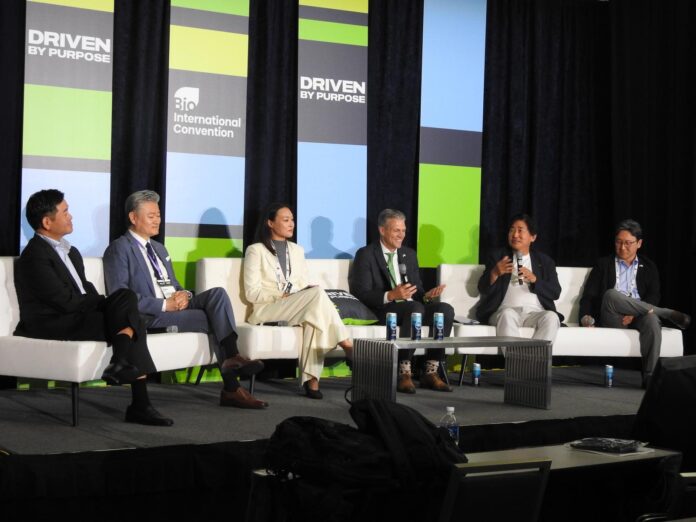

Korea Rising session
The world’s largest pharmaceutical and biotech exhibition, the “2026 BIO International Convention (BIO USA),” hosted an official session dedicated exclusively to highlighting “K-Bio.” The session assessed that the Korean bioindustry is emerging as an “Asian innovation hub” attracting the attention of global pharmaceutical companies and investors, going beyond its role as a manufacturing base with large-scale production capacity.
On the second day of BIO USA, on the 23rd (local time), a session titled “Korea Rising: Don’t Be Late for Asia’s Next Innovation Hub” was held at the San Diego Convention Center in the United States. This is the first time that the Korean bioindustry has been featured in an independent, dedicated session on the official BIO USA stage. Industry participants view this as a change that reflects the elevated global standing of K-Bio.
The session featured James Choi, Executive Vice President of Samsung Biologics; Lee Jae-jun, CEO of Il-Dong Pharmaceutical; Lee Sang-hoon, CEO of ABL Bio; and Scott Dwyer, Vice President and Head of Business Development at Boehringer Ingelheim, as panelists discussing the drivers of growth in the Korean bioindustry and its potential for global collaboration. The panelists assessed that Korea has established itself as a global manufacturing base, underpinned by large-scale biopharmaceutical production infrastructure, a stable supply chain, and government support. Executive Vice President Choi explained, “Based on advanced infrastructure, an efficient construction environment, and government support, we have been able to build large-scale production facilities 40% faster than the industry average.”
Furthermore, participants noted that Western pharmaceutical companies are increasingly adopting technologies and drug candidates from Korean biotech firms, and that the trend of early-stage research results progressing to commercialization is strengthening. Scott Dwyer, Vice President of Boehringer Ingelheim, said, “I have never been to Korea in person, but in terms of our portfolio, we have not missed a single innovative technology from Korea,” adding, “The ‘first-in-class’ innovative drugs we seek are in Korea.”
Capital strength was cited as a challenge for domestic bio companies. Hwang Ju-ri, Head of External Cooperation at the KoreaBIO Association, said, “Korean biotech companies are quick to understand how the market moves and are adept at identifying niche markets,” while pointing out, “The problem is that capital inflows, including funds, still remain insufficient.”
ⓒ dongA.com. All rights reserved. Reproduction, redistribution, or use for AI training prohibited.