
 Download



Having grown up in both Louisiana and Morocco, Faiza Filali arrived at Notre Dame as a speaker of seven languages with plenty of global experience. So when she started planning her academic path in international politics, she could’ve easily gotten a head start in a number of specialties.
But instead, Filali used her background to decide what not to do.
“I was interested in building expertise in a really specific region that I had no natural correlation to,” she said.
Because she spoke English and French, she ruled out studying American or European politics. And with a childhood full of Arabic, Berber, Darija, and Tamazight, Africa and the Middle East were out of the running, too. That left Latin America and Asia, but because Filali learned a little Spanish in high school, Asia — East Asia specifically — was declared the winner with her addition of minors in Asian studies and Korean to her political science major.
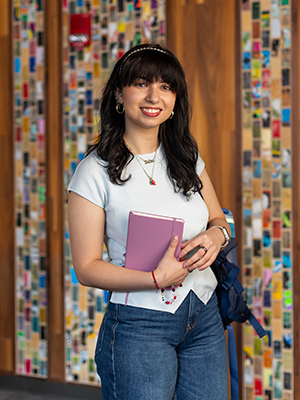
To further refine her studies, she added a supplementary major in international peace studies and became an undergraduate fellow of the O’Brien Notre Dame International Security Center.
Now a senior, Filali’s turned nothing into quite a something as she’s used her undergraduate years to become an expert in East Asian politics, studying abroad in South Korea several times, learning Japanese as well as Korean, and seeing regional politics in action through Notre Dame’s Washington Program.
And she’s found the issue she wants to focus on for the rest of her career: nuclear nonproliferation.
Nuclear politics are a major part of East Asian politics, as many nuclear powers and U.S. allies are spread throughout the region. But potential nuclear attacks could be disastrous for the entire planet.
Filali hopes that by utilizing both her specialized education and her cross-cultural connections, she can make a lasting impact.
“I know the world can be a better place,” she said. “That’s exactly why I’m in my field — why I care so much about ending the nuclear crisis.”
Finding her vocation
While nuclear nonproliferation is a hugely important issue, it’s not necessarily a high priority for the typical college student. But it’s become something Filali just can’t ignore.
As a sophomore, her interest in East Asian politics brought Faiza to an internship at the National Committee on North Korea (NCNK), which she completed as part of the Washington Program, an Arts & Letters experience that allows students to spend a semester studying and interning in the nation’s capital. She sat in on several meetings between high-level officials, receiving firsthand exposure to developments in the nuclear policy issues that define U.S.-North Korea relations.
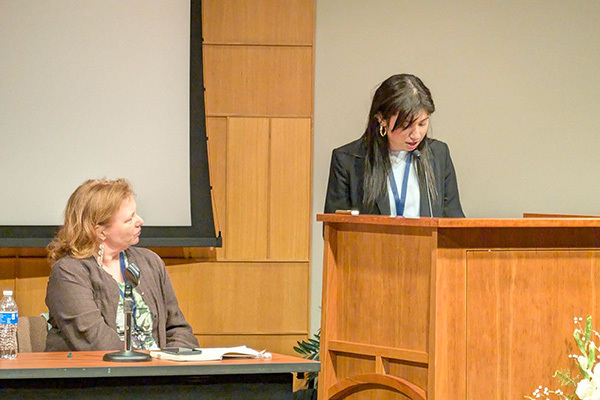
“I noticed that there was this tizzy around talking about the nuclear question because we fully understand that nuclear warheads are out of our control,” Filali said. “Nuclear posturing and nuclear proliferation are assigned powers and responsibilities, but they’re also completely at the whim of any leader of a nuclear nation.”
International conflicts occurring during Filali’s internship further emphasized the importance of nuclear nonproliferation. She wondered whether nuclear war was as far away as most people believed.
This remained on her mind as she finished her internship and returned to Notre Dame, stayed with her as she read the news, and came to the forefront as she mulled over her vocation with her academic advisors.
“It hit me that if I could do one thing for the next generation, it would be this,” she said.
Filali plans to devote her entire career to ending the nuclear crisis. She’s currently applying to graduate programs in international relations so that she can fight nuclear proliferation as a scholar, and she’s already started working on it with her senior thesis.
Titled “Bombs in the Back of Our Minds,” Filali’s senior thesis argues that nuclear proliferation is not a natural process — the existence of nuclear weapons should not be considered inevitable and permanent.
“Nuclear weapons are the biggest international anxiety, but for decades, we’ve just been like, ‘This is completely normal,’” Filali said.
Nuclear powers maintain their arsenals to sustain credibility and deterrence against adversaries, Filali said. The idea is that if a country has enough nuclear weapons, no one will send a nuclear attack their way for fear of retaliation — it’s mutually assured destruction.
“Every experience I’ve had in the past four years has shaped me into a much better person than I was before.”
In her thesis, Filali uses a thought experiment to assess how states respond and create rationality and where the strategy of deterrence has worked and where it’s failed, creating policy implications with the results. She also examines the ways different countries navigate their nuclear anxieties — like how the U.S. builds nuclear alliances while Ireland maintains a staunchly antinuclear position, despite the fact that it’s never experienced or initiated a nuclear attack itself.
“It’s a culmination of questions I’ve been asking for years,” Filali said.
In her senior thesis research, Filali has read plenty about what would happen if a nuclear scenario played out, but it was visiting Nagasaki, Japan — where remnants of a nuclear attack from over 80 years ago still linger — that put it all into perspective.
“I’ve been very lucky to see so many beautiful things around the world, but I don’t think I ever resonated with the feeling of tragically beautiful until I was there,” Filali said. “I sat there, and I cried. It’s just a level of human atrocity you can’t even understand. There’s no active violence in front of you, but you can’t ignore it’s shadow.”
‘The pursuit of seeing humanity’
Filali is the type of person who can’t do nothing. She wakes up early and goes to bed late, constantly in action while her eyes are open.
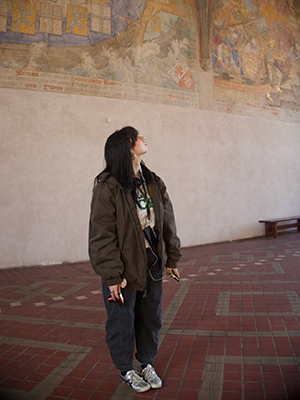
On top of her regular classwork, she’s taken on responsibilities in Notre Dame Athletics, the Hesburgh-Yusko Scholar Program, and the Glynn Family Honors Program. Every day she can, she exercises her brain through her journal and her body through the gym. She’s more deeply explored her academic interests through clubs like the Alexander Hamilton Society, and she’s connected with her faith through the Muslim Student Association. But she also ventured outside her typical circles when she managed the men’s lacrosse team. Even when she does take time to rest and relax, she needs a book in hand to deflect boredom.
This spirit makes her an ardent academic and a formidable foe of the nuclear crisis. But what Filali calls her greatest asset isn’t her workaholic nature but her love of human connection.
“What matters most to me is the constant pursuit of seeing humanity in other human beings,” she said. “That’s what leads to peace in the end.”
With her knowledge of languages spanning several continents, Filali doesn’t usually have trouble communicating in a new place, even when she doesn’t speak the country’s official language. But when she visited Ireland last semester, she encountered a true language barrier for the first time.
Because she speaks no Celtic languages, Filali couldn’t understand the Irish speakers she encountered — and to her, that’s just not acceptable. Now she’s aiming to learn Irish — plus German and Spanish — to bring her language total to 11 before she turns 22 in August. She’ll hopefully get plenty of practice while completing the Irish Internship Program this summer at Notre Dame Dublin.
Filali’s love of human connection has taken her across campus and around the world. And it’s all been worth it.
“Every experience I’ve had in the past four years has shaped me into a much better person than I was before,” she said. “Notre Dame has taught me to seek opportunities where you can meet community and make friends and also learn about yourself, and I don’t think I would have gotten that anywhere else.”
Originally published by at al.nd.edu on April 22, 2026.