 Download

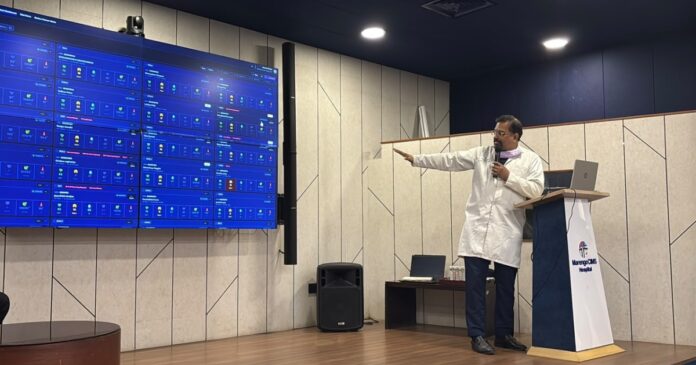

Marengo CIMS says the AI platform prevented 115 Code Blue emergencies in 2.5 years.
An AI-powered remote patient monitoring system at an Indian hospital has helped prevent 115 cardiac Code Blue emergencies and avert 836 cases of patient deterioration over the past two and a half years, according to the hospital.
Marengo CIMS Hospital in Ahmedabad has deployed wearable biosensors that continuously track vital parameters including heart rate, blood pressure, respiratory rate, and oxygen saturation in real time. When the system detects an abnormality or rising clinical risk, it sends simultaneous alerts to the patient’s smartphone, the treating doctor, and a dedicated 24×7 central monitoring command centre.
“Most serious cardiac emergencies do not occur suddenly. The human body gives subtle physiological signals hours or even days before a critical event,” said Mayur Dave, facility director at Marengo CIMS Hospital.
The hospital says the platform has monitored more than 6,551 high-risk patients since deployment, preventing 81 ICU transfers and facilitating three CPR interventions during that period.
“Marengo CIMS Hospitals has been using this AI-enabled biosensor technology for more than two and a half years for patients at high risk of cardiac and other life-threatening conditions,” said Dr. Dhiren Shah, director of Cardiovascular and Thoracic Surgery and Heart Transplant Programme at Marengo CIMS Hospital.
Unlike conventional in-hospital monitoring, the platform follows patients through discharge and home recovery, allowing doctors to remotely track high-risk individuals with heart failure, weakened heart function, stroke risk, asthma, and other chronic conditions. The system continuously analyses patient data to generate early warning scores, risk insights, and real-time clinical summaries for treating physicians. A dedicated clinical team at the command centre verifies alerts and coordinates with doctors when intervention is required.
Dr. Raajiv Singhal, Managing Director and CEO of Marengo Asia Healthcare, said the platform supports clinical workflows through continuous monitoring, risk stratification, AI-assisted documentation, and coordinated escalation protocols, contributing to reduced ICU stays and lower treatment costs.