
 Download

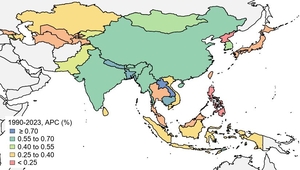

COVID-19 cut life expectancy by 0.33 years in Southeast Asia and 0.28 years in East Asia from 2019 to 2023
The high-income Asia-Pacific region, which includes South Korea and Japan, recorded Asia’s highest average life expectancy at 84.1 years in 2023, a study showed.
The research team led by Korea University professor Kang Ji-seung and Kyung Hee University professor Yon Dong-keon analyzed life expectancy, cause-specific mortality and health risk factors across 34 Asian countries from 1990 to 2023.
The study, published in Nature on Wednesday, found that life expectancy increased across Asia during the period.
South Asia recorded the largest gain, with average life expectancy rising by 12.6 years from 58.6 years in 1990 to 71.2 years in 2023.
In high-income regions such as Korea, advances in medical technology and systematic access to treatment for cardiovascular diseases were the main contributors to longer life expectancy.
In South and Southeast Asia, where many lower-income countries are concentrated, expanded childhood vaccination programs and improved access to clean water and sanitation played a greater role.
Women lived longer than men in all regions examined. In the high-income Asia-Pacific region, female life expectancy stood at 87.1 years, 6.1 years longer than the 81 years recorded for men.
Asia’s decades-long rise in life expectancy suffered a setback during the COVID-19 pandemic. Between 2019 and 2023, Southeast Asia lost an estimated 0.33 years of life expectancy, while East Asia lost approximately 0.28 years.
The researchers also identified high blood pressure, unhealthy diets and air pollution as the three leading risk factors threatening longevity in Asia.
Exposure to high blood pressure and elevated fasting blood glucose has continued to increase across Asia over the past three decades, indicating a need for greater attention from public health authorities.
“Beyond presenting fragmented health statistics, the study identifies in detail which diseases and risk factors have raised or reduced life expectancy in individual countries and regions,” Kang said.
“We hope the findings will serve as a key indicator and compass for Asian health authorities seeking to formulate practical and effective policies tailored to their respective circumstances.”
seungku99@heraldcorp.com