
 Download

-
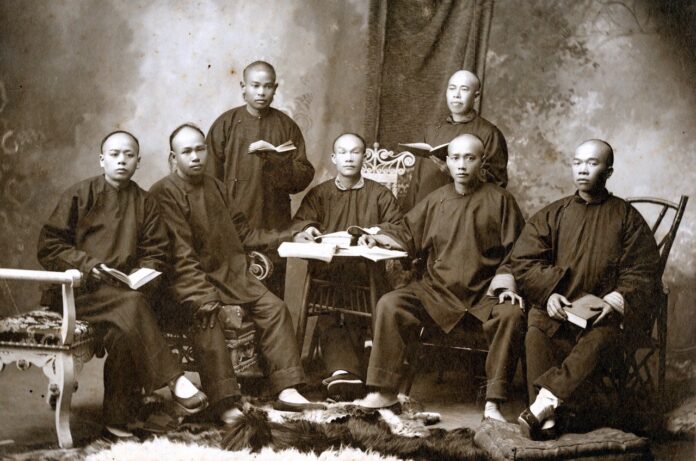
Lem Sam (center) leads a class at the Santa Cruz Congregational Chinese Mission. (Courtesy UCSC Special Collections)


1 of 5
Lem Sam (center) leads a class at the Santa Cruz Congregational Chinese Mission. (Courtesy UCSC Special Collections)
In 1853, Ah Moon became the first Chinese settler in downtown Santa Cruz, married to the county’s first woman of Chinese descent, having the first American-born boy of Chinese descent in the county. Moon rented a building from Elihu Anthony at the corner of Knight Street and North Pacific Avenue (near today’s Town Clock site). Moon was growing potatoes, but when the boom went bust, he opened the first laundry in Santa Cruz. Moon’s friend Anthony was a civil rights abolitionist who helped found the first Methodist church, started the first downtown business and stood up for underdogs. These included two Black men, one named London Nelson, who willed his property to the school system with Anthony’s help, and the other being David Boffman, a man cheated out of his property, whom Anthony helped to obtain a farm.
The original Chinatown was on Pacific Avenue between Walnut and Lincoln streets, right below the congregational parsonage. But as white merchants were unable to expand their businesses on Main Street (now Front Street), they moved to Pacific Avenue starting in 1870, and the growing Chinese population — now at about 156 — started relocating completely to the block of Front Street north of Cooper Street. The transition to upper Front Street was completed by 1877. While there were tensions between Chinese American and white settlers, this new Chinatown settled on the riverbank, while across the street to the west was a series of white-owned businesses, including brothels and saloons.
The 1870s were a depression, in which workers of Irish and Chinese descent competed for jobs building the railroads. To solve the economic suffering, San Francisco’s Henry George wrote “Progress and Poverty,” sparking progressive ideas. He believed the density of urban populations caused the scarcity of real estate to such a degree that speculators could charge anything above its actual worth.
George proposed that the only tax needed was on land, and Elihu Anthony became an avid follower of Henry George. George was anti-monopoly, to prevent price-fixing and ruthless exploitation of workers for obscene business owner profits. Yet in 1869, Henry George also promoted the idea that Chinese American labor working for what the exploiters would pay, were actually depressing wages for white workers, and proposed that corporate monopolies should be restricted from using workers of Chinese descent.
Henry George was shocked when Denis Kearney took over his idea in 1877, to found the Anti-Chinese Workingman’s Party. Kearney delivered race-baiting sandlot harangues to San Francisco mobs, that “the Chinese must go” for undercutting the wages of white workers. Chinese Americans were blamed as puppets of the railroad monopoly, taking jobs from “real Americans.”
PROTECTIONS
The Chinese found community in the Chee Kung Tong, organized in 1880 as a masonic secret society called the Chinese Freemasons. Canton, where most people of Chinese descent in Santa Cruz were from, remained China’s one open trading port for goods and ideas. The Taiping Rebellion (1850-1864) sought to restore the Ming Dynasty and end the caste system. But when the revolt failed, they returned to get food and jobs, and California Chinese kept their queue if they wished to return home again.
In 1852, the Presbyterian Chinese Mission was organized in San Francisco, opening medical clinics to serve Chinese newcomers. From 1866 to 1868, the Rev. Otis Gibson built Methodist Chinese Missions in San Francisco, Los Angeles, Oakland, San Jose and Chico, offering schools and refuge for women fleeing slavery. The California Chinese Mission led by the Rev. William C. Pond (1830-1925), opened congregational Chinese missions to teach English and provide shelter and education. Santa Cruz Congregational pastor Mahlon Willett credited his wife Anna Wood Willett for coordinating with Pond to establish the Santa Cruz Congregational Chinese Mission, opened May 1, 1881, for a Chinese population of 300. Anna Willett was the first teacher, and Wong Ock and Pon Fang were the first Chinese pastors, with Fang doubling as choir director. The mission grew rapidly to learn English, have safe fellowship and were not required to join the church. Thus, 10% became Christians, while the rest followed their own traditions.
The Rev. Pon Fang started in Santa Cruz as cook and housekeeper for Mary Fagan, a woman strongly in support of the Congregational Chinese Mission. Fang’s brother Pon Hong was chef at the Pacific Ocean House, but his pigtail dropped onto his chopping block once too often and he angrily chopped it off. Without it, he could never return to China, so he wore western clothes from then on. The Rev. Pon Fang opened a Chinese goods store selling a variety of porcelain and silk near the Canton Market (north of today’s Catalyst Club on Pacific Avenue). He sent for his wife, who had been crippled by foot-binding, a tradition Fang longed to end. Their children were Samuel, Joseph, Ruth, Esther and Daniel.
In 1882, a chilling sight filled the night of April 4, of a hanged man set on fire on the Lower Plaza surrounded by an angry mob. It turned out to be an effigy of President Chester Alan Arthur hung after the president vetoed a treaty to ban Chinese laborers from entering the U.S. for 20 years. The president said it violated an 1880 treaty with China. Congress couldn’t override the veto, so they lowered the immigration ban to 10 years. The president still objected, hoping to maintain commercial and diplomatic ties with China, but he signed the Chinese Exclusion Act May 6, 1882.
The 45-man Boulder Creek Anti-Chinese Club went door to door by torchlight in the autumn of 1885, to give the Chinese Americans 24 hours to leave town. Many moved to the Santa Cruz Chinatown. There were calls to drive the Chinese Americans out of Santa Cruz, too, but when the City Council referred the problem to a legal consultant, he gave the opinion that it was illegal. (Surf, Jan. 20, 1886). They chose instead to boycott Chinese businesses, but when that didn’t work, the hope was to boycott white businesses who employed Chinese. Yet private homes were unwilling to give up housekeepers and cooks who in some cases had become close friends.
Former advocate for the downtrodden, Elihu Anthony was elected head of the Santa Cruz Anti-Chinese Workingman’s Club. Yet a backlash forced Anthony to appear in the Methodist Church on Sunday, sitting in the front pew instead of his usual back pew. When the Rev. J.W. Bryant finished his sermon, Anthony got up to speak. Bryant was taken aback, but as this was one of the founders of the church, he thought Anthony had earned a hearing. Bryant assumed Anthony was responding to the Santa Cruz Surf (May 5, 1886), denouncing him as one of 31 “conspirators” in the local Anti-Chinese movement, whom the newspaper called a gathering of the “un-esteemed” followers of Anthony.
Being aware of his racist activities, the congregation was surprised at Anthony presenting “a decidedly … irreligious episode, … (which) was the occasion of considerable after-comment.” Anthony stood before the alter rail and made a rambling speech on the boycott. He said he hoped to continue his long connection with the Methodist Church but was aware of the sentiment to expel him from their fellowship. (Surf, May 10, 1886). While expelling members was not a Methodist practice, one might guess that the Rev. Bryant or some other church official, told Anthony he cannot represent himself in such a way that people conclude he speaks for the Methodist Church. In fact, some members did quit the Methodist Church over fears Anthony had church approval.
Likewise, Duncan McPherson’s support for the Anti-Chinese movement as editor of the Sentinel, didn’t find much favor among members of his Congregational Church, given that many supported the church’s own Congregational Chinese Mission. Likewise, Catholic bishops statewide were deeply divided over this mostly Irish-Catholic Anti-Chinese movement. While Catholic labor may have celebrated the Chinese Exclusion Act, clergy remembering the anti-Catholic Know Nothing Party feared if it could be done against Chinese, it could be done against Catholics. (Catholic University of America, Oct. 2, 2024).
In 1894, a fire destroyed Chinatown, most of the tri-corner block bounded by Front, Pacific and Cooper streets, and the county courthouse. Yet the Chinese Americans in Santa Cruz were not friendless. Harriet Blackburn built a row of cottages on Sycamore Street near her three-story home. Eliza Boston offered truck gardens where the Chinese Americans could grow vegetables, and George Birkenseer built a row of cottages behind the former Front Street Chinese businesses. Judge Henry Rice had rented his Branciforte farmland to Chinese American gardeners beginning in the late 1870s, and for decades John Henry Bilodeau gladly made grave markers for Chinese Americans buried at Evergreen Cemetery.
Pastor Wong Ock went to China for the Salvation Army, then opened a church in Canton. Pon Fang moved to San Francisco with his family in 1905, and the Rev. Fang became a deacon and Sunday school superintendent at the Congregational Mission, where his daughter Ruth played the pipe organ. Fang’s son, Samuel, graduated from UC Berkeley and became a college professor. The Rev. Fang went to China to open a library in his hometown. One of the Santa Cruz Mission workers, Soo Hoo-dong, became a faculty member at the Imperial University in Tientsin, China. And the descendants of Anthony and McPherson have long rejected that behavior and lived their lives as an example of inclusion and helpfulness.
FURTHER INTEREST
“Chinese Gold,” by Sandy Lydon, 1985; ““Evergreen Cemetery of Santa Cruz,” by Traci Bliss with Randall Brown, 2020; “Our Old Santa Cruz,” by Ernest Otto, 2023.