
 Download


At 72, most people might be thinking about slowing down. But Liu Heung Shing had other plans.
The Pulitzer Prize-winning Chinese American photographer wrapped up a three-year, 270,000-kilometer journey across four continents at the end of last year, and has turned the feat into a book documenting the Belt and Road Initiative.
“I think the BRI could very well be one of the greatest projects of the 21st century,” Liu said during his book sharing session in Shanghai on Sept 12.
“What intrigued me most was how China would make it work across different cultures, religions and levels of economic development,” he added.
Official figures show that since 2013, more than 150 countries and 30 international organizations have signed BRI cooperation documents.
In 2025, China’s overseas engagement under the BRI reached about $213.5 billion, according to a study by Fudan University and Australia’s Griffith University. That included $128.4 billion in construction contracts and $85.2 billion in investments.

Liu began documenting China in 1976. Over the decades, his work has taken him across China, the former Soviet Union and beyond.
For more than a decade, he has been mainly based in Shanghai, where he founded the Shanghai Center of Photography. In 2023, he turned his lens to the BRI, ultimately traveling through 21 countries and 50 regions.
“You have to be there. You have to use your ears, your eyes, and observe people’s body language,” Liu said. “Otherwise, the story lacks global perspective and breadth.”
The journey is documented in Old Road, New Connections: China Builds a Different World, a 508-page photo book featuring more than 330 photographs. The project was jointly launched with ShanghaiTech University, where Liu is a distinguished professor.
Peter Hessler, author of River Town: Two Years on the Yangtze, wrote on the book’s cover that the images — “Chinese cars being sold in Tehran, a Chinese-built train delivering pilgrims to attend the Hajj in Mecca” — make it “almost impossible to grasp the scale of change”.
Beyond that, what emerges from the book is not simply a portrait of infrastructure, but of people — those building it, living alongside it and creating connections across cultures.

For some, that means working on railways, ports, water treatment plants and mines.
In Kazakhstan, Liu visited a water treatment plant that Chinese engineers were handing over to the local government — a facility serving 170,000 people.
In Indonesia, he spent months negotiating access to the cockpit of the Jakarta-Bandung high-speed railway, where Chinese drivers were training Indonesian operators.
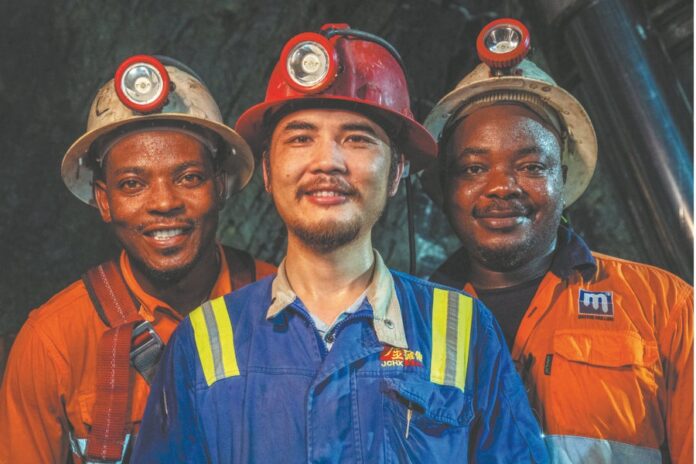
In the Democratic Republic of Congo, he descended 1,546 meters underground to photograph Chinese engineers working alongside local miners.
But the BRI also takes shape in everyday life.
In Kashgar, in Northwest China’s Xinjiang Uygur autonomous region, Liu met a man from the Uygur ethnic group, who had studied at Fuzhou University and now runs a cafe with his Tanzanian wife.
Others are building bridges of another kind — across languages and cultures.
In Kenya, Liu met a 32-year-old Chinese graduate who had spent a decade working in Africa and had no plans to return to China for work.
He also met a student in Uzbekistan who hoped to study in China and return home to work as a translator.
Liu said he did not set out with a predetermined conclusion.
“I don’t know what I’m going to see until I get there,” he said.
He followed what he encountered on the road, seeing the book simply as a record — not an argument.
“You do the best you can, put it on the table, and let people look at it and form their own understanding,” he said.

For Camille Whitworth, an American teacher who has lived in China for 13 years, Liu’s book offers a perspective on China and the BRI that many Americans rarely encounter.
“It’s helping people out, making connections, having business connections and family connections with China,” she said.
“Chinese people are everywhere and an important part of the world community. This book is a great way to document China’s relationship with the rest of the world.”
Liu’s journey was not without risks.
Before leaving for the Democratic Republic of Congo, he asked his lawyer to prepare a will. He also needed five vaccinations over eight weeks.
He left Iran before Israeli strikes hit the country, and he left the DRC before local conflicts escalated.
“I don’t know if I was chasing them, or they were chasing me,” Liu joked.
After three years on the road, now 75, Liu said he was ready for a break.
“I hope you can be kind to me,” he said. “I really need a rest.”
Then he paused.
“There are still one or two ideas warming up.”