
 Download

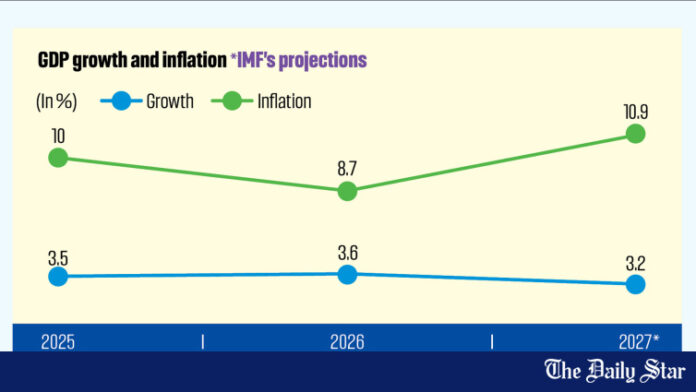

The International Monetary Fund (IMF) has cut its economic growth forecast for Bangladesh in the current fiscal year (FY2026-27) to 3.2 percent from the 4.3 percent projected in April, joining other major development partners in downgrading their outlooks amid persistent economic challenges.
It also projected an increase in average inflation in Bangladesh to 10.9 percent in the current fiscal year, reversing the easing seen in FY26, when average consumer price inflation fell to 8.7 percent from double digits, according to the IMF’s World Economic Outlook (WEO) report released yesterday at the annual meetings of the IMF and World Bank Group in Bangkok.
The IMF’s inflation projection is higher than the World Bank’s forecast of 8.6 percent for the current fiscal year, FY27, made earlier this month. However, both multilateral lenders have cut their economic growth forecasts for the South Asian country.
The World Bank has recently revised down its forecast for Bangladesh’s economic growth to 3.4 percent this year, while the ADB trimmed its growth projection for Bangladesh to 4 percent in September.
It would be the fourth consecutive year of slowing economic growth, as energy shortages, banking sector vulnerabilities, subdued credit growth and tight fiscal constraints continue to weigh on Bangladesh’s economy.
The downgrade in the economic outlook for the South Asian economy comes as the IMF expects the global economy to grow by 3.1 percent in 2026, down from 3.5 percent last year, with the war in the Middle East and a surge in artificial intelligence-related investment pulling economies in different directions.
It projects that advanced economies will grow by 2.1 percent this year and emerging and developing economies by 3.7 percent. The Middle East and Central Asia region is expected to be the hardest hit, contracting by 0.3 percent.
In South Asia, India is projected to grow by 7 percent in both FY27 and FY28, among the fastest rates in the region. Pakistan’s economy is projected to expand by 3.6 percent in FY26 and 3.5 percent in FY27.
The IMF said the global outlook masks growing disparities, with 32 economies expected to account for 95 percent of global growth, down from 54 in April. About 47 percent of economies have had their growth forecasts downgraded.
Countries less exposed to the energy shock and more closely connected to the technology supply chain are holding up better, it said.
Energy-importing economies outside that supply chain, including many low-income countries, face higher import bills, currency pressures and weaker incomes. The IMF said oil prices will average around $96 a barrel in 2026, compared with $68 a year ago.
The fund said global inflation would rise to 4.7 percent this year from 4.1 percent in 2025, driven mainly by energy and food prices.
The multilateral lender warned that a prolonged conflict in the Middle East and weather disruptions linked to El Niño could push energy and food prices higher. A reassessment of expected returns from artificial intelligence investment could also trigger a sharp market correction.The IMF urged governments to rebuild fiscal buffers, avoid broad fuel subsidies and price controls, and keep any support temporary and targeted, preferably through cash transfers.