
 Download

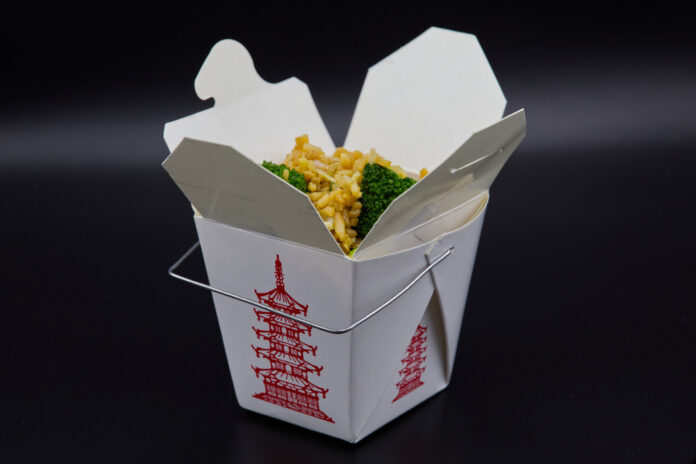

NEW YORK | It’s an icon, that small white receptacle made from a single piece of cardboard folded into a trapezoid-shaped box. Sometimes there’s a wire handle, sometimes a bright red graphic of a Chinese-style pagoda on the side. And inside, deliciousness.
The Chinese takeout container — at least, as it’s commonly seen in the United States — is actually about as American as it gets, with its mix of ingenuity, immigrant cultures becoming homegrown staples, and the desire for convenience (also known as sitting at home in your PJs.)
The idea of what is essentially a paper bucket dates to 1894, when inventor Frederick Weeks Wilcox was granted a patent for what he called “a new and useful improvement” for pails used to carry oysters. A single piece of material would be folded in such a way that it would have structural stability while also limiting the ways it could leak, and also incorporate a lid.
That’s the container. What about the contents we assume are inside it?
Chinese immigrants started coming to the U.S. in the mid-1800s, taking part in the Gold Rush and working to help build the railroads. The communities they created, known as Chinatowns, rose up in places like San Francisco and later around the country. They included eating spots where the foundations of an Americanized style of Chinese food was laid.
After World War II, there was a “real profusion of Chinese restaurants, diversifying away from just chop suey and chow mein … we see this explosion of interest and growth in Chinese food,” says Michelle King, professor of Chinese history at the University of North Carolina at Chapel Hill.
Crucially, it was also the start of an association in the public mind of Chinese food with cheaper prices, availability and convenience, she said. And restaurant owners wanted to be considered accessible, for which takeout played a part, she said. “You need to take it home, you have a dinner party you want to cater for, we can do that for you, right?” King says.
At some point in the 1970s, at a packaging company then known as Fold-Pak, the pagoda design was added, sometimes along with words printed in a font used to stereotypically evoke an association with Chinese culture.
“It kind of becomes claimed as a Chinese American food eatery item, like the pizza box or something like that might be for Italian food,” King said.
These days, takeout cartons come in a variety of shapes, and the food landscape has expanded to include a range of cuisines that might show up in the former oyster pail.
Even so, it IS still an icon — quite literally. Check your emojis for “takeout.”
Part of a recurring series, “American Objects,” marking the 250th anniversary of the United States. For more American objects, click here. For more stories on the anniversary, click here.