
 Download

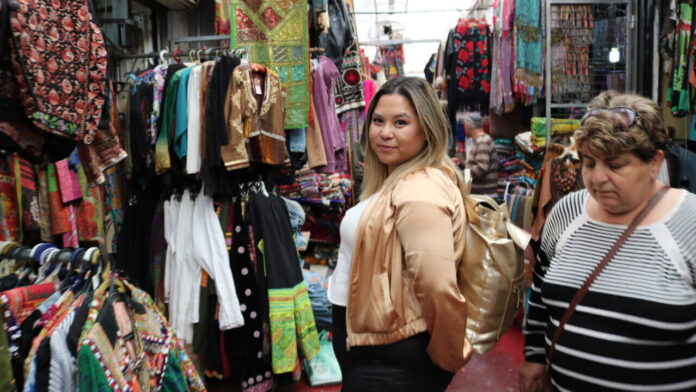

Amy Albertson’s nearly 50,000 Instagram followers know her for her sassy, playful, educational and joyful content about her Asian American Jewish identity and love for Jewish diversity and Israeli culture — and her affinity for Hello Kitty. Over the last two years, amid surging antisemitism across the U.S., Albertson has used her influencer status and public social media platform (@theamyalbertson) to combat antisemitism and anti-Zionism head-on.
In March 2024, Albertson, who grew up in Sacramento and now lives in the Bay Area, found herself facing her largest in-person audience to date. Thousands of people — Jews, Israelis and allies — gathered at San Francisco’s Embarcadero Plaza and headed up Market Street for a unity march against antisemitism in the early months of the Israel-Hamas war. “Sheryl Sandberg was on the same stage as me,” Albertson said, adding it was a rare moment of public speaking that made her nervous. “I really love being in front of a crowd,” she said. She has spoken on numerous podcasts and was a panelist at the 2024 Z3 Conference.
Albertson has achieved quite a lot at just 34 years old. She received the Women’s International Zionist Organization Warrior for Israel Award and was named one of Hadassah magazine’s “18 American Zionist Women You Should Know,” both in 2023.
Last summer Albertson added a new role to her resume, as lead communications strategist for the Z3 Project, the Oshman Family JCC’s initiative to explore the future of Zionism and Jewish peoplehood in the U.S. and Israel. She continues her work as an educator who is “proudly and loudly uplifting Jewish diversity,” according to her website.
She sat down with J. ahead of her favorite holiday, Yom HaAtzmaut, Israel’s Independence Day, which falls this year on April 21.
This interview has been edited for length and clarity.
You love sharing about your Asian American Jewish identity. What was Judaism like for you growing up?
My mom is not Jewish. She’s Chinese American. My dad is your average Ashkenazi American guy. I grew up very secular. We celebrated Hanukkah and Passover every year, but we didn’t use a haggadah. My grandma, my dad’s mom, lives in Berkeley, and she’s very Berkeley. We still did Jewish holidays, but very much on her own terms.
It wasn’t until high school when I started to be more curious. Ironically, I went to a Catholic high school and we were required to take religious studies. When I went to college, it was the natural place for me to dive in.
How so?
I quickly made friends at the Hillel [at Portland State University]. I started being involved, and the next thing I know, I’m vice president, and then the next year, president.
I also went to different synagogues in Portland and met with different rabbis. I don’t know what I was looking for, but one of them, Rabbi [Arthur] Zuckerman, was just really inviting, really welcoming. He’s like, OK, so you want to learn here. Services are at this time. Here’s some books. He gave me books off his shelf. I still have them. I just started learning and taking everything in.
What inspired you to seek out a synagogue in the first place as an undergraduate student?
I wanted to learn more and do more and find out more. It’s really interesting, because the Reform rabbi I met asked, “So you want to convert?” And I said “No. I don’t know.” She goes, “OK, what do you want?” I said, “I was hoping you could answer that question.” Rabbi Zuckerman was part of a Conservative congregation, though he is technically an Orthodox rabbi. He was the most welcoming one.
How did Israel come into the picture?
Around my second year in Portland, we got an Israeli shaliach (emissary), Amos, who I’m still friends with to this day. He was the first Israeli I’d ever really met. And he brought Israel programming to our campus. We showed this documentary about Israel, really apolitical, nothing controversial. And it was protested. People came in with their hands tied and their mouths taped, and they sat down for 10 minutes while someone filmed them, and they left us this letter.
I was obviously shocked. I’m like, what’s wrong with these people? What’s wrong with this movie? Everyone’s like, oh yeah, the Israeli-Palestinian conflict. I had no idea. I had never thought that Israel could be contested. It’s a Jewish country. There’s one Jewish country. From that moment, I needed to understand what’s going on. And I kind of became obsessed, you could say, both with learning about the Israeli-Palestinian conflict, but also just learning about Israel and learning about Israeli people and meeting more Israelis. I started learning Hebrew.
After the protest of our movie screening, I said to our Hillel director and other board members that we needed to address this. And my Hillel director’s response was, we’re the Jewish group. We’re not the Israel group. We’re not doing anything about that. So a couple of other students and I decided to start a new group that was the Israel group.
Is that what ultimately led you to identify as a Zionist?
It never even occurred to me that anyone, let alone a Jew, wouldn’t be a Zionist. The Jewish people have faced and still face antisemitism today, and need Israel. And the more I’ve learned, seen and experienced only has strengthened my Zionism and my belief that Jewish culture, religion and history is inextricably linked to Israel, that Jewish sovereignty is a key component of Jewish peoplehood, and to deny these facts is disingenuous.
You made aliyah shortly after college, in 2015, after one Birthright trip to Israel. What was the process like?
The Law of Return allows people like me to make aliyah, but when you do, Israel’s government asks what your religion is. And if you’re not halachically Jewish [by matrilineal descent], they cannot list you as Jewish. So I’m in the Tel Aviv airport, I go to the little mini office for immigrants, and they process you there. The girl is asking me questions. “What do you do? Nationality? Mom’s name? Dad’s name? Religion?” She says, “Because your mom’s not Jewish, I can’t put that. Do you want to put something else?” I was like, “What else would I put?” So it said “nothing.”
It’s also so weird being Asian in Israel. There are two halves of it. There are people who get excited because I’m unique or exotic and they want to know what brought me here. Israelis love when people make aliyah. They get really excited. Also, they love Americans. They also especially love people from California. People were generally nice to me most of the time.
But then there’s the other side of it. In Israel, the large majority of Asian people in Israel tend to be Filipino workers. I’m not Filipino, but I could pass as Filipino. People in Israel came up to me and started speaking in Tagalog to me, and I’m like, sorry, no, I don’t speak Tagalog. Sometimes people assumed I was a caretaker or a service worker, which was unpleasant. It sucks that they would treat me differently because they thought that.
You lived in Israel for six years, until Covid, and started the Instagram account “The Asian Israeli.” How did that come about?
On Yom Kippur in 2018 my photographer friend and I went out and did a photo shoot all over Tel Aviv because the streets were closed for Yom Kippur. I started posting every day about all kinds of different things. Here’s where I go eat, here’s the beach on Shabbat. And I did a lot of election coverage in English. We had four elections in two years. So I would translate, with help, a lot of election materials into English. That was kind of a big thing that I became known for at that time.
Yom HaAtzmaut is coming up. How do you celebrate?
I’ll be barbecuing like any good Israeli!