
 Download


Alex Dering | Photo Editor
WashU’s Asian American Association (AAA), otherwise known as “Triple A,” recently collaborated with 25 cultural clubs and nine sponsors to host its biggest event of the year: “Night Market.” The 2026 theme, Neon Lights, brought a vibrant, energetic atmosphere to over 1,200 students from the Gregg storefronts to the Clocktower on the South 40 as a welcoming space for WashU students to come together in celebration of the distinct Asian communities on campus. Every aspect of AAA’s latest take on their annual tradition was carefully designed to highlight the sheer diversity of Asian cultures present in the world.
“One of our biggest goals is to connect with the Asian community and also teach to others,” Co-Presidents Shreya Srivastava and Rishi Sattaluri said.
This goal is especially evident in the wide variety of food options they served, which represented various regions and countries across Asia. Dishes ranged from desserts and snacks like pistachio baklava to ube cake, mochi, and takoyaki, alongside entrees like biryani, samosas, and bulgogi. Having this wide complimentary spread gave way for WashU students and St. Louis community members alike to culinarily explore a true spectrum of Asian identities all in one night.
For this free dining experience to exist, there was an “activity stamp card” system put in place where, in order to receive their food, attendees had to complete at least six separate activities out of those offered by the 25 student groups at Night Market. This give-and-take strategy that requires active involvement with several booths throughout the night is where the educational aspects of Asian cultures shine brightest.
“I think it’s really important that they had the little stamp system to get food because otherwise, people would have gotten food and just left. I think that it really forces people to engage with the [booths],” sophomore Courtney Lucas II said during his time at Night Market. “Of course, people are going to do that on varying levels, but I think overall having to do six booths that interest you is really important. So that system especially makes it culturally engaging.”
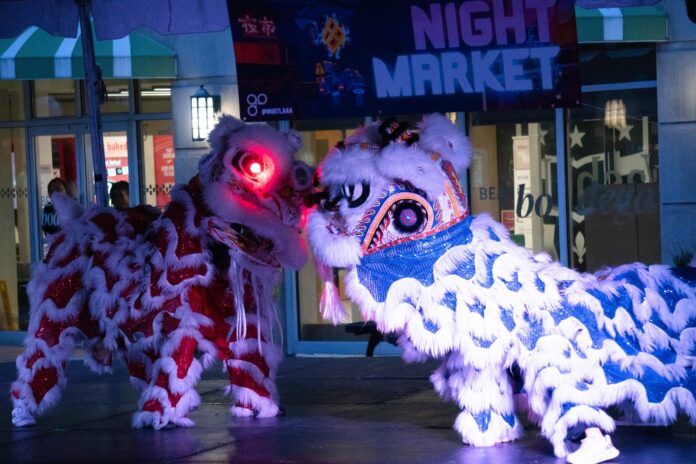
Such booths featured some of the oldest cultural histories on campus. Namely, the Lion Dance performance group is the longest-running act in WashU’s Lunar New Year Festival (LNYF), which itself has been a yearly cultural event since 1996. Their dance performance later into Night Market introduced both Asian and non-Asian attendees to the ancient Chinese and Southeast Asian tradition that still roars on today. The activity at their booth involved teaching basic acrobatic moves called “stacks,” where the performer acting as the lion’s head is lifted by the performer acting as the tail.
“I think Triple A does a very good job at introducing all the cultures together in a safe space,” said junior and Lion Dance member Lance Yeh.
“It’s not as intimidating as it may seem,” fellow member Justin Lan said of non-dancers learning a stack. “It doesn’t matter whether you lack knowledge or you don’t know how to do certain things. It’s all an open, safe space, like Lance said, to be creative, try something new, and just do whatever you want.”
In addition, the Chinese Students Association (CSA) created an engaging game where students used chopsticks to move items from one plate to another while wearing vision-shifting glasses at their Night Market booth. This activity was a small but effective learning opportunity for attendees who weren’t familiar with East Asian household manners.
Additionally, some students who had previously lived in East Asian countries resonated with the event’s paper-lantern and warm string light decoration, elements that resembled traditional night markets from their upbringing.
“Part of my favorite childhood memories in Asia have been traveling around and exploring these night markets. … Seeing how many people are congregated here and smiling is just really nostalgic to me,” said junior and Vice President of Programming for CSA Daniel Li. “I’m really grateful to have something like this on campus where I go to school.”
A standout educational booth was hosted by Asians Demanding Justice (ADJ), WashU’s social and political club for Asian American and Pacific Islander (AAPI) students. Their pinboard on the different kinds of cultural insensitivity that, while unintentional, often go unnoticed in day-to-day conversations brought this nuanced topic to light for white and non-white students alike.
One example attendees found surprising was the practice of asking someone (almost always non-white) who speaks multiple languages to say a word from their native tongue. If not done politely or out of respect, this seemingly harmless request can act as an underlying microaggression, even without our conscious knowledge.
“That’s actually happened to me, and l’ve never thought about it in that type of way,” sophomore attendee Vinisha Tripathi said. “I was able to have amazing conversations about it and it’s gotten me more interested in how I interact with people about my identity as an Asian American.”
Outside of East Asia, the night also saw lesser-known and culturally recognized parts of the continent receive awareness as well. At the booth run by Ashoka, WashU’s South Asian Student Association, members gave attendees henna tattoos, known as Mehndi, to promote their own “Mehndi Night” event happening on April 16. Their presence at AAA’s Night Market speaks to the many faces of Asian culture and fosters cultural solidarity through this inclusive representation.
“People often forget that South Asia is part of Asia, and that’s something that we’re trying to push more as Ashoka,” President and junior Varun Vadhera said.
Beyond the student-run booths celebrating the rich traditions across Asia, AAA also hosted two sets of performances over the duration of Night Market to showcase the heritage behind various Asian dances.
The first performance opened with a powerful collaboration between Washu’s Samulnori club and the Lion Dance team. Samulnori delivered high-energy, rhythmic percussion rooted in Korean traditions, while the Lion Dance featured expressive choreography central to Chinese culture. The two groups later joined together for a combined performance, fusing Korean and Chinese traditions together through synchronized movements and rhythm.
This was followed by a traditional Tinikling dance led by WashU’s Tinikling team, where performers demonstrated precision and agility as they moved between rapidly clapping bamboo poles. The energy continued with two performances from the K-pop dance team PL4Y and concluded with Garba by Ashoka.
The second performance segment showcased an elegant violin performance by first-year Simon Park, an executive member of AAA. Following his act, the WashU Chinese Yoyo Club (YoWU) showcased highly controlled, coordinated maneuvers and tricks with their yoyos.
To conclude the show, AAA’s executive members performed their own dance, closing the night with a celebratory final act that showcased their dedication and appreciation for the unity of Asian cultures.
Ultimately, the 2026 Night Market was a tour de force that encouraged the breaking down of cultural barriers between Asian regions and created a welcoming space where students, staff, and St. Louisans could engage meaningfully with a wide range of Asian cultures. Through food, club booths, and performances, AAA highlighted the diversity of Asian identities while maintaining a shared sense of community and celebration.