
 Download


Listen to politicians speak or read news coverage about The City’s Asian American electorate and you’ll inevitably encounter two words: public safety.
The issue has become attached to the community with the onset of the COVID-19 pandemic and the subsequent rise in hate crimes against Asian Americans nationwide.
It’s also at the heart of an apparent wedge that, to some, has deepened a divide throughout The City’s Asian American political landscape.
The Examiner spoke to roughly a dozen Asian American leaders and community advocates across The City’s political spectrum who acknowledged an escalating fracture inside the community — one that mirrors the ideological tug-of-war in San Francisco politics as The City heads into the November election.
The City’s elected officials and the electorate generally agree on certain issues that are considered partisan nationally, such as same-sex marriage or reproductive rights. But San Franciscans still differ on many hot-button topics, resulting in The City’s own — albeit imprecise — ideological scale, which tends to encompass a range from moderate to progressive Democrats.
Moderate-leaning politicians argue that fortifying Asian American public safety boils down to stricter tough-on-crime policies. At the same time, progressives retort that those measures will do little to address the root causes of the violence.
And given the heightened attention on Asian voters, who make up a third of The City’s population, the issue has taken center stage in several races and has put the community under a political microscope.
The progressive perspectiveMost Asian American progressive leaders we spoke with agreed that public safety should be a top priority and expressed serious concern about violence towards their community.
But they ardently pushed back against an increasingly loud moderate coalition that has repeatedly claimed that Asian American San Franciscans’ fears over safety are driving them towards more moderate attitudes and policies, specifically pro-police and law-and-order measures.
They alleged that moderates in power are abusing the electorates’ fears for their own political gain.
“Public safety is everyone’s issue. Everybody cares about it,” said San Francisco Supervisor Connie Chan, the only Asian American on the Board of Supervisors. “What I think though, is there’s an active force that is using this to divide people. It’s a right-wing tactic to fearmonger and push people into making certain decisions based on those fears.”
Chan, considered a progressive, was far from alone in accusing San Francisco moderates of using the anti-AAPI hate movement disingenuously.
“[Moderates are] weaponizing fear to create a straw man to attack Connie [Chan] or [Supervisor] Aaron Peskin,” said former Supervisor Eric Mar, a board member of the Chinese Progressive Association. “It’s a tactic straight out of the [former President Donald] Trump playbook, where you don’t really address the issue, and you turn progressives into a convenient whipping boy or scapegoat.”
“I think that the issue of safety has been brought front and center, and people are really concerned about it. I also think that there have been forces that have used this as an opportunity to push a certain agenda,” said Claire Lau, an organizer with the Chinese Progressive Association.
Politicians and experts said ideological differences throughout the Asian American political community have always existed. But Mar said he thinks the divide between the moderate and progressive camps is as big as it’s ever been, highlighted by the swath of moderates, including several Asian Americans, who won seats on the highly influential Democratic County Central Committee in March.
He blamed the chasm on the rise of groups such as TogetherSF and GrowSF, backed by tech-industry leaders and venture capitalists.
“I do think that money has driven the voice of conservative Asian Americans,” Mar said. “And the demographic change of the lessening of working class and progressive organizing, plus the Trumpism within the Asian American communities, has made the divide even more intense. And then there’s an imbalance, where conservatives get more of a voice … it makes me concerned about the future of San Francisco politics.”
Rise of the Moderate activist
Jade Tu’s story symbolizes the growing number of young Asian American moderates who have recently arrived on The City’s political map — and those who progressives accuse of being taken advantage of by moderate political actors. It’s unclear how many of them there are, but their voices have unquestionably swelled recently in the San Francisco political sphere.
Tu, who graduated from Menlo College in 2019, began her professional life in the health-care industry. Before the pandemic, she said, she was politically agnostic, simply identifying as a Democrat and not knowing the difference between a progressive and a moderate.
“I genuinely was not into local politics,” she said.
Then she watched the video of Vicha Ratanapakdee, an 84-year-old Thai American, being violently pushed to the ground and killed in San Francisco in January 2021. Tu, a Chinese American, said she worried for her community and her family’s well-being.
“That traumatized me,” Tu said. “That really woke something up inside of me. I thought, ‘Oh God, I have to do something.’”
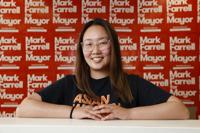
Jade Tu, Mark Farrell for Mayor campaign manager, at the campaign headquarters at 299 West Portal Avenue in San Francisco on Friday, May 24, 2024.
Craig Lee/The Examiner
In about three years, she founded an Asian American nonprofit called “Dear Community,” helped run Brooke Jenkins’ bid for District Attorney, and is now managing Mark Farrell’s mayoral campaign.
Her arc is representative of many young Asian American activists who were politically activated after the uptick of hate crimes and viral videos showing Asian elders being violently assaulted.


In his State of the Arts column, Max Blue examines the artists calling for a cease-fire in Gaza and putting pressure on their exhibitors to join them
A new report says Open Door Legal has paid dividends in Bayview-Hunters Point — and now it wants city support to expand

Here are their choices, with recommendations for San Franciscans of all stripes
Now, they’re on the frontlines of several campaigns, pushing that The City’s Asian community is unified in its demands for more police presence and measures that bulk up police power.
Tu was adamant she isn’t being “weaponized” and disingenuously used to drum up votes.
“More Asian hate is still happening, so whether it’s fear-mongering or not, that’s how people feel right now,” she said. “I’m 1,000,000% confident. I can’t emphasize that enough. We’re still victims to this day.”
William Brega, a Chinese American, said he also barely paid attention to politics before 2021. But fears over his grandparents’ safety drove him to found Dear Community with Tu and join TogetherSF.
“To me it feels like they’re uplifting me as a young leader,” Brega explained. “I mean, I know my values. I know what I want to see in The City I live in. I know what change I want to see.”
Lily Ho, a community activist who won a seat on the DCCC in March’s election, said she “feels the friction” from the progressive side but insists that the electorate is unified in its alignment with moderate policies.
“When I was campaigning, I got to interact with everybody, from shop owners and people of every income level — and the messaging resonated: public safety was their No. 1 priority,” Ho said. “It’s unscientific, but it’s something we see when we just walk around.”
But David Ho, a progressive political consultant who’s worked in the community for decades and closely with Rose Pak, defiantly downplayed the role Asian Americans played in recalling Boudin.
David Ho — who is not related to Lily Ho — said that the recall of Boudin was a “correction” back to the norm of San Francisco politics rather than an ideological shift or sign of unrest within the community.
“Chesa Boudin has no business winning in 2019,” David Ho said. “He only won because Suzy Loftus and Nancy Tung couldn’t get their stuff together. That’s a correction. Voters always want a moderate mayor and moderate DA.”
Mar’s election was the outlier because the other Asian American candidates who had come before him, Leland Yee, Fiona Ma, Ed Jew, Carmen Chu, and Katy Tang, were all moderates.
“[Mar] was never supposed to get elected before he won,” Ho said. “No one has thought about this angle because they don’t want to dig deep into the substance of why certain groups are winning and losing. They just want to kind of adhere to the Chinese community as a monolith, but they also don’t talk about just a reason why.”
Where the electorate stands
It remains an open question whether San Francisco’s Asian American electorate — which has generally voted more moderately on the west side and more progressively in neighborhoods such as Chinatown and the Bayview — is also being pushed closer to the political center.
Nationally and statewide, there has been no meaningful trend towards more Republican Asian American voters, according to Karthick Ramakrishnan, executive director of the research center AAPI Data.
The center conducted a survey that found public safety is among the least prioritized issues in the community, behind inflation, immigration and the environment — though those results could be different if the polling were locally based since policing is often considered a local issue.
However, what is clear is that moderate Asian American voters have mobilized to the polls in recent years, especially compared with more left-leaning voters.
An Examiner analysis showed that higher percentages of residents in many majority Asian American precincts voted in favor of Proposition E and Proposition B — a confusingly worded police-staffing measure that divided city politicians — during the March primary than San Franciscans as a whole (27.6% and 54.1%, respectively).
Still, voter turnout in those precincts has dipped overall since 2020, though it spiked in 2022, the same year as the Boudin and San Francisco school board recalls.
“I do think that there is a broad base of politics in the Chinese American community on issues from tenants’ rights to public safety,” said former San Francisco Supervisor Jane Kim, a progressive. “That being said, in the last two election cycles, there has been greater energy and activity amongst Chinese Americans who are concerned about public safety, and they’re therefore electing candidates that they believe will make our community safer.”
“Does that mean that they’re growing in numbers? I’m not sure,” she said. “But there’s certainly a lot of energy. For me, it’s never about which group is growing or declining — it’s which group was activated to come out and vote.”