
 Download

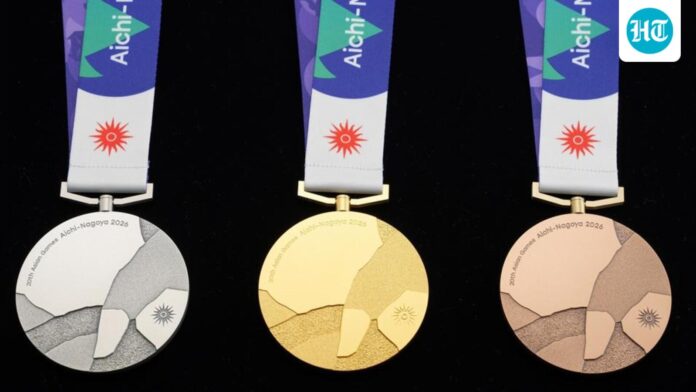

This is what every athlete who has travelled to Aichi-Nagoya for the 2026 Asian Games will be fighting for. This is what the athletes have trained for over four years. This is what they will be awarded when they stand on the podium: medals.
But do you know how these medals were made? Or how much they weigh? Or how much gold is there in the gold medal? Let’s find out.
In a quiet design studio, ceramic discs were repeatedly shattered, their fractured pieces carefully examined as they settled into naturally captivating forms.
Japanese designer Daisuke Shiba was searching for something deeper than mere metallic brilliance for the 20th Asian Games. He envisioned the invisible journey of an athlete — the gruelling training sessions, the quiet sacrifices and the trials endured far from the stadium lights.
Just as those broken ceramic pieces reassembled into a compelling new shape, the scattered fragments of an athlete’s perseverance converge into a single crystallisation of achievement.
This vision of the medals breathes life into the Games’ slogan — Imagine One Asia. The design reflects a continent that once shared a common origin before expanding into a rich tapestry of distinct languages and cultures. Through sport, these diverse streams flow back together.
“I sincerely hope that these medals, as symbols of the dedication and perseverance that athletes have accumulated through years of effort, will further enhance their sense of joy and pride,” Shiba, designer of the medals, told the Asian Games website.
Now let’s get to know the medals themselves.
The medal itself, measuring 80mm across and 5mm thick, embodies this reunion. The physical pieces carry a profound connection to the community.
The top prize, the gold medal, weighs 265gm and is cast in pure silver plated with at least 1gm of gold. The silver medal weighs a gram less and is pure silver. The bronze weighs 222gm and is made of warm red brass, comprising 95% copper and 5% zinc.
A portion of every metal was recovered from small electronic devices donated by local residents across Aichi’s municipalities, transforming everyday technology into symbols of athletic glory through a commitment to a circular economy.
This was done as part of the Aichi-Nagoya 2026 Recycled Medal Project which aimed to promote awareness of the Sustainable Development Goals (SDGs).
Regarding the design, a competition was opened to design students with professional experience in the field. The winning design was selected by a review committee from among the submitted entries.
When placed around a winner’s neck, the medal rests upon a ribbon styled with the silhouette of the kakitsubata, or Japanese iris, the official flower of the Aichi Prefecture. Sweeping, fluid arcs inspired by the plant’s leaves mirror the power and athletic grace displayed on the field, bridging local botanical heritage with international victory.
To preserve these memories for a lifetime, each medal rests inside an octagonal box crafted from fragrant, Aichi-grown hinoki (Japanese cypress). Grounded in the region’s historical tea ceremony traditions, where precious artefacts are treasured in fine wooden containers, the case pays homage to local craftsmanship.
Its eight-sided geometry evokes the Japanese character for 8, a motif historically embedded in the emblem of the Owari Tokugawa clan and featured in the official symbol of Nagoya city. As the strokes of the character widen toward the bottom, the vessel symbolises outward expansion toward the future — a lasting safeguard for a monument of human effort.